How Much Sleep Do Adults Really Need?
Sleep is not a luxury or a personality quirk. For most adults, the evidence points to a clear nightly range, and falling short of it quietly raises the risk of illness, accidents and early death.
 By
By 
Most healthy adults need about 7 to 9 hours of sleep per night. The National Sleep Foundation recommends that range for young adults and adults under 65, and the American Academy of Sleep Medicine advises adults to get seven or more hours on a regular basis to protect health, alertness and daytime performance.
Those numbers are not a wellness fad. They come from large reviews of how sleep duration tracks with heart disease, diabetes, mood, cognition and death rates. Sleep less than that for weeks or months and the body keeps score, even if you feel you have "adapted."
Why 7 to 9 hours, not 5 or 10?
Sleep need varies a little from person to person. Genetics, age, illness and recent sleep debt all matter. That is why guidelines give a range, not a single magic number.
The National Sleep Foundation's landmark recommendations, first published in 2015 and reaffirmed after a decade of further evidence in 2026, put healthy sleep for adults aged 26 to 64 at 7 to 9 hours, with 6 or 10 hours possibly appropriate for some individuals. Young adults (18 to 25) share the same 7 to 9 hour target. Older adults (65 and up) are guided toward 7 to 8 hours. The American Academy of Sleep Medicine and Sleep Research Society, in a joint consensus statement, concluded that adults should sleep seven or more hours regularly, and that six hours or fewer is inadequate for sustained health and safety. They deliberately did not set a hard upper limit, because longer sleep can be appropriate during recovery, illness or youth.
Neither India nor the World Health Organization publishes a single official adult sleep-duration number the way they do for physical activity. Public-health practice therefore leans on the NSF and AASM ranges, which also sit close to guidance used by the UK National Health Service and other national bodies. The practical message is consistent: for most working-age adults, parking nightly sleep in the mid to upper 7s is a safer default than treating 5 or 6 hours as normal.
What short sleep actually costs
Chronic short sleep is linked to a long list of problems that matter for individuals and for cities:
- Heart and metabolism: higher risks of hypertension, coronary disease, stroke, obesity and type 2 diabetes.
- Brain and mood: worse attention, memory and learning; elevated risk of depression and anxiety; slower reaction times that matter on roads and factory floors.
- Immune function: more frequent infections and poorer vaccine responses in some studies.
- Accidents: drowsy driving rivals alcohol as a cause of crashes; shift workers face higher rates of workplace injury.
Sleeping far longer than usual, night after night, can also mark underlying illness. The takeaway is not that everyone must hit exactly eight hours, but that a stable pattern inside the recommended band, with you waking feeling restored, is what to aim for.
How the body clocks sleep
Sleep is not a simple "off" switch. It is organised by two overlapping systems. A homeostatic pressure builds the longer you stay awake, making sleep feel necessary. A circadian clock, centred in the brain's suprachiasmatic nucleus, times alertness and sleepiness to the 24-hour light–dark cycle. Evening darkness and a rise in melatonin help open the sleep gate; morning light closes it and resets the clock.
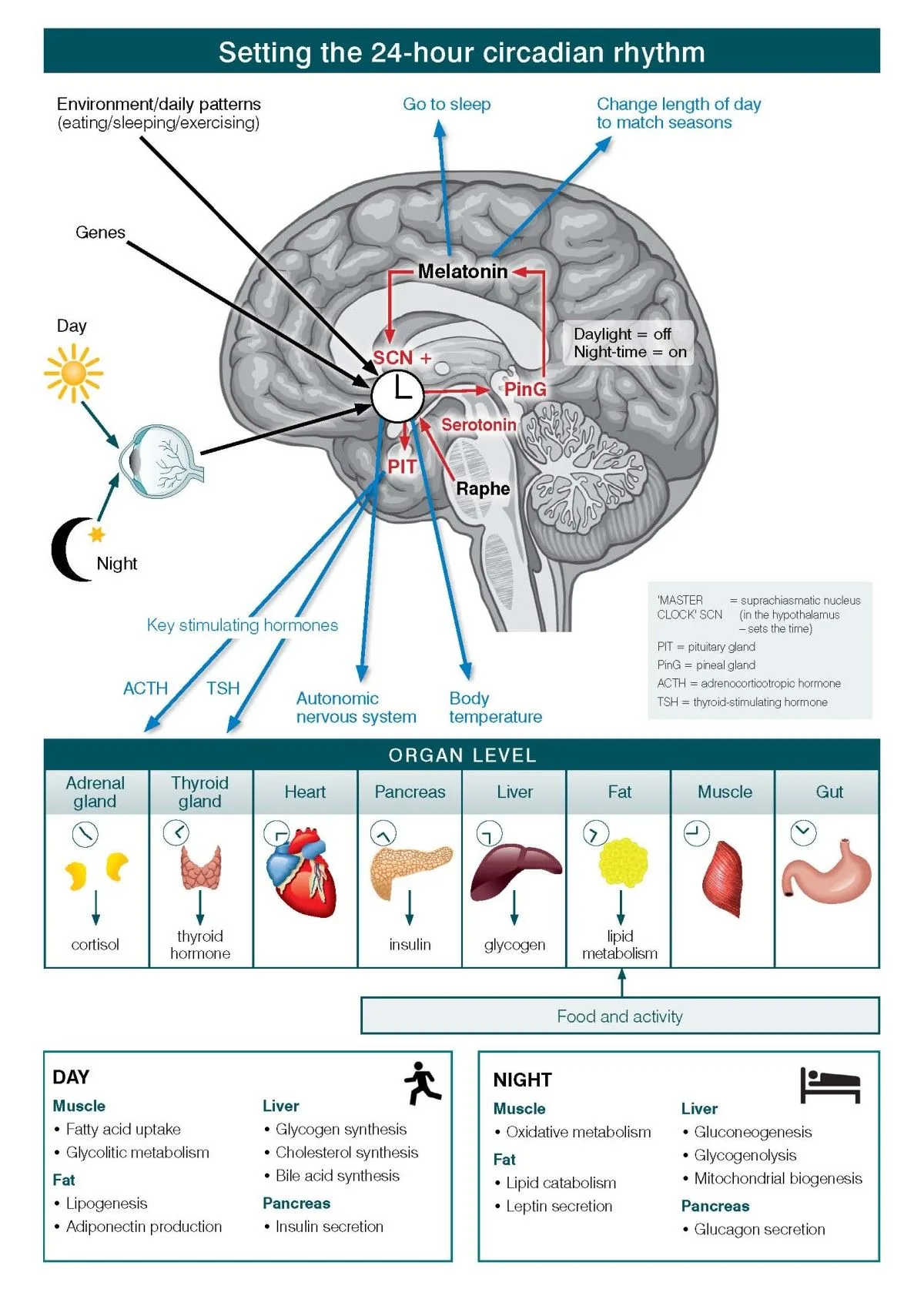
When those systems align, falling asleep and waking feel natural. When they clash, as in jet lag, night shifts or late-night screens, you can be exhausted and still unable to sleep. Blue-rich light from phones and laptops late in the evening delays melatonin and pushes bedtime later, which is why "just one more scroll" so often becomes a lost hour.
Quality matters as much as quantity
Hours in bed are not the same as hours of restorative sleep. Fragmented sleep from sleep apnoea, pain, noise, alcohol or an irregular schedule leaves people tired even after a long night. Good sleep usually includes:
- Continuity: falling asleep within a reasonable time and staying asleep most of the night.
- Timing: a schedule that matches your circadian preference and social life as closely as possible.
- Depth: enough slow-wave and REM sleep across the night for body repair and memory processing.
Snoring with gasping, persistent insomnia, or daytime sleepiness that feels unsafe deserve medical attention. Duration guidelines assume broadly healthy sleep architecture; they do not replace diagnosis of a sleep disorder.
Movement, meals and the night before
Daytime habits set up the night. People who move more during the day generally fall asleep more easily and sleep more deeply, which is one reason a daily walk pays off beyond heart health. Endurance sport makes the same point from the other direction: marathon training only works if recovery includes enough sleep for muscles and the nervous system to adapt.
Caffeine late in the day, heavy late dinners and alcohol near bedtime all chip away at sleep quality. Alcohol may help you nod off, then fragments the second half of the night. Spicy or very large evening meals, including the rich plates that chillies helped reshape in Indian cooking, can delay sleep for people prone to heartburn. A lighter, earlier dinner and a caffeine cut-off in the afternoon are among the highest-yield hygiene changes for many adults. Spreading daily fluid intake through the day, rather than drinking a large volume right before bed, also helps protect uninterrupted sleep.
Urban India and the sleep debt
India does not publish a national sleep-duration guideline, yet time-use and survey data sketch a clear urban problem. India's 2019 Time Use Survey and analyses built on it show that large shares of adults, especially urban women juggling paid work and unpaid care, fall short of an eight-hour night. Delhi and several other states sit near the bottom of state-level charts for adequate sleep among working-age women. Private surveys of Indian adults repeatedly find late bedtimes (often past 11 pm), heavy phone use in bed, and mornings that start already tired.
The drivers are familiar to anyone living in a big Indian city: long commutes, shift and IT schedules that ignore daylight, dense housing where noise never fully stops, and screens that turn the last hour before sleep into another work or entertainment shift. Ayurvedic dinacharya traditionally favoured earlier nights and earlier mornings, aligned with natural light. That rhythm is hard to keep when the office Slack channel is still active at midnight, but the physiology has not changed. Light still sets the clock; cortisol still rises before dawn; the brain still needs consecutive hours of relatively uninterrupted sleep.
Shift work deserves special mention. Rotating nights and early-morning starts force sleep into the biological day, when the circadian system is trying to keep you awake. Naps help, but they rarely fully repay the debt. Employers and cities that treat sleep as infrastructure (quiet housing, sensible shift design, limits on late-night light pollution) are protecting productivity and safety, not indulging staff.

Practical targets, not perfection
You do not need a perfect sleep lab routine. A workable adult target looks like this:
- Aim for 7 to 9 hours in bed on a schedule you can keep most nights, including weekends (large swings create "social jet lag").
- Protect the hour before bed: dimmer lights, fewer feeds and emails, cooler room.
- Get morning daylight when you can; the blue-rich light of a clear sky anchors the circadian clock more powerfully than any app.
- Move during the day; treat walking and other activity as sleep preparation, not only fitness.
- Watch for red flags: loud snoring with pauses, irresistible daytime sleepiness, or insomnia lasting weeks. Those need a clinician, not another tip list.
Track how you feel for two weeks at a consistent bedtime rather than chasing a single wearable score. If you wake without an alarm most days and stay sharp through the afternoon, you are probably near your personal sweet spot inside the evidence-based range.
The bottom line
Adults are not supposed to run on five hours and willpower. The National Sleep Foundation's 7 to 9 hour band for most adults, and the AASM's floor of seven or more hours, summarise decades of outcome data in one clear message: sleep is a biological requirement with a measurable dose. Cities, workplaces and households that treat that dose as negotiable pay for it in accidents, chronic disease and lost focus. Protecting a solid night's sleep is one of the highest-return health decisions available, and it costs less than almost any supplement on the shelf.