How Much Water Should You Drink a Day?
You do not need eight glasses of plain water every day. Expert bodies set adequate intakes for total water from drinks and food, and Indian heat can push needs far higher than any office slogan.
 By Kirti Kaliraman· 8 min read
Most healthy adults need roughly 2 to 3.7 litres of total water a day from drinks and food combined, not eight rigid glasses of plain water. Europe's food-safety authority sets adequate intakes near 2.0 L for women and 2.5 L for men in moderate conditions; the U.S. National Academies set higher medians of 2.7 L and 3.7 L. India's ICMR-NIN dietary guidelines suggest about 2 litres (eight glasses) of water and beverages for a normal healthy adult, rising in hot weather and hard work.
Those figures are adequate intakes, not hard prescriptions. Thirst, urine colour, climate and activity usually guide day-to-day drinking better than a fixed glass count. People with kidney, heart or endocrine disease, or who take medicines that affect fluid balance, should follow medical advice rather than any internet rule.
Where the "eight glasses" story came from
The popular "8 × 8" rule (eight 8-ounce glasses of plain water daily) is one of the most successful health slogans of the late twentieth century. It is also poorly supported as a universal requirement for sedentary adults in temperate climates.
In 1945, the U.S. Food and Nutrition Board of the National Research Council noted that a convenient water allowance was about 1 millilitre per calorie of food, which for a 2,000-calorie day works out near 2 litres. The same guidance made clear that much of that water comes from food. Later readers often dropped the food caveat and turned the number into eight glasses of plain water alone. In 2002, physiologist Heinz Valtin reviewed the literature in the American Journal of Physiology and found no rigorous evidence that every healthy sedentary adult must drink eight glasses of plain water beyond thirst and ordinary meals. Coffee, tea and other beverages generally count toward the daily total for most people.
That does not mean hydration is unimportant. It means the slogan oversold a single number and undersold context.
What expert bodies actually recommend
Modern reference values talk about total water: drinking water, other beverages, and the water already in food (soups, fruit, yoghurt, rice, vegetables). Roughly one-fifth or more of total water in typical diets comes from food, so "glasses of water" alone understate real intake.
European Food Safety Authority (EFSA), 2010: for moderate temperature and moderate activity, adequate total water intakes are about 2.0 L/day for adult women and 2.5 L/day for adult men. Pregnant and breastfeeding women need more (EFSA suggests roughly an extra 300 ml in pregnancy and about 700 ml while breastfeeding, on top of non-pregnant/non-lactating baselines).
U.S. National Academies (Institute of Medicine, 2005): adequate intakes for young adults are 2.7 L/day for women and 3.7 L/day for men, based largely on median intakes in U.S. surveys that keep plasma osmolality normal. Of that, fluids (water and beverages) typically supply about 2.2 L and 3.0 L, with the rest from food. The Academies did not set a Tolerable Upper Intake Level for water, because healthy kidneys can usually excrete excess, but they warn that drinking much faster than the kidney can clear (roughly 0.7 to 1.0 L per hour) can cause acute water toxicity.
ICMR-NIN Dietary Guidelines for Indians (2024): a normal healthy person needs about eight glasses (2 litres) of water per day, with higher need in very hot weather and vigorous activity. The same guidelines stress safe, wholesome water (free of pathogens and harmful chemicals) and note that soft drinks are not substitutes for water or fresh fruit.
None of these bodies claims that everyone must hit the same glass count every day. Needs rise with heat, humidity, altitude, illness with fever or diarrhoea, pregnancy, lactation and prolonged exercise. Needs can fall in cooler, sedentary conditions when food is moist.
Thirst, urine and what "enough" feels like
For most healthy people, thirst and meals keep total body water remarkably stable over 24 hours. Plasma osmolality (the concentration of dissolved particles in blood) is tightly guarded; when it rises, the brain triggers thirst and the kidneys conserve water via antidiuretic hormone.
Practical, low-tech checks still help:
- Pale straw-coloured urine usually signals adequate hydration; persistently dark yellow urine can mean you need more fluid (diet, vitamins and some medicines also tint urine).
- Dry mouth, headache, dizziness, unusual fatigue or reduced urine after heat or exercise are common early signs of deficit.
- Sudden confusion, severe headache, nausea or seizures after heavy fluid intake are medical emergencies and can mark hyponatremia (low blood sodium), not "more water needed."
Older adults often have a blunted thirst response and may need reminders to drink, especially in heat. Infants and young children lose water quickly with diarrhoea or fever and need prompt oral rehydration under clinical guidance. This article cannot replace individual medical care.
Heat, sweat and the Indian summer
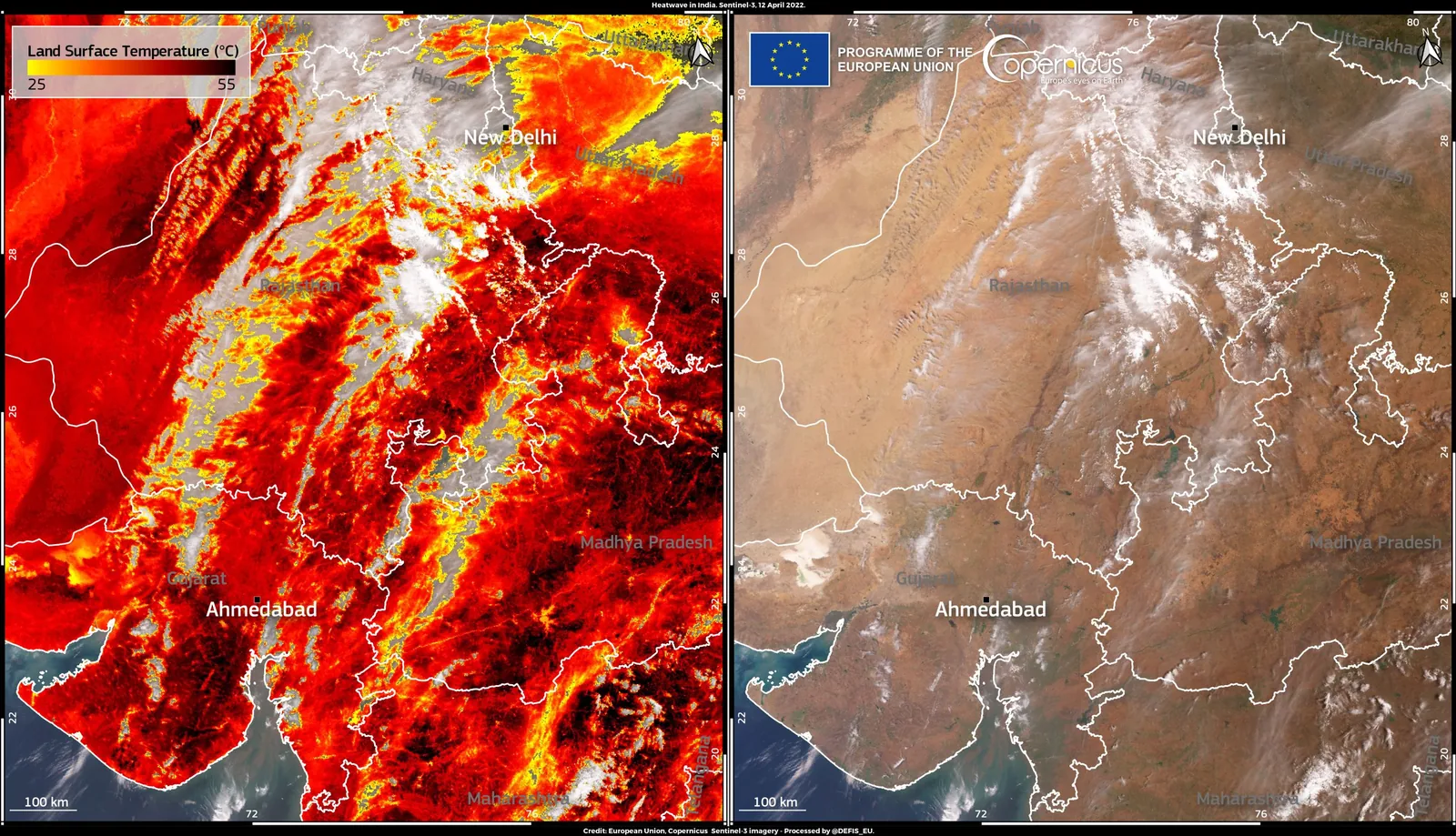
Water need is not a desk-job constant in India. From March through June, and again in humid monsoon spells, outdoor workers, delivery riders, construction crews, soldiers and athletes can lose litres of sweat in a single shift. Satellite composites from Europe's Copernicus programme have repeatedly mapped extreme land-surface temperatures across northwest India during heatwave peaks, a reminder that public-health advice here must treat climate as a first-order variable.
India's National Programme on Climate Change and Human Health advises drinking water regularly even when not thirsty during extreme heat, preferring water, oral rehydration solution, lemon water, buttermilk or coconut water over alcohol and very sugary drinks. Heat exhaustion and heatstroke (core temperature at or above about 40°C, with confusion or collapse) are emergencies: cool the person, move them to shade, and seek urgent care. Hydration alone cannot fix heatstroke, but dehydration makes heat illness more likely and harder to reverse.
Urban India adds a second problem: safe water access. ICMR-NIN stresses boiling or otherwise treating doubtful sources. Fluoride, arsenic, nitrates and industrial pollutants remain regional risks. "Drink more" only works if what is in the glass is safe.
Traditional cooling drinks (chaas, nimbu pani, jaljeera, tender coconut water) already supply water plus electrolytes and flavour, which can help people drink enough in heat. They still count toward total fluid. Sweet commercial soft drinks add sugar without replacing the need for plain water.
Exercise: drink, but do not overdrink
Physical work and sport raise sweat rates. A brisk daily walk in mild weather may need only a little extra fluid; a long run or outdoor labour shift in 40°C heat can need much more. Endurance events such as the marathon illustrate both sides of the problem: dehydration impairs performance and raises heat strain, while forcing fluids beyond thirst has caused exercise-associated hyponatremia in some distance athletes.
Sports-medicine guidance (including position statements from athletic trainers and wilderness medicine groups) generally converges on:
- Start activity reasonably hydrated.
- Drink according to thirst and conditions, not a campaign to gain weight with water during the event.
- For long, heavy-sweat sessions, include sodium (food, ORS or appropriately formulated drinks) rather than only plain water.
- After exercise, replace losses over hours with meals and drinks rather than gulping several litres at once.
Body-mass change across a session is a rough check for athletes: finishing lighter usually means net fluid loss; finishing heavier can mean overdrinking.
Food, tea and what counts as water
Total water is not only the bottle on your desk. Cucumbers, oranges, yoghurt, dals, stews and rice all contribute. So do coffee and tea. Valtin and later reviews note that for habitual consumers, moderate caffeine does not cancel the fluid in the cup the way older folklore claimed. India's chai habit therefore already supplies a meaningful share of daily fluid for millions of people, even though plain water remains the cleanest default for heat and for cutting sugar.
Alcohol is different: it can increase urine output and impair judgment about heat and thirst. Soft drinks and packaged juices add water but also sugar and, often, salt; ICMR-NIN advises against treating them as water substitutes.
Sleep and hydration interact quietly. Mild dehydration can worsen next-day fatigue and headache, while a large volume of fluid right before bed fragments sleep with night trips to the bathroom. Spreading intake through the day usually works better than a late binge.
When more water is medicine, and when it is risky
Higher fluid intake is sometimes used clinically to help prevent recurrent kidney stones and is advised in some urinary-tract settings; those are medical strategies, not proof that every office worker needs three litres of plain water. Conversely, people with advanced kidney disease, heart failure or certain hormonal disorders may need fluid restriction. Rapid overdrinking in contests or extreme "detox" rituals has caused fatal hyponatremia. Healthy kidneys are good at protecting you, but they are not infinitely fast.
If you have a chronic condition, take diuretics, or notice unexplained swelling, severe thirst or very high urine volumes, ask a clinician for personal targets. Public guidelines describe populations; they do not replace diagnosis.
A practical daily approach
For a healthy adult in ordinary conditions:
- Treat EFSA's ~2.0–2.5 L or ICMR-NIN's ~2 L of beverages as a useful baseline for total drinks, remembering that moist food adds more and that U.S. survey-based AIs sit higher.
- Increase intake in heatwaves, outdoor labour, fever, diarrhoea and long workouts; use ORS when sweat or stool losses are large.
- Prefer water, buttermilk, lemon water and coconut water in Indian summer heat; keep sugary soft drinks occasional.
- Use thirst and pale urine as day-to-day feedback rather than obsessing over a single glass count.
- Do not force water far beyond thirst during endurance events.
- Protect water quality as carefully as quantity.
Hydration is a daily habit shaped by climate, work and food, not a moral scoreboard of empty glasses. Match intake to losses, keep water safe, and let physiology (not a 1945 slogan) set the pace.