Why Is the Sky Blue?
Sunlight is white, yet the sky above us is blue. The answer is a trick of scattering by the air itself, and it explains red sunsets, the butterscotch skies of Mars and the voyage that set C.V. Raman on the road to a Nobel Prize.
 By Sushant Kataria· 9 min read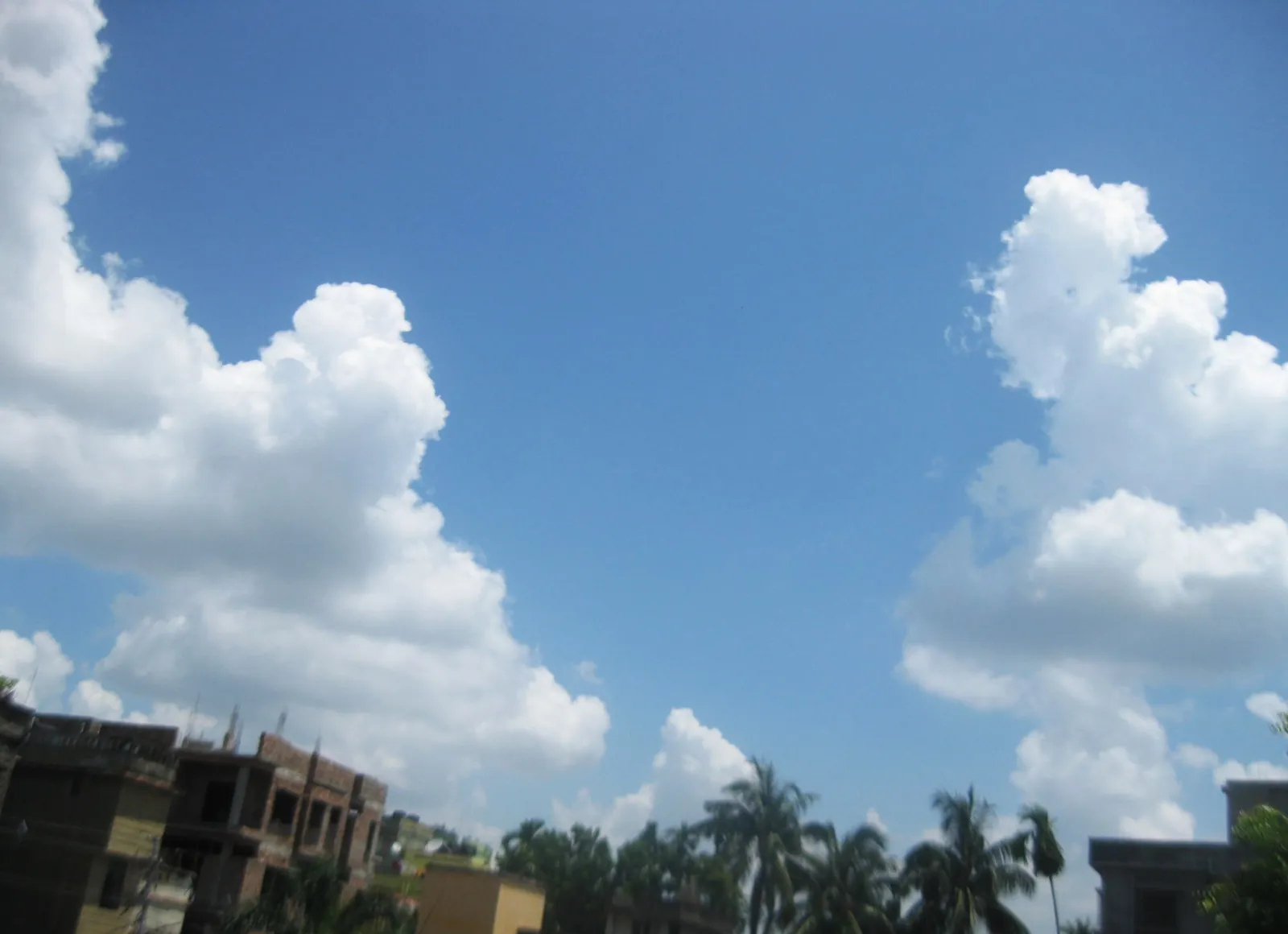
The sky is blue because the gas molecules in our air scatter short, blue wavelengths of sunlight far more strongly than long, red ones, so blue light is bounced across the whole sky and reaches your eyes from every direction. Physicists call this Rayleigh scattering, and it is strong enough that blue light is scattered almost six times as much as red.
That is the short answer. The longer one explains why the sky is not violet, why sunsets turn orange, why the sky on Mars is the colour of butterscotch, and how a question about the colour of the sea led an Indian physicist to a Nobel Prize.
Sunlight is every colour at once
Sunlight looks white, but it is a blend of all the colours of the rainbow, from violet at about 380 nanometres to deep red at about 700 nanometres. A prism or a raindrop separates them; normally they arrive together and our eyes read the mixture as white.
Earth's atmosphere is mostly nitrogen and oxygen molecules, each more than a thousand times smaller than a wavelength of visible light. When a light wave passes one of these tiny molecules, its electric field makes the molecule's electrons oscillate, and the oscillating molecule re-radiates some of that light in new directions. This is scattering, and for particles much smaller than the wavelength it follows a striking rule.
The fourth-power rule
In 1871 the British physicist John William Strutt, better known as Lord Rayleigh, showed mathematically that the amount of light scattered by very small particles is proportional to one over the wavelength to the fourth power. Halve the wavelength and the scattering rises sixteenfold.
Blue light at around 450 nanometres has a much shorter wavelength than red light at 700, and the fourth-power rule magnifies that difference: blue is scattered roughly 5.9 times more strongly than red. So as a beam of sunlight crosses the atmosphere, a small but significant share of its blue is redirected sideways, again and again, until it seems to pour down from the entire dome of the sky. Look anywhere away from the Sun and the light you see is mostly that scattered blue.
Rayleigh was building on experiments by John Tyndall, who in the 1860s shone light through fine suspended particles in his laboratory and produced a convincing artificial blue sky in a glass tube. Rayleigh first framed his theory in terms of tiny suspended particles, but by 1899 he had concluded that the air molecules themselves were enough to colour the sky. Marian Smoluchowski and Albert Einstein later refined the picture, with Einstein's 1910 paper tying the scattering to minute fluctuations in the density of the gas. Clean air on a mountaintop is bluer, not less blue, than the air over a dusty plain.
So why isn't the sky violet?
If shorter wavelengths scatter more, violet should beat blue, and in pure physics terms it does. Three things keep the sky from looking purple.
First, sunlight contains less violet than blue to begin with; the Sun's output peaks in the middle of the visible spectrum and falls away toward the violet end. Second, our eyes are much less sensitive to violet. Human colour vision relies on three types of cone cell, and the mixture of scattered light (plenty of blue, a good deal of violet and green, a little of everything else) stimulates them in a combination the brain reads as pale sky blue. Third, the scattered light is never a single wavelength. The sky's colour is a blend, and blue is the name our visual system gives it.
A subtler effect keeps the sky blue at dusk. In 1953 the American physicist Edward Hulburt showed that the blue of the overhead sky at twilight depends heavily on ozone, which absorbs orange and red light high in the atmosphere. Without the ozone layer, twilight skies would be noticeably less blue.
Why the horizon is paler and sunsets are red
The sky near the horizon is usually a washed-out, whitish blue. Light from that direction has travelled through far more air, and it has been scattered many times over, so all colours get mixed back together.
The same long path makes sunsets. When the Sun is on the horizon, its light crosses nearly 40 times as much air as it does at noon overhead. Along the way, most of the blue and much of the green is scattered out of the beam, leaving the oranges and reds to reach you directly. Dust, smoke and sea salt add their own glow by scattering and lighting up clouds from below. After large volcanic eruptions, such as Krakatoa in 1883 or Pinatubo in 1991, sunsets around the world turned unusually vivid for months.
Clouds, by contrast, are white because their water droplets are much larger than light's wavelength. Big particles scatter all colours roughly equally, a process known as Mie scattering, so a cloud returns the full white mix of sunlight. The same physics explains a familiar sight in North Indian winters: when haze from vehicle exhaust, dust and crop-residue smoke hangs over Delhi or Lucknow, its larger particles scatter every colour and the sky fades to a milky white. After the monsoon has washed the air clean, the deep blue returns. During the strict lockdown of April 2020, the cleaner air let residents of Jalandhar in Punjab see the snowy Dhauladhar range of the Himalayas, roughly 200 kilometres away, for the first time in decades.
A black sky on the Moon, a butterscotch sky on Mars
Take away the air and the blue disappears. The Moon has essentially no atmosphere, so nothing scatters sunlight on its way to the ground. That is why Apollo photographs show a pitch-black sky above a brilliantly lit landscape, even at lunar midday. The same airless sky hangs over the laser reflectors the astronauts left behind, which still reveal why the Moon is slowly drifting away from Earth.
Mars is stranger. Its atmosphere is thin, less than 1 percent of the pressure at Earth's surface, so molecular scattering is weak. Instead, the Martian sky is dominated by fine reddish dust rich in iron oxide, lofted by winds and global dust storms. Those particles absorb blue light and scatter warm colours, so the daytime sky is a hazy butterscotch, as properly colour-calibrated images from the Viking landers in 1976 and Mars Pathfinder in 1997 confirmed.
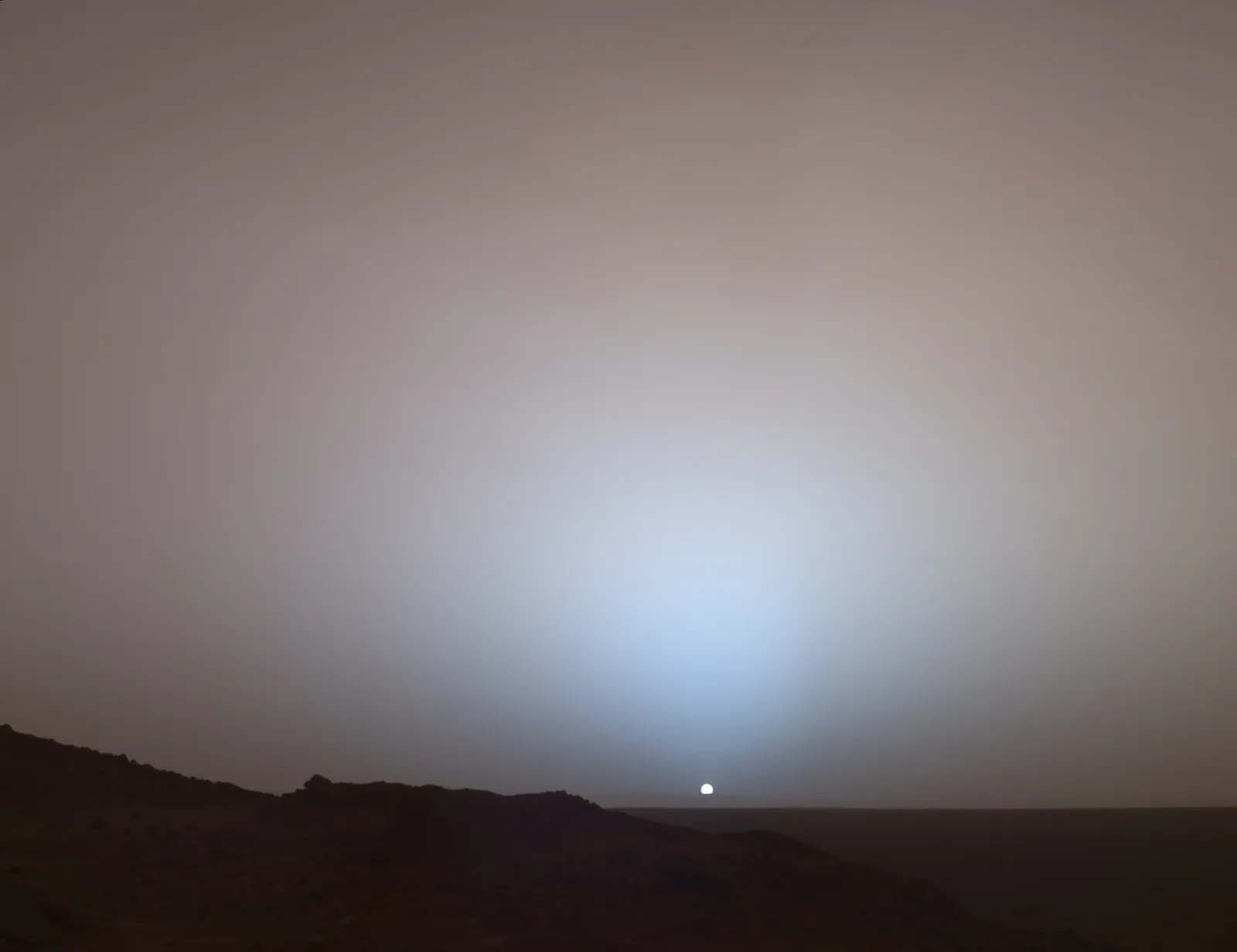
At sunset the colours flip. The dust grains are just the right size to scatter blue light forward, close to the direction of the Sun, so a cool blue glow surrounds the setting Sun while the rest of the sky stays rusty. NASA's rovers have photographed this repeatedly.
The voyage that turned a blue sea into a Nobel Prize
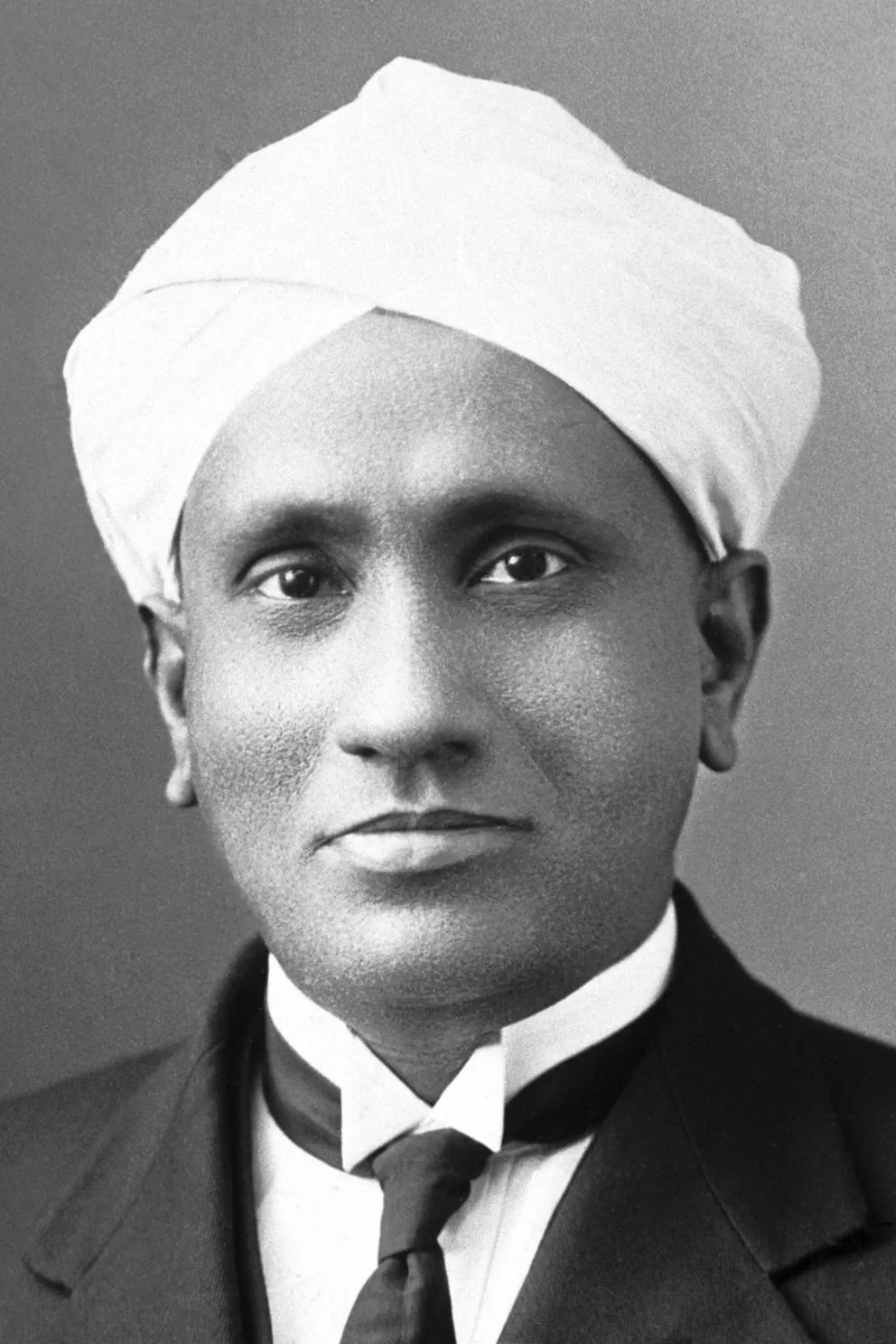
In 1921, Chandrasekhara Venkata Raman, then a professor at the University of Calcutta who did his research at the Indian Association for the Cultivation of Science, travelled to Britain to attend the Congress of Universities of the British Empire at Oxford. On the voyage home aboard the SS Narkunda, he was struck by the deep blue of the Mediterranean.
The accepted explanation, from Lord Rayleigh himself, was that the deep blue of the sea "has nothing to do with the colour of water, but is simply the blue of the sky seen by reflection." Raman doubted it, and he had the tools to test it in his pocket. Reflected light from the sea surface is strongly polarised, so by looking through a Nicol prism, a polarising crystal, at the right angle he could block the reflection of the sky. If the sea were only a mirror for the sky, its colour should have vanished. Instead, the blue looked richer and more saturated than ever, in the Mediterranean and the Red Sea, and a little less strikingly in the Arabian Sea.
Raman wrote up his findings as the ship lay in Bombay harbour, dating the letter 26 September 1921, and Nature published it as "The Colour of the Sea" on 17 November 1921. He argued that water molecules scatter light much as air molecules do, so the sea has a blue of its own. (Scientists today add that water also absorbs red light slightly, which deepens the blue, but Raman's central point, that the colour is not merely reflected sky, holds firm.)
Back in Calcutta, Raman turned the question into a research programme on how molecules scatter light. Over the next seven years he and his colleagues, including K.S. Krishnan, studied scattering in dozens of liquids and found something new: a faint part of the scattered light came out at a slightly different colour, shifted by an amount that depended on the vibrations of the molecules it had struck. The discovery dates to 28 February 1928. The Raman effect won him the 1930 Nobel Prize in Physics, the first Nobel awarded to an Asian scientist in any of the sciences.
India remembers the day. In 1986 the Government of India designated 28 February as National Science Day, first celebrated in 1987, and schools, laboratories and research institutes across the country now mark it every year with open days, lectures and exhibitions.
A colour that keeps paying off
The Raman effect became one of the most useful tools in modern science. Raman spectroscopy identifies substances by the precise colour shifts they produce, and it is used to check medicines for counterfeits, analyse pigments in old paintings without damaging them, screen for explosives at airports and identify minerals on other worlds. NASA's Perseverance rover carries a Raman instrument, SHERLOC, to study rocks in Jezero crater on Mars, a planet whose own sky is a lesson in scattering.
Scattered skylight is also polarised, most strongly at 90 degrees from the Sun, and many insects, including honeybees, use that invisible pattern to navigate. Humans rely on daylight in a different way: the blue-rich light of a morning sky is one of the strongest signals for the body's internal clock, which is why getting outside early helps you sleep better at night. And the same atmosphere that scatters sunlight also slightly delays the radio signals your phone uses to work out where you are with GPS, an error that receivers have to correct.
So the next time you look up on a clear day, you are seeing physics at work across many kilometres of air: nitrogen and oxygen molecules flinging blue light in every direction, a thin layer of ozone tinting the dusk, and, if you know where to look, the same principle that sent a physicist from Calcutta to Stockholm.