Why Was the Taj Mahal Built?
Shah Jahan built the Taj Mahal in Agra as a marble mausoleum for Mumtaz Mahal after she died in childbirth in 1631. The story covers its construction, its craft and how India still guards it.
 By Sushant Kataria· 7 min read
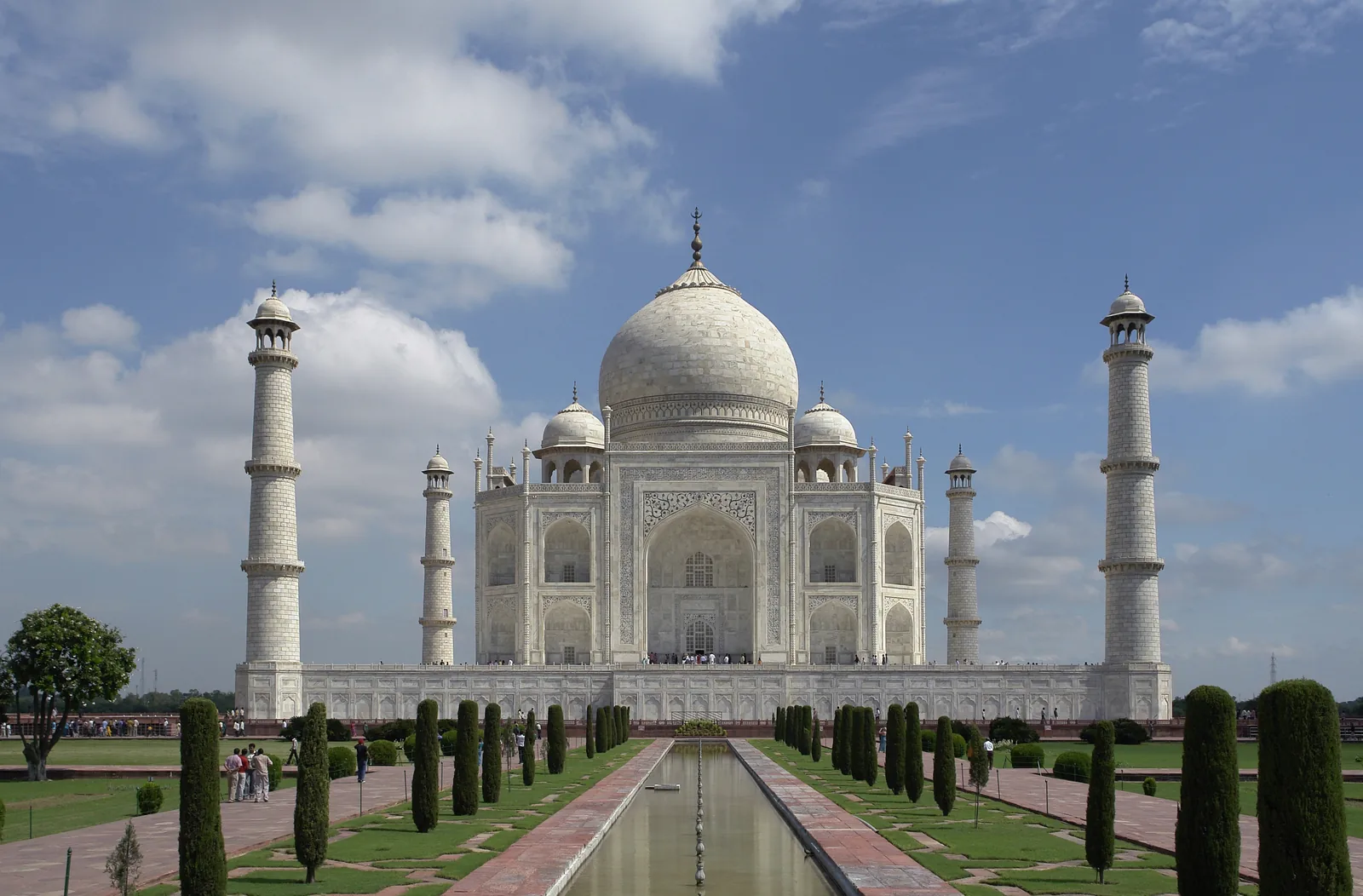
The Taj Mahal was built because the Mughal emperor Shah Jahan ordered a monumental tomb for his wife Mumtaz Mahal, who died in childbirth at Burhanpur on 17 June 1631. It is a white-marble mausoleum on the Yamuna at Agra, not a palace and not a temple: the complex exists so that her body (and later his) would rest in a garden tomb that announced imperial grief and power at once.
That purpose still shapes how India presents the site. Archaeological Survey of India custodianship, the 1983 UNESCO World Heritage listing and Agra's tourist economy all flow from one decision: to bury an empress in stone the world would not forget.
A consort, a campaign and a death at Burhanpur
Arjumand Banu Begum, titled Mumtaz Mahal ("Chosen One of the Palace"), was Shah Jahan's chief consort. She travelled with him on campaigns and bore him fourteen children. In June 1631, on a Deccan campaign, she died giving birth to their daughter Gauhara Begum at Burhanpur. Contemporary historians describe a week of public mourning and years in which the emperor put aside music and lavish dress.
Her body was first buried at Burhanpur, then brought north. Shah Jahan chose a riverside site south of Agra's walls, land exchanged with Raja Jai Singh I for a palace in the city. The brief was a rauza, an illuminated garden tomb. Later romance calls it the world's greatest love story; the harder fact is funerary architecture commissioned by a grieving emperor who still ruled one of the richest states on earth.
The same Mughal century remade Indian courts as centres of taste, from the slow pots of biryani in imperial kitchens to Kashmir pashmina shawls that marked rank. Marble, rice and wool answered the same demand: make the empire visible.
Who designed it, and how long it took
Guidebooks sometimes invent a single genius. The record is more institutional. Court architect Ustad Ahmad Lahauri (also spelled Lahori) is the name most often credited with leading the board that planned the complex. Calligraphy, dome geometry, stone cutting and garden layout were split among specialists from the Timurid and Indo-Persian world. Amanat Khan Shirazi signed the Qur'anic inscriptions.
Work began about 1632. The UNESCO description summarises the main build as 1631 to 1648. More precise modern accounts put the mausoleum at about 1648, with mosque, guest house, gateway and garden finishing into the early 1650s, often given as about 1653 for the full complex. A ceremony on 6 February 1643, the twelfth anniversary of Mumtaz's death, shows the core was already usable before every outbuilding was done.
The workforce figure repeated in countless books (about 20,000 artisans and labourers) is an often-quoted estimate, not a surviving payroll. What is solid is the logistics: Makrana marble hauled over long ramps, brick cores faced in stone and a riverside supply chain that kept Agra a construction camp for two decades.
Marble, inlay and a map of Asian stone
The tomb's skin is Makrana marble from Rajasthan. Red sandstone from the Fatehpur Sikri region frames the mosque and jawab that balance the riverside platform. Into the marble, craftsmen set pietra dura (parchin kari): flowers, vines and geometry cut from lapis, jade, turquoise, carnelian and other hardstones. Accounts of the build list materials from a wide Asian circuit (jade and crystal associated with China, turquoise with Tibet, lapis with Afghanistan, sapphire with Sri Lanka, carnelian with Arabia). Whether every modern shopping list matches a seventeenth-century invoice, the visual point stands: the tomb wears a trade map.
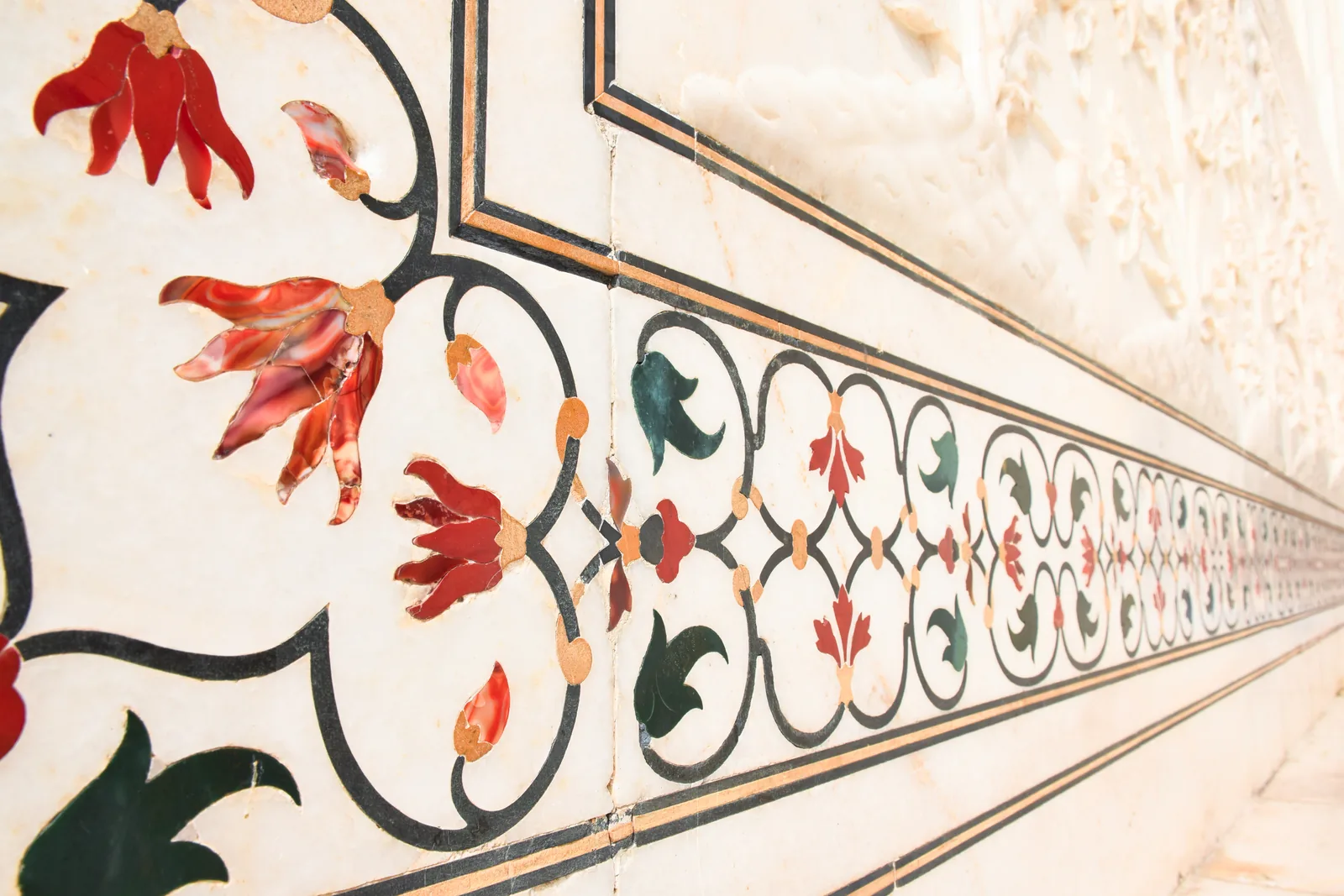
The decoration is Islamic and Indo-Persian: no human figures, plant and geometric pattern, calligraphy sized so higher panels read evenly from the ground. The dome, the four minarets (tilted slightly outward so collapse would fall away from the tomb) and the octagonal chamber sit in bilateral symmetry. Stand on the garden axis and the building resolves into one mirrored argument about order.
Charbagh, Yamuna and the cenotaphs
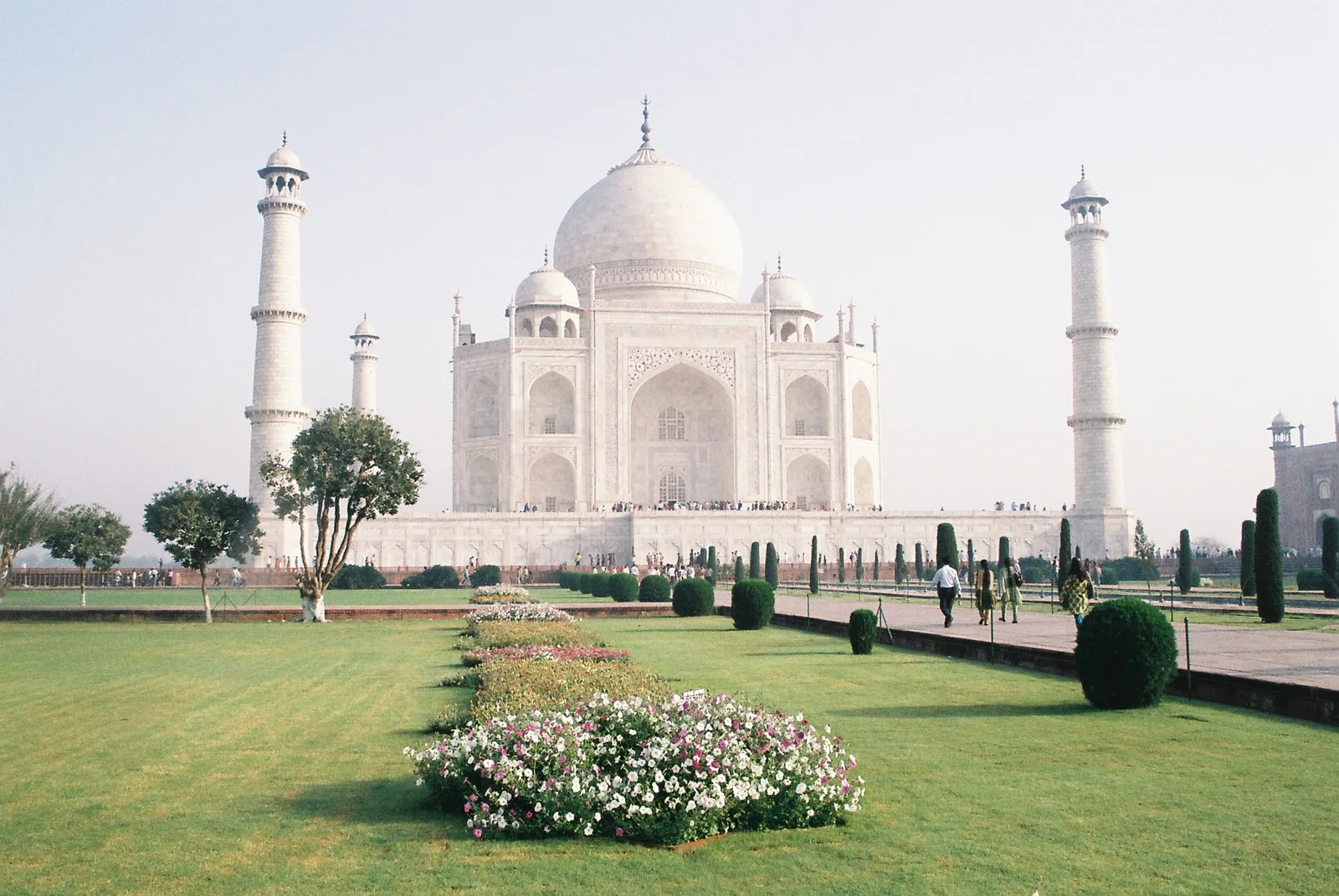
The garden is a classic charbagh: four quarters divided by water channels, an earthly diagram of paradise gardens Babur had already planted in India. At the Taj the tomb sits at the north end rather than dead centre, so the Yamuna becomes the fourth edge and the reflecting pool aims the eye at the marble. Across the river, Mehtab Bagh (the Moonlight Garden) completes the riverside composition ASI and archaeologists have studied as part of the wider design.
Inside the main chamber, visitors see cenotaphs: false sarcophagi for Mumtaz (centred) and Shah Jahan (to her side). The actual graves lie below. The offset of the emperor's cenotaph has fed romantic theories; it also matches burial etiquette that places a husband to the right of his wife, faces toward Mecca. Symmetry rules the architecture. Death rearranged the furniture.
The black Taj that was never proven
A stubborn legend says Shah Jahan planned a matching black marble mausoleum for himself across the Yamuna, linked by a bridge, and that Aurangzeb stopped the work. The story traces to the French traveller Jean-Baptiste Tavernier, who visited Agra in the 1660s. Darkened stones at Mehtab Bagh once seemed to hint at foundations. Excavations and historians have not confirmed a black twin; discoloured white marble and garden walls explain the "ruins" better. Treat the Black Taj as an unproven tale that grew because the white one invites a mirror.
What did happen is plainer. In 1658 Aurangzeb deposed his father and confined Shah Jahan in Agra Fort, within sight of the tomb. When the emperor died in 1666, he was buried beside Mumtaz. The couple share the building raised for her alone.
UNESCO, ASI and the crowds that still come
In 1983 the World Heritage Committee inscribed the Taj Mahal under criterion (i), calling it the jewel of Muslim art in India and a universally admired masterpiece. The official dossier is on the UNESCO World Heritage Centre site; the ASI manages day-to-day care under the Ministry of Culture. The public face of the monument also sits on tajmahal.gov.in.
The footfall is not a rumour. The Ministry of Tourism's India Tourism Data Compendium 2025 (issued via the Press Information Bureau) reports that among centrally protected ticketed monuments in FY 2024 to 2025, the Taj led both domestic visits (about 6.26 million) and foreign visits (about 0.645 million): roughly 6.9 million ticketed entries in one fiscal year, far ahead of other ASI sites.
Yellowing marble, the TTZ and a Supreme Court case
Love built it; chemistry threatens it. Since the late twentieth century, sulphur dioxide and particulate pollution around Agra have been blamed for yellowing and staining the marble. Foundries, brick kilns, vehicles, generator sets and the Mathura refinery entered a long fight over the air that wraps the tomb.
Environment lawyer M. C. Mehta petitioned the Supreme Court. On 30 December 1996 the Court ordered, in M. C. Mehta v. Union of India (reported 1997), that polluting industries switch to cleaner fuel or relocate, tightening protection around the monument. The full text is in the Supreme Court judgment archive (PDF). Out of that litigation grew the Taj Trapezium Zone (TTZ), a roughly 10,400 square kilometre control area with stricter emissions rules. Mud-pack cleaning, traffic limits near the gate and ongoing ASI conservation are the daily version of the same argument: a seventeenth-century marble face still needs modern law.
What the question really asks
Ask why the Taj was built and the first answer is personal and political at once. Shah Jahan buried Mumtaz Mahal in a garden tomb that fused Persian paradise plans, Indian craft and an empire's treasury. The second answer is public. India still stakes part of its global image on that riverside marble, lists it for humanity's heritage and litigates the air that yellows it. One commission for one grave became a national responsibility: conservation budgets, tourist tickets and court orders, all pointed at the same white dome above the Yamuna.