Why Did Chandrayaan-3 Land Near the Moon's South Pole?
Chandrayaan-3 aimed for the lunar south polar region because permanently shadowed craters may trap water ice, and because no nation had soft-landed there before. Here is what ISRO's Vikram and Pragyan found, and why the site still matters.
 By Sushant Kataria· 6 min read
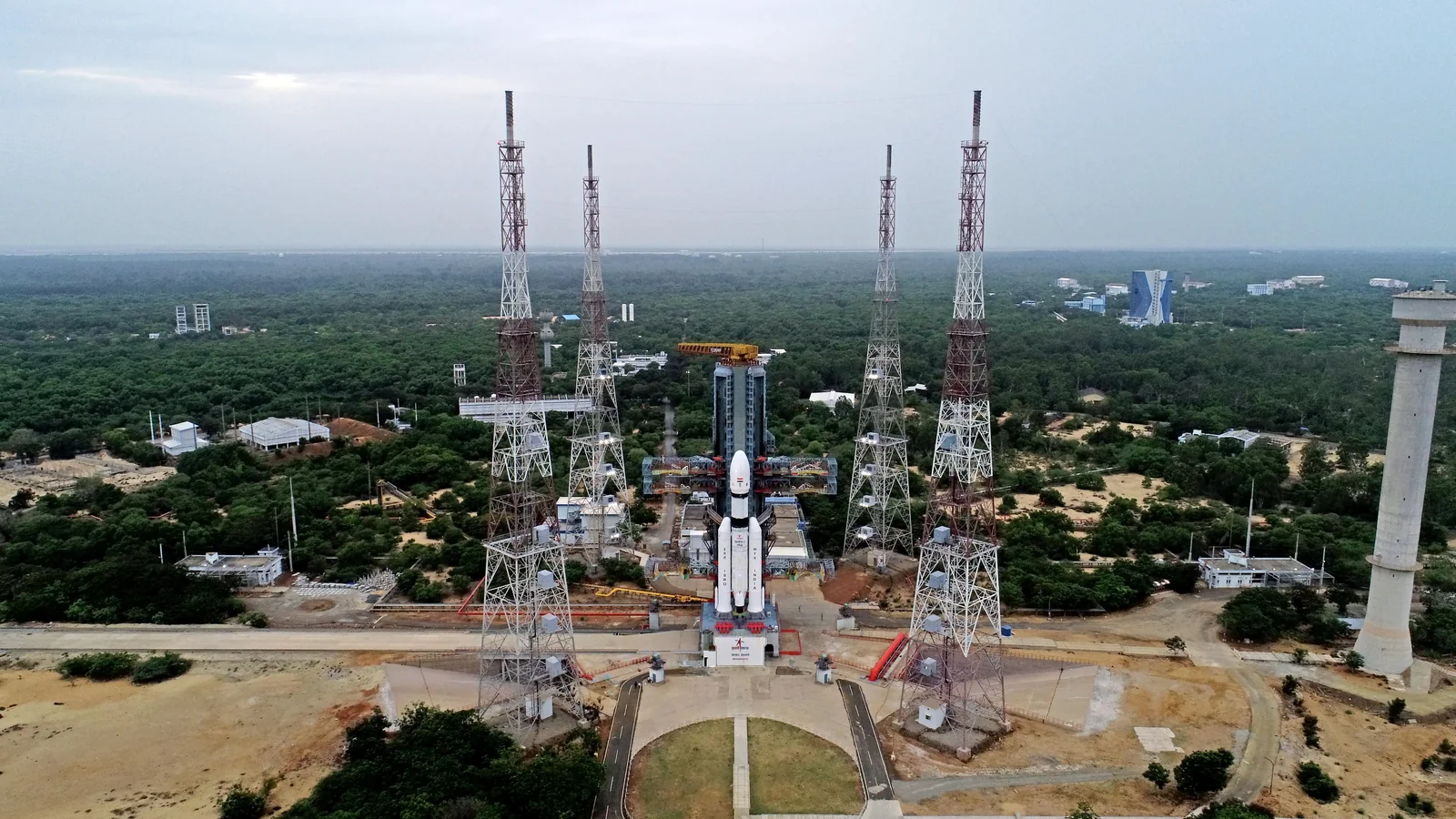
Chandrayaan-3 landed near the Moon's south pole because that region holds permanently shadowed craters that may trap water ice, a resource valuable for science and for any future long stay on the Moon, and because no mission had ever soft-landed there before. The Indian Space Research Organisation chose a high-latitude site that combined exploration prestige with a chance to sample a polar environment orbiters had only studied from above.
That is why, on 23 August 2023, the Vikram lander touched down near 69.37° S: not on the geographic pole itself, but close enough to open a new chapter of lunar geography that Apollo never reached.
From Sriharikota to Shiv Shakti
Chandrayaan-3 left Earth on 14 July 2023 aboard an LVM3 (LVM3-M4) from the Satish Dhawan Space Centre at Sriharikota. After weeks of Earth and lunar orbit manoeuvres, Vikram soft-landed on 23 August 2023. ISRO and the Press Information Bureau record that India became the fourth nation to soft-land on the Moon and the first to do so near the southern polar region.
ISRO's published prime landing site was about 69.367621° S, 32.348126° E. Independent navigation analyses place the actual touchdown within a few hundred metres of that aim point, near 69.37° S. Three days after landing, the Prime Minister named the site Shiv Shakti Point (also recorded as Statio Shiv Shakti) and declared that 23 August would be celebrated as National Space Day. The Chandrayaan-2 crash footprint was named Tiranga Point at the same time.
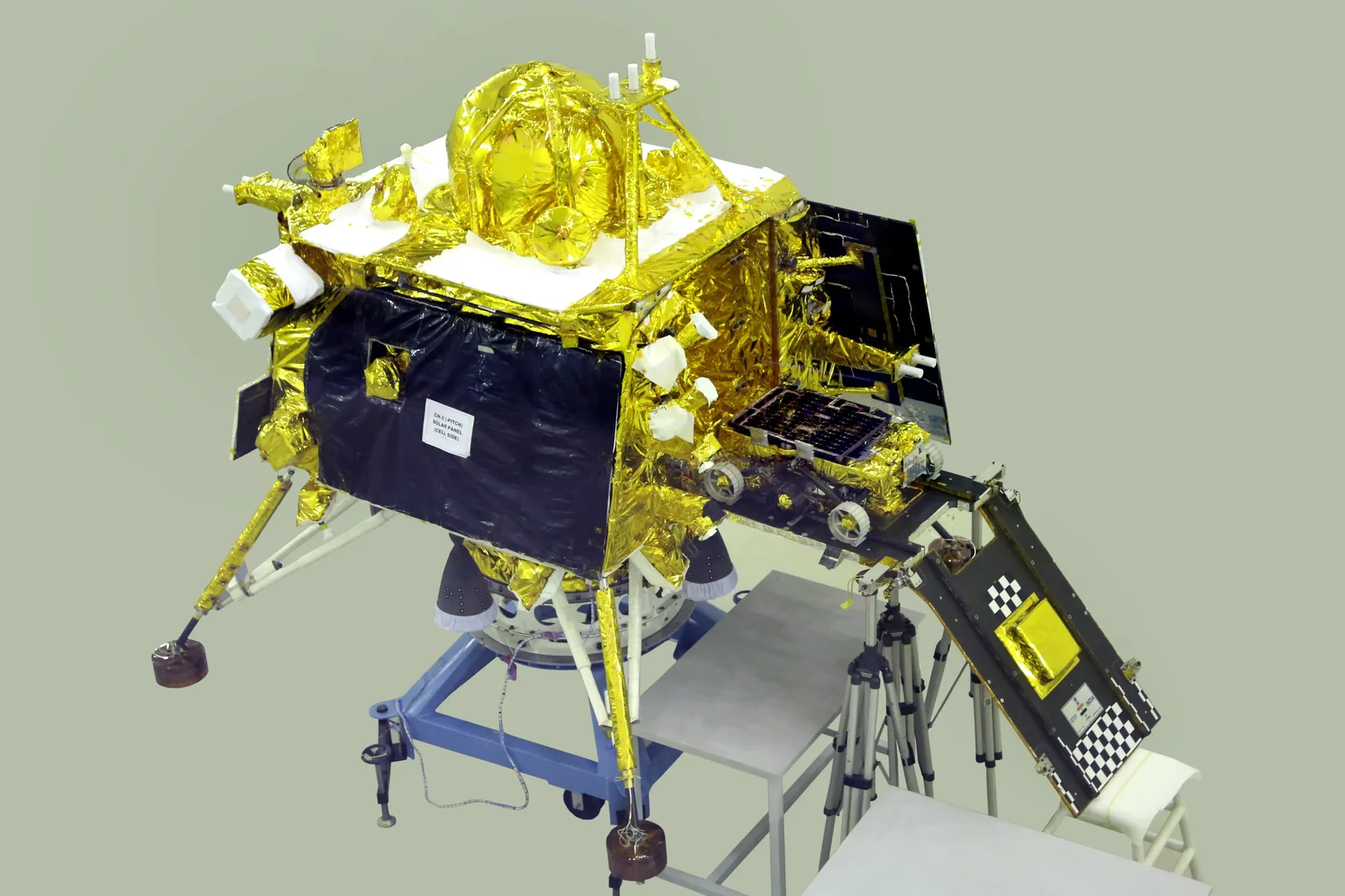
What Vikram and Pragyan were built to do
Chandrayaan-3 was a lander-and-rover mission with a propulsion module that carried them to lunar orbit. Vikram hosted instruments including ChaSTE (Chandra's Surface Thermophysical Experiment), ILSA (seismicity) and RAMBHA (near-surface plasma). The six-wheeled Pragyan rover carried LIBS (Laser-Induced Breakdown Spectroscopy) and APXS (Alpha Particle X-ray Spectrometer). Mission life for lander and rover was about one lunar day, roughly fourteen Earth days.
The science return came quickly. LIBS made the first unambiguous in-situ detection of sulphur near the south polar region, along with aluminium, calcium, iron, chromium, titanium, manganese, silicon and oxygen. That matters because orbiter instruments struggle to confirm sulphur the same way on the ground. Later, near the end of the surface phase, Vikram performed a short hop: engines reignited, the lander lifted and settled about 50 cm away, proving reignition for future ascent designs. ChaSTE measurements after the hop, analysed in a 2026 Astrophysical Journal paper, showed the plume had stripped roughly the top 3 cm of fluffy regolith and exposed a denser layered substrate.
ChaSTE's temperature story is equally striking. Early ISRO plots showed a steep gradient from roughly 70°C at the surface toward colder values within centimetres. A peer-reviewed Communications Earth & Environment analysis, summarised by ISRO, reports a peak surface temperature of about 355 K (roughly 82°C) where the probe sat on a sunward ~6° slope, while a flatter patch nearby was closer to 332 K, matching orbiter expectations. Local metre-scale slopes, not just latitude, rewrite the thermal map: an important lesson for anyone planning habitats or ice prospecting.
Lessons from Chandrayaan-2
The south pole choice was bold partly because Chandrayaan-2 had already tried and failed. On 6 to 7 September 2019, Vikram's descent proceeded normally until about 2.1 km altitude, after which communication was lost and the lander crashed. The Chandrayaan-2 orbiter survived and still supports lunar science. Chandrayaan-3 kept the science ambition but simplified the stack: no orbiter of its own, stronger landing sensors, and a propulsion and guidance design rebuilt around the hard lessons of 2019. Soft-landing is unforgiving; India treated the failure as engineering data, not as a reason to aim for an easier equatorial patch.
Why the south pole is hard, and why it is worth it
Near the poles the Sun hangs low. Shadows stretch for kilometres. Crater rims can stay in sunlight for long stretches while neighbouring floors never see the Sun at all. Those permanently shadowed regions (PSRs) stay cryogenically cold for geological time, cold enough that water ice and other volatiles can survive mixed into the soil. The same geometry that preserves ice also makes landing hard: long shadows confuse cameras and lidar, slopes and boulders crowd safe ellipses, and the lighting geometry shifts through the lunar day so a "good" site can look different hours later.
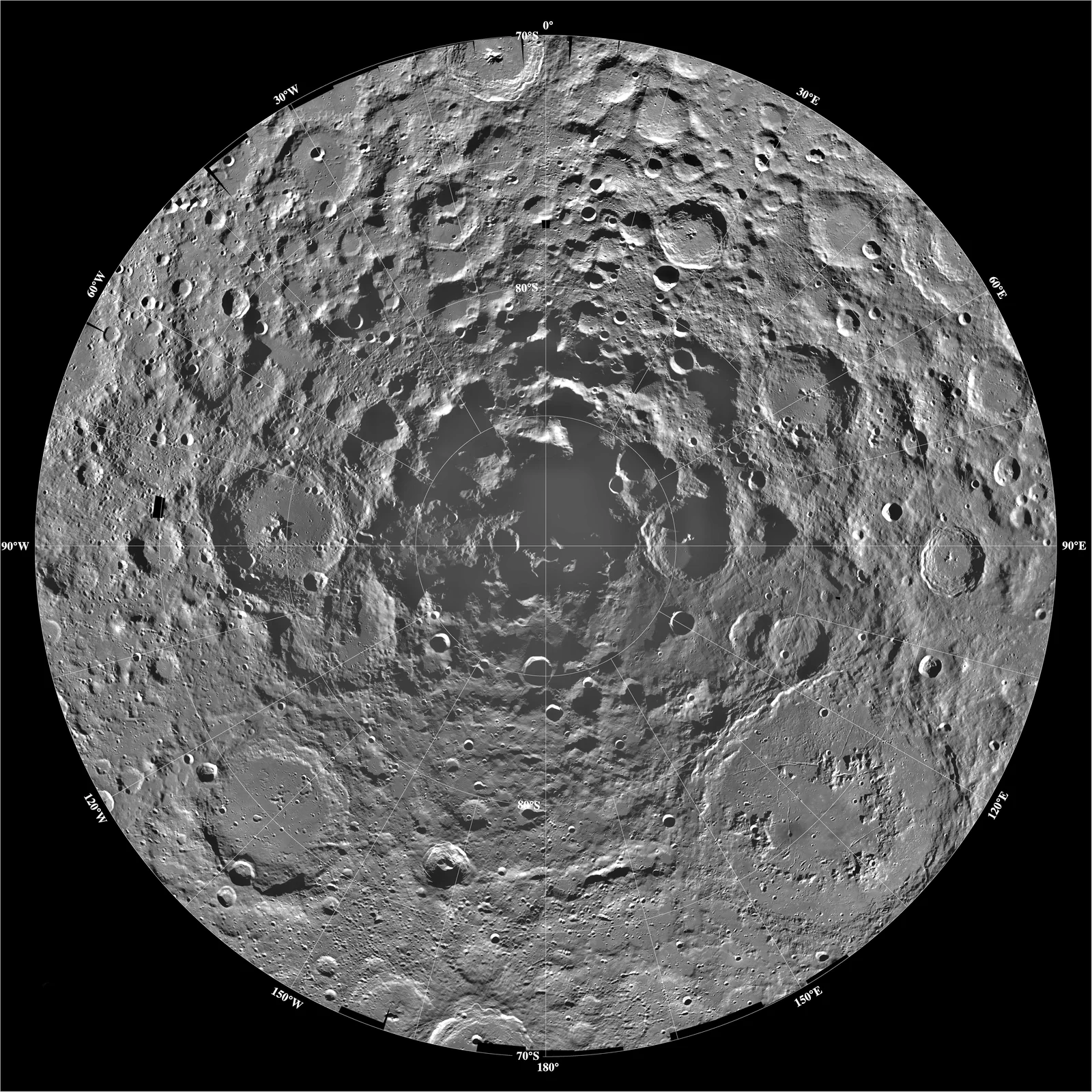
That ice case did not begin in 2023. NASA's Moon Mineralogy Mapper (M3) rode India's Chandrayaan-1 and later helped researchers report direct spectral evidence of surface-exposed water ice in polar cold traps. In 2009, NASA's LCROSS mission slammed a spent rocket stage into Cabeus crater and measured water and other volatiles in the ejecta plume. Chandrayaan-3 did not land inside a deep PSR, but it put boots (of metal) on high-latitude ground where those orbital clues could finally meet in-situ instruments.
India was not alone in racing for that geography in August 2023. Russia's Luna-25, aimed at a south-polar landing, lost contact on 19 August after a faulty orbit-correction burn and struck the Moon. A Roscosmos investigation blamed onboard control and accelerometer issues that let the engine fire too long. Four days later, Vikram landed. The calendar was coincidence; the destination was not. Polar ice had become the new lunar prize.
What comes next for polar India, and for everyone else
NASA's Artemis campaign likewise points crews toward the south polar region. Candidate landing regions for early Artemis surface work, updated in agency releases, cluster near polar massifs and crater rims chosen for lighting, communications and science access to permanently shadowed ground (NASA site-selection update).
India's roadmap keeps climbing the same slope. The Union Cabinet approved Chandrayaan-4 as a lunar sample-return technology mission; a later PIB briefing places its planned timeline in 2027 and its target near about 84° to 86° S, closer to PSRs than Shiv Shakti. Chandrayaan-5 / LUPEX, a joint ISRO and JAXA polar exploration mission, pairs an Indian lander with a Japanese rover to study volatiles near a permanently shadowed region. Soft-landing at 69° S was the proof of concept; sample return and polar volatile chemistry are the next exams.
A polar answer to an old lunar question
People have stared at the Moon drifting slowly away from Earth for as long as there have been tides and calendars. Chandrayaan-3 asked a more practical question: can India put hardware where the ice might be, under lighting that defeated earlier landers? The answer was yes. Vikram and Pragyan turned a decade of orbital hints into sulphur detections, temperature profiles and a hop that future ascent stages will need. Compared with photographing Mars's rusty dust from orbit, or explaining why Earth's sky is blue while the lunar daytime sky stays black, this was engineering under a low Sun.
So why the south pole? Because the coldest shadows may hold water, because no one had soft-landed there, and because a country that had already lost one Vikram was willing to try again where the science, and the history, are thickest.