Why Do Indians Buy So Much Gold?
India buys hundreds of tonnes of gold a year for jewellery, bars and coins. The habit is cultural, financial and political all at once: weddings and festivals meet inflation hedges, import bills and official schemes that try to channel the metal.
 By Sushant Kataria· 6 min read

Indians buy so much gold because the metal is both jewellery for life's biggest occasions and a household store of value that has outlasted currency reforms, inflation and distrust of formal finance. Alongside China, India remains one of the world's two largest consumer markets for gold, with demand still measured in hundreds of tonnes a year even when prices smash records.
That double role, ornament and insurance, is why gold keeps winning household budgets, and why every Budget that touches import duty is arguing with a habit deeper than a price chart.
Hundreds of tonnes, year after year
The scale is clearer in tonnes than in slogans. In the World Gold Council's Gold Demand Trends for full year 2024, Indian jewellery demand was 563.4 tonnes and bar-and-coin investment 239.4 tonnes. The Hindu, citing the same report, put total consumer demand at 802.8 tonnes, up 5% on 2023. That year India's jewellery volume also outpaced mainland China's 479.3 tonnes, per the Council's jewellery tables.
Record prices then cut the volume. The Council's full-year 2025 jewellery and investment chapters put Indian jewellery at 430.5 tonnes (down 24%) and bar-and-coin demand at 280.4 tonnes (up 17%). Hindu BusinessLine reports overall demand of 710.9 tonnes, down 11% by weight but up 30% by value to ₹7,51,490 crore, with imports down 17% to 663.7 tonnes. Buyers spent more rupees on less metal.
The stock already in homes is larger still. A World Gold Council note on Indian demand estimates household holdings, including temple gold, at about 25,488 tonnes. That is an industry estimate, not a vault census, but it explains why policymakers treat private gold as a macro variable.
Weddings, festivals and women's security
Ask a jeweller when the queue forms and the calendar answers first. Weddings remain the backbone of jewellery demand: gold sets are status, gift and inheritance at once. Festival buying clusters around Akshaya Tritiya in spring and Dhanteras at the start of Diwali. The Council's 2024 investment chapter notes how those festivals, plus quick e-commerce delivery of small bars and coins in big cities, lifted the final quarter.
For many women the metal is more than display. Stridhan, property a woman receives at marriage and holds as her own, has long included jewellery that can be pledged or sold when land titles and bank accounts were harder to control. That security logic still matters where rural credit was thin and medical bills arrive without warning. Gold needs no demat account, and relatives understand its value without a prospectus.
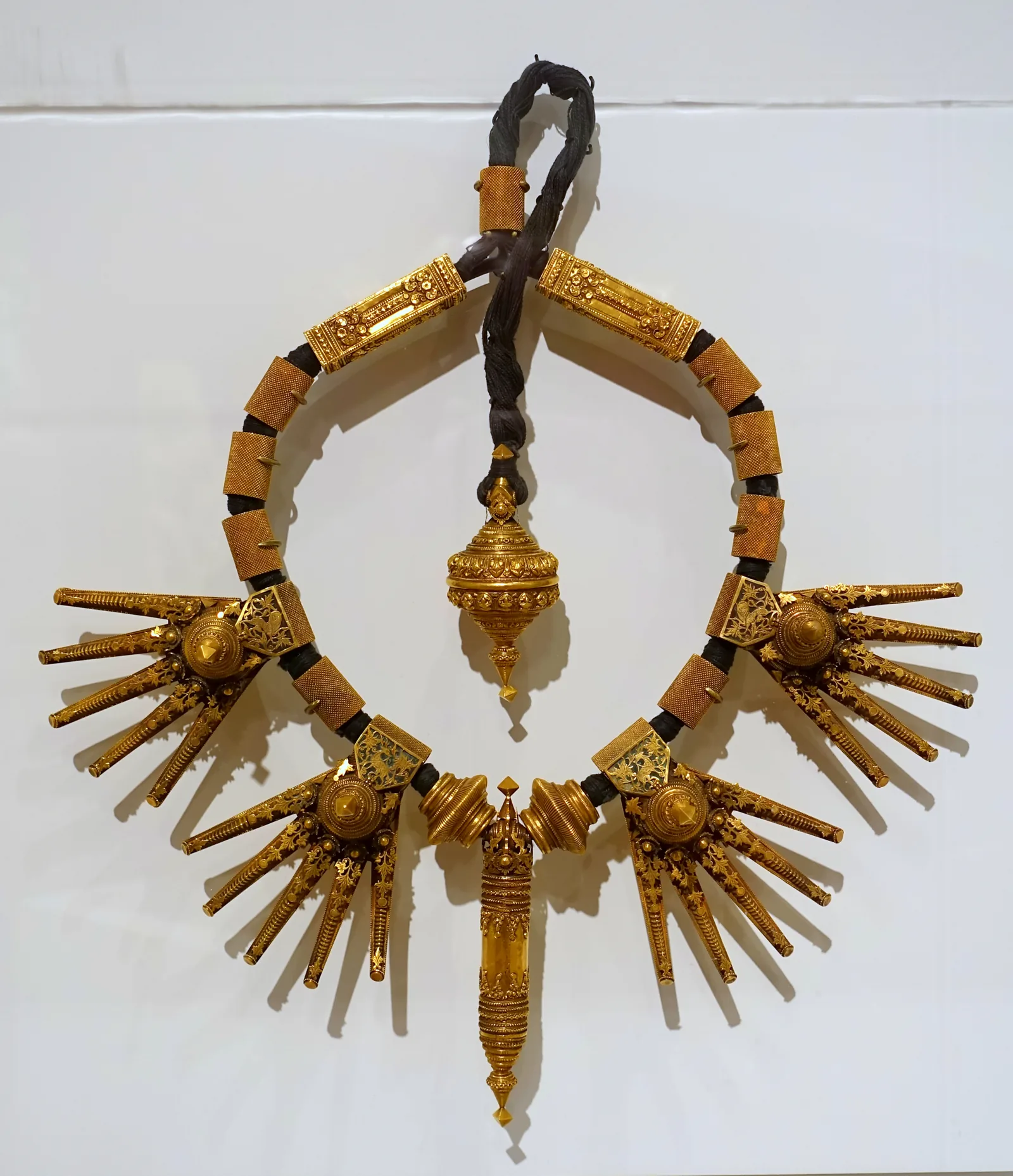
The same cultural weight once clung to other scarce goods. Centuries ago, Malabar black pepper was called black gold because Europe paid for it in metal that India then minted into coin. Today's Indian gold story flips that trade: the country now imports the bullion that households refuse to treat as optional.
Hedge against inflation and the rupee
Culture alone cannot explain why bar and coin demand jumped while jewellery volumes fell in 2025. Investors were buying weight. Gold priced in rupees rises when global prices climb or when the rupee weakens, so it hedges both imported inflation and currency slip. That is a different instinct from chasing bull and bear markets on Dalal Street, though many households now do both: equity SIPs for growth, gold for ballast.
Gold does a blunter job at home when paper money feels thin. The name of the rupee began with stamped silver; everyday coins no longer hold precious metal, which only sharpens the desire to keep the real thing separately.
Prices have rewarded that instinct. The Hindu reported MCX gold futures touching about ₹1.80 lakh per 10 grams on 29 January 2026, while Hindustan Times, citing PTI, said physical 99.9% gold in Delhi hit ₹1,83,000 per 10 grams the same day before a sharp correction. Volume can sag at those levels; the habit of wanting gold does not.

Imports, the current account and a duty cut
India mines little gold relative to what it wears and hoards, so most fresh supply is imported or recycled. That makes gold a regular line in the merchandise trade deficit and a familiar current-account worry. After the July 2024 duty cut, the Directorate General of Commercial Intelligence and Statistics review for July to September 2024 put gold at about 11% of India's import value that quarter, with August gold imports around USD 12.55 billion, and linked the surge to the duty reduction.
That cut was deliberate. In the July 2024 Union Budget, Finance Minister Nirmala Sitharaman reduced customs duties on gold and silver from 15% to 6% to support jewellery value addition and blunt smuggling. The World Gold Council's July 2024 note called it the sharpest cut on record and the lowest duty since June 2013, effective 24 July 2024. Cheaper legal imports ease jewellers' working capital; they also show how fast Indian demand can move the trade numbers.
Schemes, ETFs and the hallmark on the clasp
Governments have spent a decade trying to satisfy the hunger without stacking every gram in a locker. The Reserve Bank of India's Sovereign Gold Bond pages still manage older bonds that track gold and pay a small coupon, but new issuance has stopped. After the February 2025 Budget, Finance Minister Nirmala Sitharaman indicated the scheme was being discontinued, with officials citing high borrowing costs versus ordinary government securities. Existing bonds continue to maturity on the RBI calendar.
The parallel Gold Monetisation Scheme, launched in 2015 to pull idle jewellery into banks and refiners, was trimmed in March 2025 when medium- and long-term government deposits were discontinued, leaving short-term bank deposits to each bank's judgment. Paper gold fared better in markets: SEBI's norms for gold ETFs let funds hold physical metal, and the Council's 2025 investment chapter notes an eight-month run of Indian ETF inflows.
Trust at the counter mattered too. Mandatory BIS hallmarking began on 16 June 2021 in districts with assaying centres, the Press Information Bureau reported. From 1 July 2021 each hallmarked piece carried a six-digit HUID with the BIS mark and purity, as BIS explains and a PIB Diwali advisory reminded buyers. The stamp does not create demand. It makes the metal Indians already insist on buying harder to fake.
The habit that policy keeps meeting
So why do Indians buy so much gold? Because weddings and festivals still schedule it, because women and rural savers still treat it as portable security, because inflation and a soft rupee still advertise it as a hedge, and because jewellery plus bars keep India beside China among the largest consumer markets. Imports turn that private taste into a public finance problem, which is why duty cuts, bonds, monetisation schemes, ETFs and HUID hallmarking all orbit the same yellow metal.
Paper claims and bank apps have multiplied. The locker key has not gone away. Until a bond or ETF feels as trustworthy as a hallmarked bangle, India will keep buying gold by the hundred tonnes, and the rest of the economy will keep adjusting around that fact.