Why Is Mars Red?
Mars looks red because its surface is dusted with rust: tiny grains of iron oxide spread by wind over the whole planet. A 2025 study suggests that rust formed in water billions of years ago, and India's Mangalyaan photographed it up close.
 By Sushant Kataria· 8 min read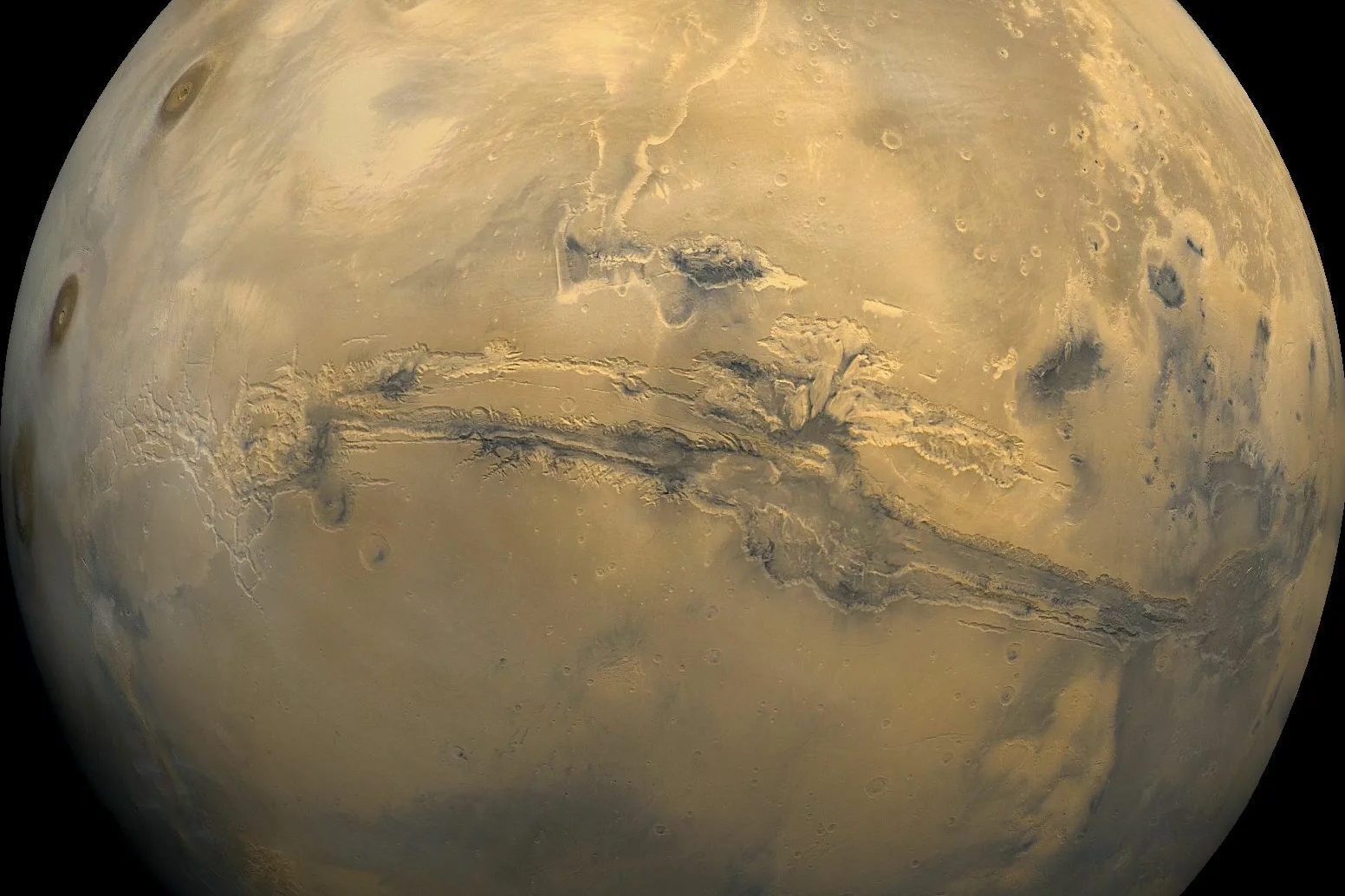
Mars is red because its surface is coated in fine dust rich in iron oxide, which is essentially rust, and that dust reflects red and orange light while absorbing blue. Winds and planet-wide dust storms spread the rusty powder over almost everything, so from Earth the whole planet glows a ruddy orange.
That is the short answer. The longer one involves ancient water, a 2025 study that rewrote the textbook explanation, a rover drill that exposed grey rock under the red skin, and a low-cost Indian orbiter that sent home one of the most striking portraits of the planet ever taken.
A planet named for its colour
People noticed the colour long before anyone knew why. Mars is one of the five planets visible to the naked eye, and at its brightest it outshines every star in the night sky with a steady, coppery light. Ancient Egyptian astronomers called it Her Desher, "the red one". Babylonian sky-watchers linked it to Nergal, a god of war and plague. The Greeks named it after Ares and the Romans after Mars, their own god of war, and the colour of blood and fire made the association feel natural.
Indian astronomy reached for the same imagery. In Sanskrit the planet is Mangala, and one of its old names is Angaraka, "the glowing coal". It also gave the week a day: Tuesday is Mangalvar in Hindi and many other Indian languages, just as it is mardi in French and martes in Spanish, both from the Latin for "day of Mars". Across very different cultures, the first thing anyone said about this planet was that it was red.
The answer is iron, and lots of it
Mars is a rocky planet roughly half the width of Earth, about 6,779 kilometres across, and its rocks are unusually rich in iron. Martian volcanic rock contains roughly twice as much iron oxide as rock from Earth's mantle. When iron meets oxygen, especially with some water involved, it oxidises: the same chemistry that turns an old bicycle chain orange.
On Mars, that oxidised iron sits mostly in the dust. Martian dust grains are tiny, around a micrometre or two across, finer than talcum powder. Because they are so small, they are easily lifted by the thin winds and carried for thousands of kilometres. Over billions of years the wind has ground rock into powder and spread a rusty film over plains, craters and volcanoes alike.
Iron oxide is red because of how it handles light. It strongly absorbs blue and green wavelengths and reflects the longer red and orange ones, so sunlight bouncing off the dust comes back warm-toned. Pure white light goes in, and a rusty orange colour comes out.
The red is only skin-deep
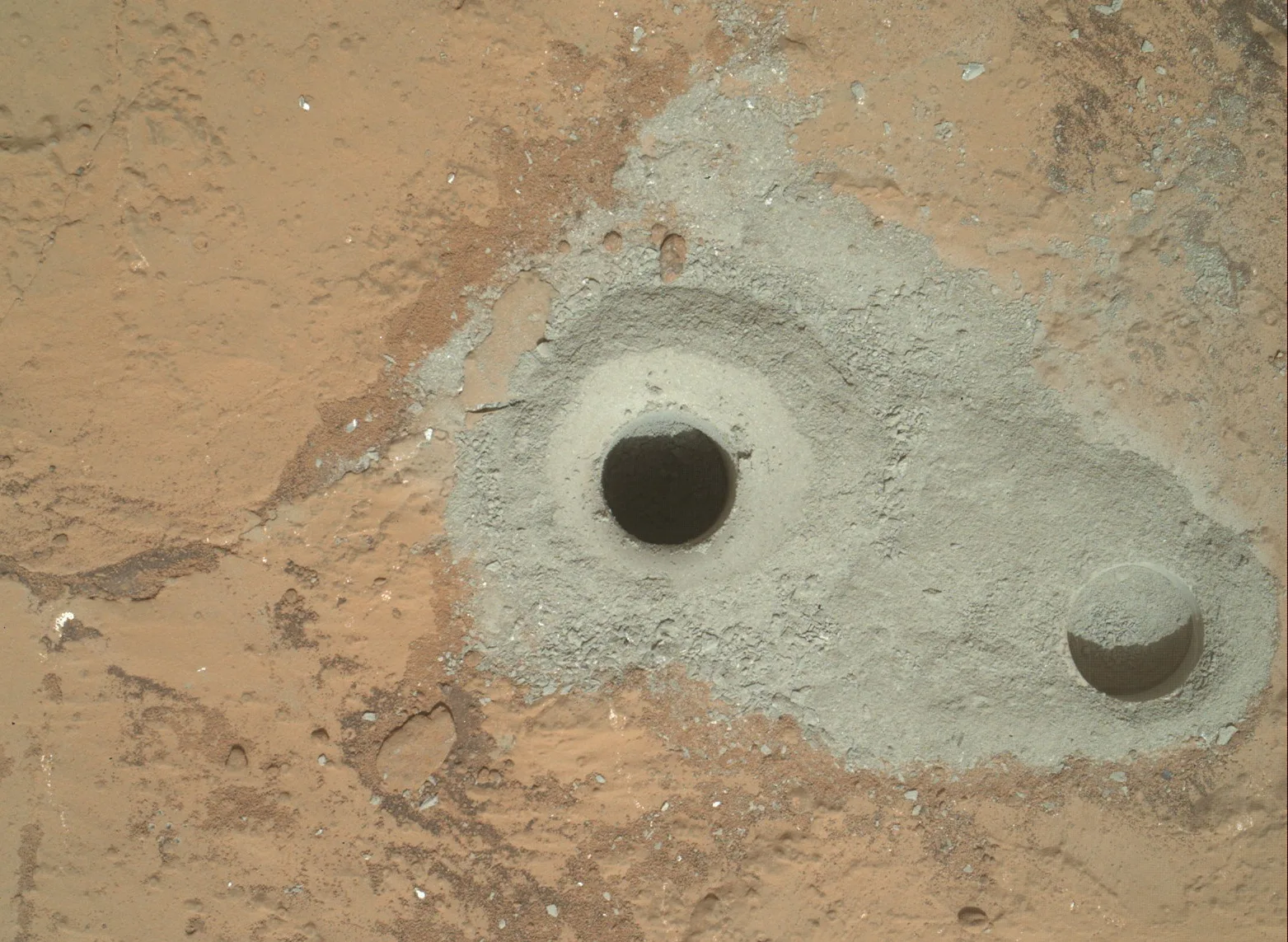
One of the most telling images from Mars is not a landscape but a hole. On 8 February 2013, NASA's Curiosity rover drilled its first sample from a flat rock in Gale crater that the team had named John Klein. The hole was about 1.6 centimetres wide and 6.4 centimetres deep, and the powder piled around it was grey.
That is the whole story in one picture. Underneath the dust, much of Mars is made of dark basalt, the same kind of volcanic rock found in Hawaii, Iceland and India's Deccan Plateau. The red is a coating, sometimes only a thin layer of weathered material and fine dust on top. Where wind scours the dust away, orbiters see dark patches such as Syrtis Major, a region visible through even modest telescopes as a dark smudge on the orange disc.
The rust that formed in water
For decades the standard explanation was that the dust was coloured by hematite, a dry form of iron oxide. The idea was that Mars had rusted slowly over billions of years with very little water, as the iron in its rocks reacted with oxidising chemicals produced when sunlight breaks apart molecules in the thin atmosphere.
In February 2025 a team led by Adomas Valantinas, working at Brown University and the University of Bern, published a different answer in Nature Communications. They combined data from several orbiters, including ESA's Mars Express and ExoMars Trace Gas Orbiter and NASA's Mars Reconnaissance Orbiter, with readings from rovers on the ground, and compared it all with dust they made in the laboratory. The best match was not hematite but ferrihydrite, a poorly crystalline iron oxide that contains water in its structure.
That matters because ferrihydrite typically forms quickly in the presence of cool water. If it is the main colouring agent, then Mars did much of its rusting early, during a cold, wet period when water still moved across the surface, before the planet dried into the desert it is today. The team's experiments also showed ferrihydrite stays stable under present Martian conditions, which explains how it could survive for billions of years. In other words, the colour of Mars is a fossil record of its watery past.
The finding is strong but not final. The clearest test will come from samples examined in laboratories on Earth, and NASA's Perseverance rover, which landed in Jezero crater in February 2021, has been sealing rock and dust samples in tubes for exactly that kind of future return mission.
Why the planet looks orange, but the sunsets look blue
The same dust shapes the Martian sky. Because the particles are about the size of a wavelength of light, they scatter light differently from the tiny gas molecules that turn Earth's sky blue. By day the Martian sky is a pale butterscotch, tinted by suspended rusty dust. At sunset the effect reverses: the dust scatters blue light forward, close to the direction of the Sun, so a cool blue glow surrounds the setting Sun.
The dust can also take over the whole planet. Roughly every few Martian years (a Martian year is 687 Earth days), regional storms merge into a global dust storm that can wrap the entire planet in haze for weeks. The storm of 2018 was so thick that sunlight could not reach the solar panels of NASA's Opportunity rover. The rover last made contact on 10 June 2018, and NASA declared its mission over in February 2019, after more than 14 years on a mission that was planned to last 90 days.
How India photographed the red planet
India's Mars Orbiter Mission, better known as Mangalyaan, gave the country its own view of that colour. Launched on a PSLV rocket from Sriharikota on 5 November 2013, it entered Mars orbit on 24 September 2014, making India the first Asian nation to reach Mars orbit and the first country to do so on its first attempt. Its budget was about ₹450 crore, a figure that became famous because it was smaller than the budget of some Hollywood space films.
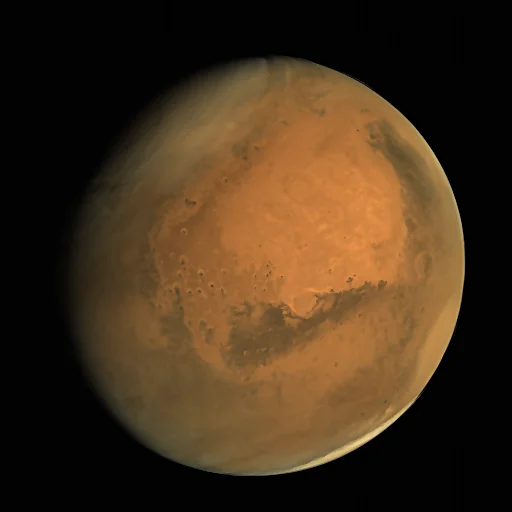
Four days after arriving, its Mars Colour Camera captured a full-disc image of the planet from about 74,500 kilometres away: an orange globe streaked with darker basalt and fringed with thin haze. The orbiter was designed for six months but kept working for about eight years, until ground stations lost contact in 2022. Along the way it mapped the planet, watched dust storms and studied Mars's tiny moon Phobos. The mission even featured on the back of the ₹2,000 banknote introduced in 2016. It sits in a growing list of Indian space achievements, alongside Chandrayaan and the NavIC navigation system that guides phones and ships across the subcontinent.
Red earth closer to home
You do not need a spacecraft to see the same chemistry. India's red soils, which cover large parts of Tamil Nadu, Karnataka, Odisha and Chhattisgarh, get their colour from iron oxides formed as old rocks weather. The laterite blocks used in houses across Kerala, Goa and coastal Karnataka are rich in iron and aluminium oxides for the same reason. The cold, high desert of Ladakh is used by researchers as a Mars analogue because its dry, rocky, high-radiation landscape resembles the red planet more than almost anywhere else in the country.
The difference is scale and time. On Earth, plate tectonics, rain, rivers and life constantly churn and recycle the surface. Mars lost most of its atmosphere and surface water billions of years ago, and with no active plate tectonics to bury and renew its crust, the rusty dust from its wet youth has simply been blown around ever since.
Seeing it for yourself
Mars is easy to spot when it is near opposition, the point when Earth passes between Mars and the Sun and the two planets are closest. Oppositions come about every 26 months; the next one falls in February 2027. On 27 August 2003, Mars came within about 55.8 million kilometres of Earth, its closest approach in nearly 60,000 years, and the steady orange point drew crowds to telescopes around the world. Unlike stars, which twinkle, Mars usually shines with a calm light, and its colour is obvious even from a bright city.
So the next time you see that orange dot in the sky, you are looking at a planet covered in rust, much of it probably formed in water that vanished billions of years ago. Like the Moon slowly drifting away from Earth, it is a reminder that the sky we see is the result of very long stories, still being worked out one rover drill hole and one orbiter image at a time.