Why Is the Moon Moving Away From Earth?
Every year the Moon moves about 3.8 centimetres farther from Earth. Lasers fired at reflectors left on the lunar surface measure it precisely, and the same process is slowly lengthening our days.
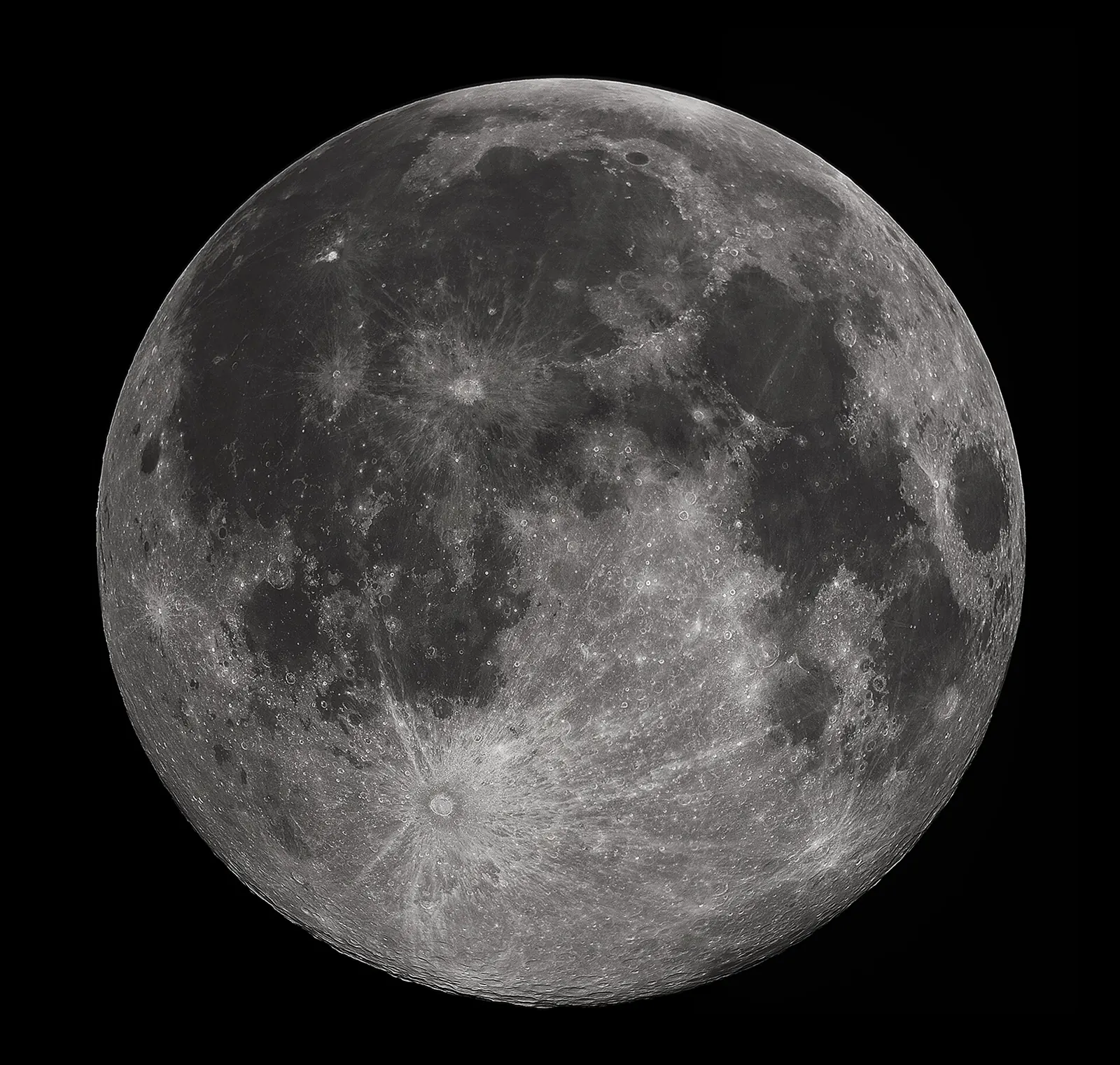
The Moon is moving away from Earth by about 3.8 centimetres a year because of tides: Earth's tidal bulge pulls the Moon slightly forward in its orbit, transferring rotational energy that pushes it outward while Earth's spin slowly brakes. We know the rate precisely because scientists bounce lasers off mirrors left on the lunar surface by Apollo astronauts.
The Moon looks permanent, a fixed companion that has hung in the sky for every generation of humans. It is not. Our satellite is gradually spiralling outward, retreating by roughly 3.8 centimetres a year, about the speed at which your fingernails grow. We know this with remarkable precision thanks to an experiment that began more than half a century ago and is still running today.
Mirrors on the Moon
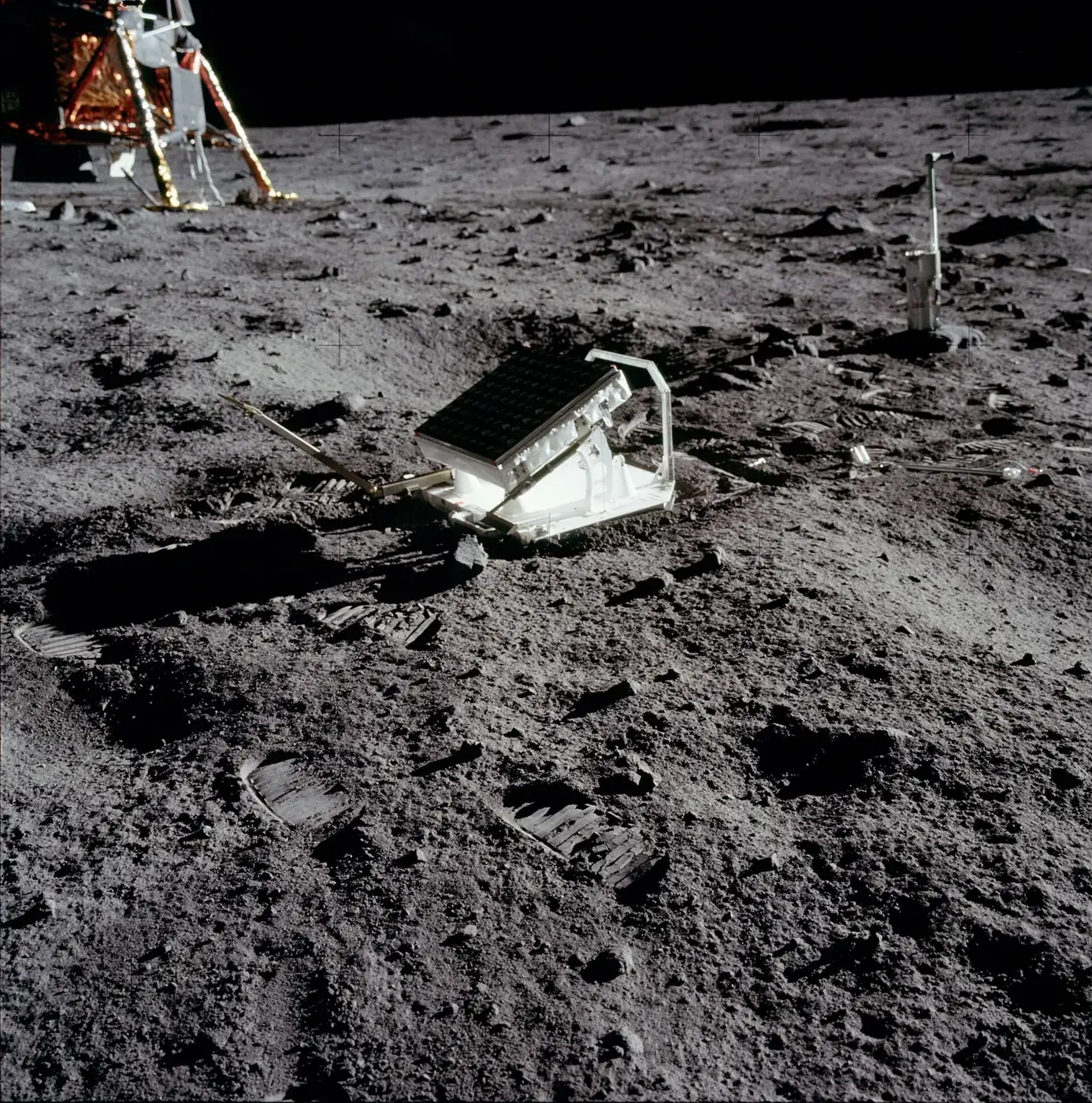
When the Apollo 11 astronauts landed in July 1969, they set up a small panel of precisely shaped glass prisms called retroreflectors. Unlike an ordinary mirror, a retroreflector sends light back exactly in the direction it came from, no matter the angle at which it arrives. Apollo 14 and Apollo 15 left more, and the Soviet Union's robotic Lunokhod 1 and Lunokhod 2 rovers carried French-built reflectors too.
Observatories on Earth, including the Apache Point Observatory in New Mexico and the Côte d'Azur Observatory in France, fire powerful pulsed lasers at these reflectors. By the time the beam reaches the Moon, it has spread to a few kilometres wide, and only a handful of photons from each pulse make it back to the telescope. But by timing that round trip, which takes about 2.5 seconds, scientists can measure the Earth-Moon distance to within millimetres.
This technique, known as lunar laser ranging, is one of the longest-running experiments in science. It has confirmed the Moon's retreat, tested Einstein's general theory of relativity to extraordinary precision and revealed that the Moon likely has a liquid outer core.
Why the Moon is moving away: tides
The cause is the same force that rocks harbours twice a day: tides.
The Moon's gravity pulls on Earth's oceans, raising bulges of water on the side facing the Moon and the side opposite it. But Earth spins on its axis much faster than the Moon orbits, once a day versus about once every 27 days. That rapid rotation drags the tidal bulge slightly ahead of the line between Earth and the Moon.
This leading bulge has mass, and it pulls gently forward on the Moon, giving it a tiny boost of orbital energy. A satellite with more energy moves into a higher orbit. Meanwhile, the Moon's gravity pulls back on the bulge, acting like a brake on Earth's rotation.
The result is an exchange: Earth spins slower, and the Moon drifts farther away. The total angular momentum of the system stays the same; it is simply transferred from Earth's spin to the Moon's orbit.
Our days are getting longer
The braking effect means each day lasts slightly longer than the one before. The change is tiny, on the order of a couple of milliseconds per century on average, but over geological time it adds up dramatically.
The evidence is written in rocks and fossils:
| Time | Approximate length of day | Evidence |
|---|---|---|
| Today | 24 hours | Atomic clocks |
| ~400 million years ago (Devonian) | ~22 hours | Daily growth rings in fossil corals suggest about 400 days per year |
| ~620 million years ago | ~21.9 hours | Tidal rhythmites, layered sediments laid down by tides |
The rate has not been constant. It depends on the shape of ocean basins and the arrangement of continents, which affect how strongly tides resonate. Today's oceans happen to be close to resonance, which is why the current rate of retreat is thought to be faster than the long-term average.
Where the Moon came from
The Moon's retreat also tells us it was once much closer. The leading explanation for its origin is the giant-impact hypothesis: roughly 4.5 billion years ago, a Mars-sized body, often called Theia, collided with the young Earth. Debris from the collision coalesced into the Moon, initially at a small fraction of today's distance.
A Moon that close would have loomed enormous in the sky and raised colossal tides. Over billions of years, tidal interaction pushed it out to its current average distance of about 384,400 kilometres.
Will we lose the Moon?
No, not in any practical sense. At 3.8 centimetres a year, the Moon would take billions of years to move dramatically farther away. In theory the process would continue until Earth's rotation slowed to match the Moon's orbit, with both locked face-to-face, much like Pluto and its moon Charon. But the timescale for that is tens of billions of years, and the Sun will swell into a red giant in roughly five billion years, transforming the inner solar system long before.
There is one change humans will lose much sooner, in cosmic terms. Total solar eclipses happen because the Moon and Sun appear almost exactly the same size in our sky; the Sun is about 400 times wider than the Moon but also about 400 times farther away. As the Moon recedes, it will appear slightly smaller. In something like 600 million years, it will no longer be able to cover the Sun completely, and total solar eclipses will end, leaving only annular ones with a bright ring of sunlight around the Moon.
A living experiment
Lunar laser ranging continues today, and new generations of reflectors are planned for future lunar missions, designed to improve precision further. Each returning photon is a reminder that the solar system is not a static clockwork. It is a dynamic system in slow motion, and a few glass prisms placed by astronauts in 1969 let us watch it move.
So the next time you see a full Moon rising, consider that it is fractionally farther away than it was when you were born, and that the day you are living is a few microseconds longer than one from your childhood.
Measuring the Moon with light has a down-to-earth cousin: pulses of laser light also carry your emails, racing through undersea fibre-optic cables on the ocean floor. And precise measurement has a way of making history, as with the oddly exact marathon distance.