Why Are Markets Called Bull and Bear?
Rising markets are bulls and falling ones are bears, from Wall Street to Dalal Street. The names began as coffee-house slang in 1700s London, and the bear got there first.
 By Sushant Kataria· 7 min read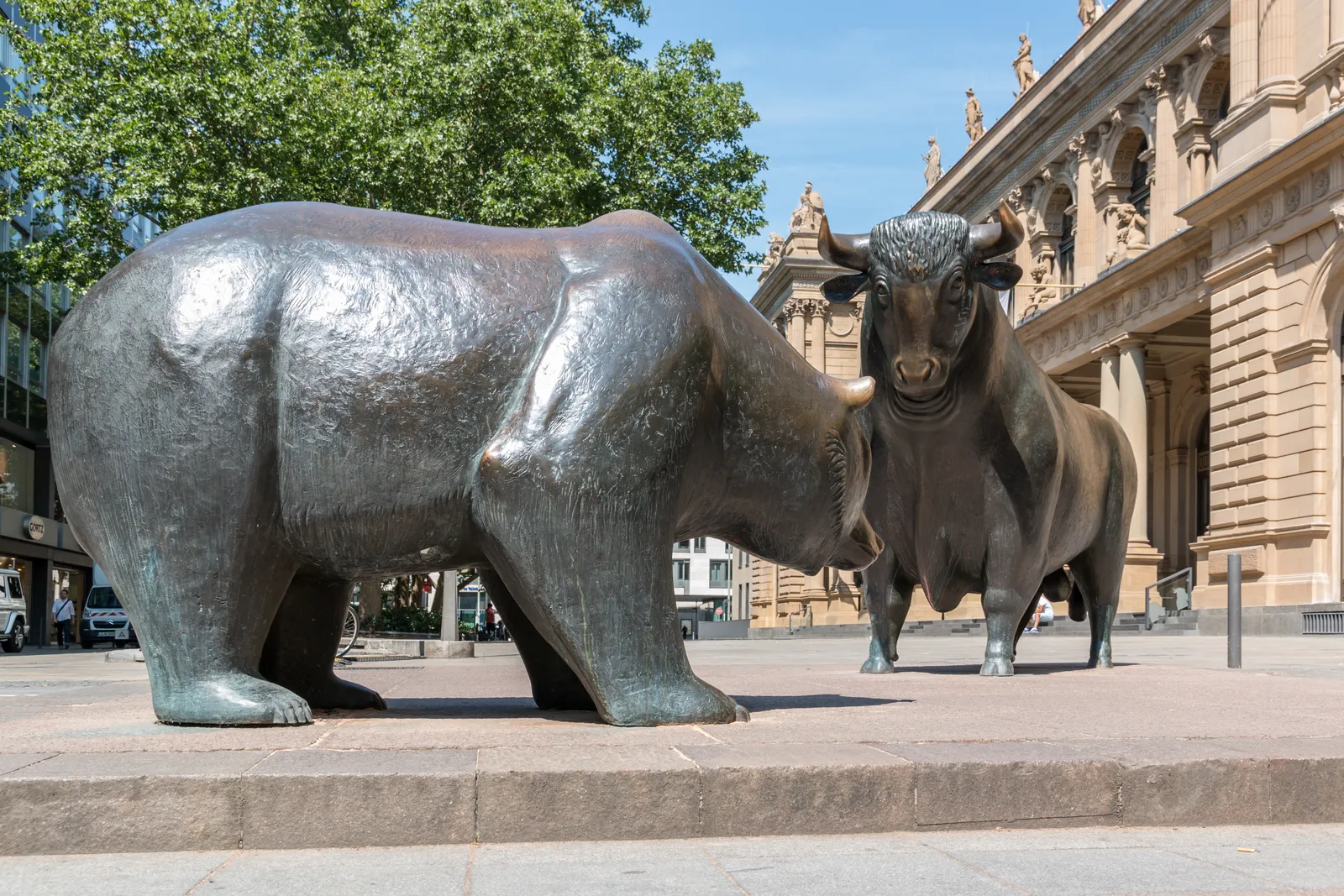
Markets are called bull and bear because traders in early 1700s London already used both animals as slang: a bear was a speculator who sold shares he did not yet own, betting the price would fall, and a bull was his opposite, buying in the hope of a rise. The bear came first, from an old proverb about selling the bear's skin before you have caught the bear, and the bull joined it within a few years as its natural rival.
So the names are not about how the animals fight, though that is the explanation most people hear. They are about a very old trick: selling something you do not have yet.
The bear came first
For centuries English speakers warned each other not to "sell the bear's skin before one has caught the bear." It meant much the same as "don't count your chickens before they hatch." The risk was obvious: if the bear got away, the seller had promised goods that did not exist.
By the early 1700s the phrase had moved into the coffee houses of Exchange Alley in the City of London, where shares were bought and sold before the city had a formal stock exchange. A "bearskin jobber" was a dealer who agreed to sell stock at today's price for delivery at a later date. If the price fell in the meantime, he could buy the shares cheaply, hand them over and pocket the difference. Today we call this short selling.
The word was still new enough in 1709 that the essayist Richard Steele felt he had to explain it to readers of The Tatler. Within a decade it needed no explanation at all. In Susanna Centlivre's 1718 comedy A Bold Stroke for a Wife, set partly among the stockjobbers of Exchange Alley, a character simply asks whether a man is a bull or a bear today. As Merriam-Webster's history of the terms puts it, "bearskin" was quickly shortened to "bear," and the word was applied both to the stock being sold and to the person selling it.
Why a bull?
The bull has a less tidy story. Etymologists generally agree that it arrived as a counterpart to the bear: two powerful animals, both starting with the same letter, standing for the two forces that push every price. London had a long history of bull and bear baiting as public entertainment, which may have helped the pairing stick, but there is no single document that explains the choice.
The explanation you hear on business television came later and works best as a memory aid. A bull attacks by thrusting its horns up, so it stands for rising prices. A bear swipes its paws down, so it stands for falling ones. It is a neat picture, but it is a rationalisation of words that were already in use, not their origin.
A bubble made the words famous
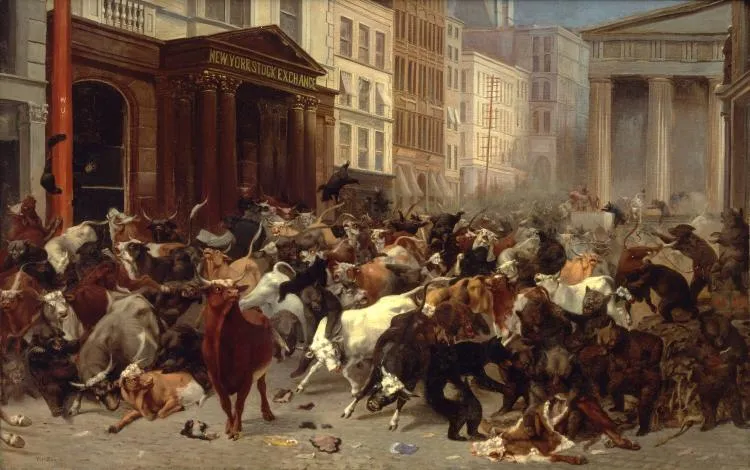
The terms were in use before 1720, but that was the year everyone in Britain learned them. Shares in the South Sea Company, set up in 1711 to trade with Spain's American colonies, soared during the spring and summer of 1720 and then collapsed. Exchange Alley was packed with speculators, and pamphlets, ballads and stage farces about the crash used the language of bulls, bears and "selling the bearskin" freely. A poem published in 1721, after the bubble burst, looked back to a time when merchants did not "sell the Bearskin, or for Premiums call."
This was not the first market of its kind. A century earlier, in 1602, the Dutch East India Company (the VOC) had sold shares to the public in Amsterdam to finance voyages for the spices that made black pepper "black gold", and Amsterdam traders had already worked out forward contracts and short selling. London's contribution was the vocabulary, and it travelled with British finance to New York, Bombay and everywhere else.
What counts as a bull or bear market today
The animals now have numbers attached. In the convention used by most analysts and the financial press:
- A bear market is a fall of at least 20% from a recent closing high.
- A correction is a smaller drop, between 10% and 20%.
- A bull market begins when prices rise 20% from their low.
The 20% line is a rule of thumb, not a law, and no regulator declares a bear market. Still, it gives investors a shared yardstick, a bit like the Big Mac Index gives economists a shared way to compare currencies.
The long-run record is reassuring for the patient. According to Hartford Funds, using Ned Davis Research data, the US S&P 500 index has had 27 bear markets since 1928. The average one cut prices by about 35% and lasted 289 days, roughly 9.6 months. The average bull market lasted about 2.7 years and lifted prices by about 112%. The shortest bear on that list was the Covid crash of 2020, which took the S&P 500 down almost 34% in just 33 days, from 19 February to 23 March.
The bulls of Wall Street, Frankfurt and Dalal Street
The animals have also become sculptures. In 1985, for the 400th anniversary of the Frankfurt Stock Exchange, the sculptor Reinhard Dachlauer cast a bull and a bear facing each other on the square outside, the pair shown at the top of this page.
Four years later, the Italian American artist Arturo Di Modica made the most famous bull of all. After the crash of October 1987, he spent his own money on a 7,100-pound (about 3,200 kg) bronze, and in December 1989 he trucked it to Lower Manhattan overnight and left it outside the New York Stock Exchange without permission. The police removed it, but after a public outcry the city installed Charging Bull at nearby Bowling Green on 20 December 1989, and it has been one of New York's most photographed objects ever since.
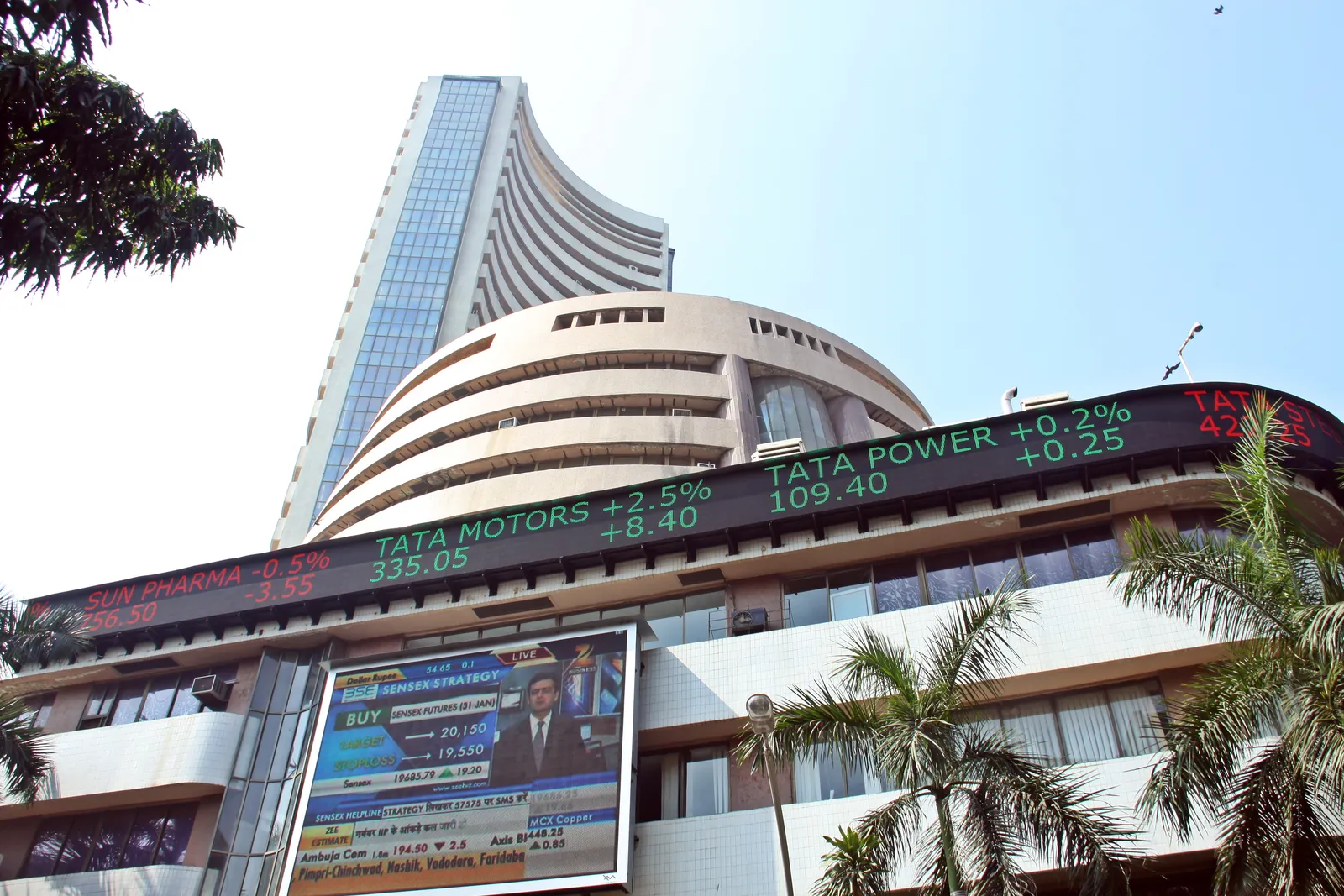
India got its own bull in 2008. Mumbai's stock market traces its roots to brokers who traded under a banyan tree near the Town Hall in the mid-1800s; in July 1875 a group of them formed the Native Share and Stock Brokers' Association, which grew into the BSE, Asia's oldest stock exchange. In 2007 the exchange asked the Solapur sculptor Bhagwan Rampure to create a bronze bull inspired by the New York original. The one-tonne statue was unveiled at the BSE on 11 January 2008.
The timing could hardly have been worse. Within days the Sensex suffered one of its sharpest falls, losing 1,408 points on 21 January 2008, and the slide turned into a full bear market. From a peak above 21,000 that January, the index fell to a close of 8,160 in March 2009, a drop of more than 60%. Some brokers on Dalal Street decided the new bull was panvati, a bad omen, and a few hundred protested to have it moved. It stayed, and so did the market's habit of recovering.
India's bulls, bears and big bulls
Indian market language has absorbed the animals completely. Hindi business news calls a rising market tezi and a slump mandi, but headlines still talk about bulls taking charge on Dalal Street. Two of the country's best-known investors were nicknamed "the Big Bull": Harshad Mehta, whose leveraged buying fuelled the 1992 boom before the securities scam that bears his name, and the late Rakesh Jhunjhunwala, who built a fortune betting on Indian growth over more than three decades.
The bears have had their moments too. On 23 March 2020, as Covid lockdowns spread, the Sensex fell 3,934.72 points, or 13.15%, to 25,981.24. Reuters called it the worst single-day rout in the history of Indian stocks.
What has changed most is who is watching. India had about 24.06 crore (240.6 million) demat accounts at the end of September 2026, according to depository data reported by Business Standard, up from about 4 crore in March 2020. Many of those investors have never lived through a long bear market, which is exactly why the old vocabulary still matters.
Why the names stuck
Bull and bear survived for three centuries because they capture something real about markets: every trade has a buyer who expects the price to go up and a seller who does not. The words are short, vivid and easy to shout across a trading floor, and they make an abstract tug of war feel physical.
They also carry a small warning, if you remember where the bear came from. Selling the skin before catching the animal is still a gamble, whether it is a stockjobber in a London coffee house or a trader shorting shares on a phone app. And like the prices that end in 99, the language of markets often works on our instincts more than our arithmetic. The bull and the bear are a reminder that markets are, in the end, made of people with opposite hunches.