Why Is It Called the Rupee?
The rupee takes its name from the Sanskrit rupya, wrought or stamped silver. A 16th-century coin reform turned that word into the currency of an empire, then of half a dozen countries.
 By Sushant Kataria· 7 min read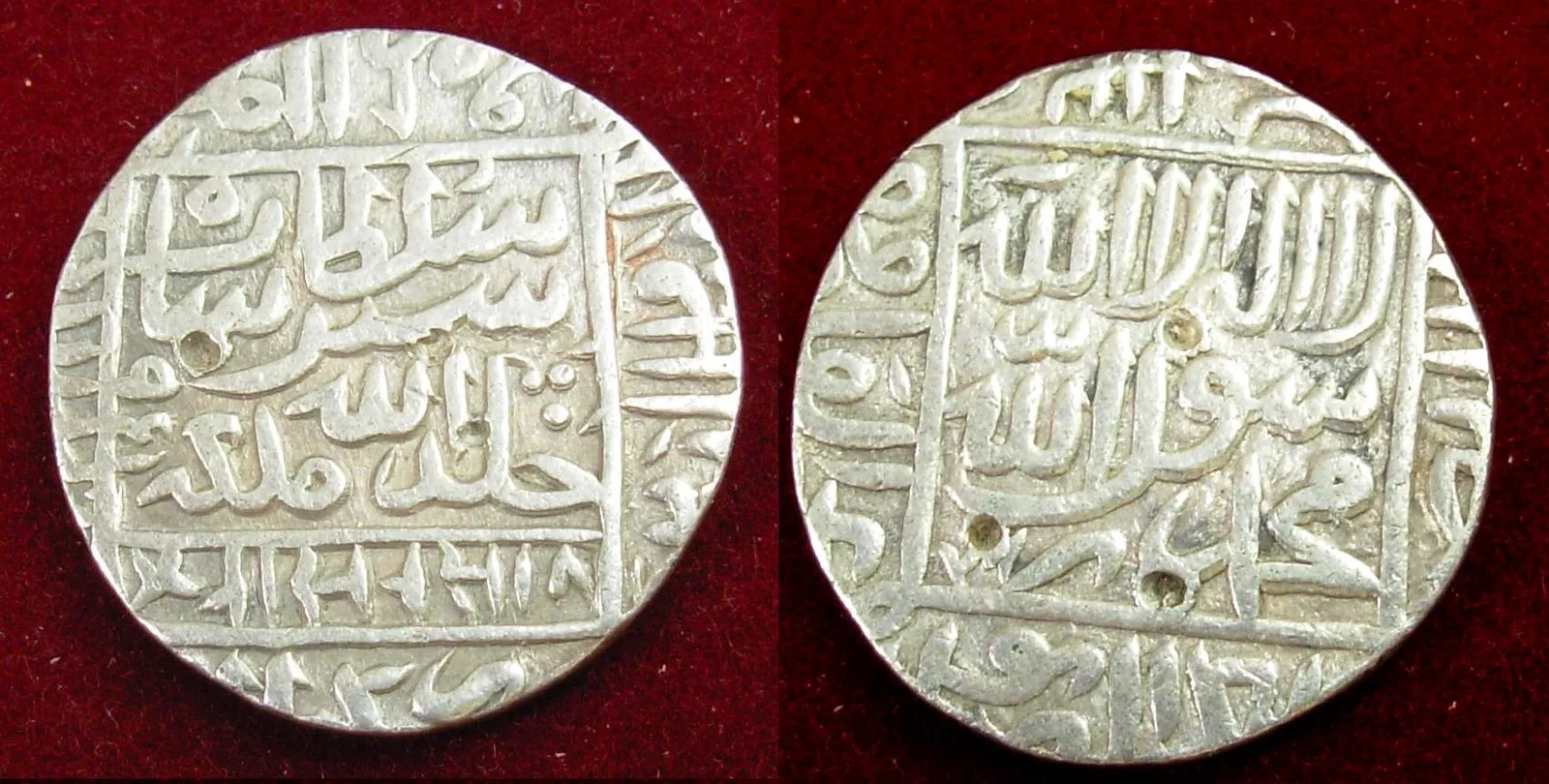
The rupee is called the rupee because the word comes from the Sanskrit rūpya, meaning "wrought silver" or "stamped silver", itself from rūpa, "shape, form or image". The name stuck to a standard silver coin, the rupiya, that Sher Shah Suri issued in the 1540s, and that coin's weight and name carried through the Mughal Empire, the East India Company and the Raj to the currency India uses today.
So the rupee began as a description: a piece of silver given a fixed shape and a stamp you could trust. Five centuries later, the coin no longer contains any silver, but the idea in its name, money that carries an authority's mark, is exactly what a modern currency is.
A word for stamped silver
Silver coins circulated in India long before anyone called them rupees. Punch-marked silver pieces were in use more than two thousand years ago, and the Delhi Sultans struck silver tankas. Sanskrit texts already used rūpya for silver, and the related sense of an "impression" or "image" fits the way coins were made: metal of a known weight, marked by an issuer.
What changed in the 16th century was that the word became the name of one standard coin. Numismatist Shailendra Bhandare of the Ashmolean Museum, Oxford, writes in A Silvered Past: The Origins and Outreach of the Rupee that North India under the Lodis was full of debased coins called Bahlulis. Sher Shah Suri, the Afghan ruler who briefly pushed the Mughal emperor Humayun out of India and ruled from 1540 to 1545, cleaned this up.
Sher Shah Suri's coin reform
Sher Shah organised his coinage around two main pieces: a silver rupiya weighing about one tola, or 11.66 grams (roughly 178 grains), and a copper dam of about 20 grams, with 40 dams to the rupee. He also struck gold mohurs. Mints were set up across his territory, and the state took and made payments in coin, which gave the new money steady demand. The Mumbai museum CSMVS describes the rupiya as the coin whose name, from the Sanskrit for a piece of silver, survives in today's currency.
His dynasty did not last, but his money did. When the Mughals returned, Akbar (ruled 1556 to 1605) kept Sher Shah's standards rather than reviving Central Asian coin types, and the word "rupiyah" appears on some rare Akbar coins. From Kabul to Chittagong, Mughal mints turned out rupees of consistent weight and purity, and that consistency made the coin trusted in markets far beyond the empire's borders.
How European silver became Indian rupees
The rupee's spread had a lot to do with trade. In the 17th century the British, Dutch, Danish and French East India Companies brought huge amounts of silver, much of it mined in Spanish America, to pay for Indian textiles, gems and spices. The same hunger for Malabar spice explains why black pepper was called black gold. That foreign silver had to be minted into Mughal rupees before it could be spent in India, so the inflow of bullion kept the rupee in plentiful supply.
The Companies then carried the trusted Mughal rupee into territories they controlled, from Ceylon (now Sri Lanka) to the Dutch East Indies. That is a big reason why currencies named after the rupee spread around the Indian Ocean.
One rupee for British India
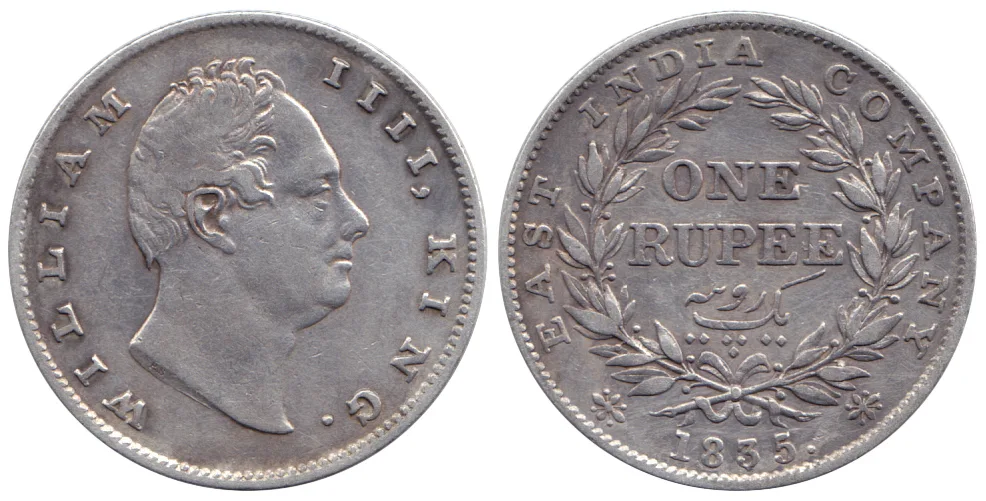
As Mughal authority faded, dozens of mints were striking rupees of slightly different weights and finenesses, and money changers profited from the confusion. The East India Company's Coinage Act of 1835 ended that by creating a single Company's rupee of 180 grains, 165 of them pure silver, bearing the head of King William IV. The date 1835 stayed on the coin through 1840, and the uniform rupee continued under Queen Victoria after the Crown took over in 1858.
For more than a century, the rupee was divided in a way older Indians still remember: 1 rupee = 16 annas, 1 anna = 4 pice, 1 pice = 3 pies, so a rupee held 192 pies. The Reserve Bank of India's coin history notes that independent India kept this system at first. The first coins of the Republic, issued on 15 August 1950, swapped the King's portrait for the Ashoka Lion Capital but still counted in annas.
Going decimal: naye paise
The Indian Coinage (Amendment) Act, 1955 divided the rupee into 100 units, and the change took effect on 1 April 1957. The rupee kept its name and value. To help the public tell old coins from new, the hundredth was called the naya paisa ("new paisa"), and old and new coins circulated side by side for a few years. Prime Minister Jawaharlal Nehru described the switch as "a silent but far-reaching revolution". On 1 June 1964 the word "naya" was dropped, and the coin became simply the paisa.
The silver went too. By the time of the Republic the rupee coin was nickel, and stainless steel one-rupee coins arrived in 1992. Today's rupee contains no silver at all, so the "wrought silver" in its name is pure history.
The rupee abroad
The rupee was once legal tender well beyond India. Bahrain, Kuwait, Qatar, the Trucial States (now the UAE) and parts of Oman used Indian rupees for much of the 20th century. By the late 1950s, smugglers were taking Indian notes to the Gulf to finance gold imports and converting them into sterling, draining India's reserves. The fix, according to the RBI's Monetary Museum, was a separate "Gulf rupee" issued from 1959, with the same design in different colours and a "Z" prefix, redeemable only in Bombay. Kuwait moved to its own dinar in 1961, and after India devalued the rupee in June 1966, Qatar and Dubai switched to a new riyal later that year.
The name lives on elsewhere. Pakistan, Nepal, Sri Lanka, Mauritius and the Seychelles all use rupees, and Indonesia's rupiah shares the same root. That crowding was one reason India wanted a symbol of its own.
Where the ₹ sign came from
On 15 July 2010 the Union Cabinet approved a symbol for the Indian rupee. It was chosen through a public competition that drew more than 3,000 entries, judged anonymously by a jury headed by an RBI Deputy Governor. The winning design was by D. Udaya Kumar, a postgraduate in design from IIT Bombay. The government's National Portal explains that ₹ blends the Devanagari letter र (ra) with the Roman capital R, and its two horizontal lines at the top represent the national flag and an "equal to" sign.
A symbol only works if every keyboard and screen can show it, so the next step was technical. The sign was encoded as U+20B9 in Unicode 6.0 later in 2010, which is why Unicode now lets ₹ appear the same way on any phone or website.
How many rupees are out there today
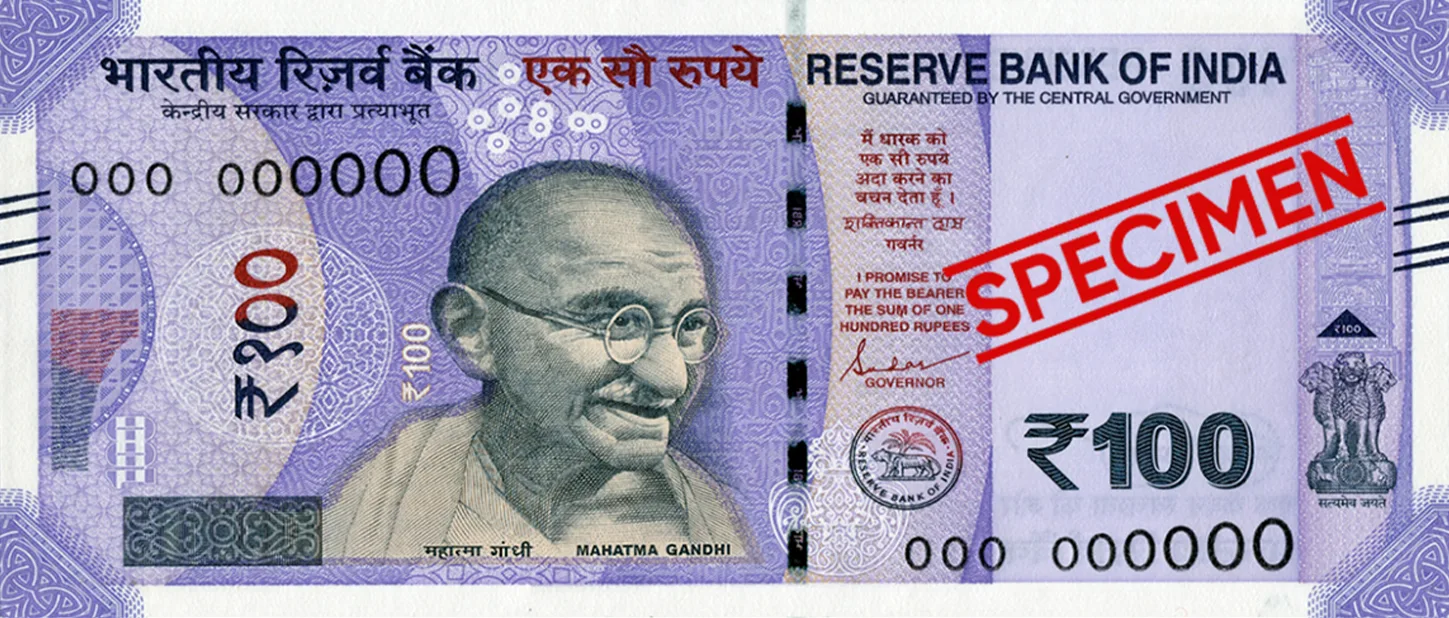
The rupee is now one of the most handled currencies on earth. According to the RBI Annual Report 2025–26, banknotes in circulation at the end of March 2026 were worth ₹41,23,995 crore (about ₹41.2 lakh crore), up 11.9% in a year, and numbered roughly 17,132 crore notes, up 10.5%. The ₹500 note dominates: it makes up 41.2% of notes by number and 85.5% by value, followed in volume by the humble ₹10. Of the ₹3.56 lakh crore in ₹2,000 notes outstanding when their withdrawal was announced in May 2023, 98.45% had come back by March 2026.
There is also a digital version. The RBI's retail e-rupee, a central bank digital currency, stood at about ₹772 crore at end-March 2026 according to the same report's balance sheet, small next to cash and next to the billions of UPI payments Indians make each month.
Comparing what those rupees buy in other countries is the job of tools like the Big Mac Index. But the name on every note still points back to a 16th-century idea: a piece of metal shaped and stamped by an authority, so that strangers could trust it.
The short version
- Rupee comes from the Sanskrit rūpya, "wrought" or "stamped" silver, from rūpa, "form".
- Sher Shah Suri standardised the silver rupiya of about 11.66 g in the 1540s; Akbar and the Mughals kept it.
- European trade silver and the East India Companies spread it across the Indian Ocean; the 1835 Coinage Act made one uniform rupee.
- India went decimal on 1 April 1957, dropped "naye" from paise in 1964, and adopted the ₹ sign on 15 July 2010.