Where Did the Number Zero Come From?
Babylon had a placeholder, the Maya had a glyph, but India turned zero into a number with its own rules. Here is how a dot on birch bark became the digit the whole world counts with.
 By Sushant Kataria· 9 min read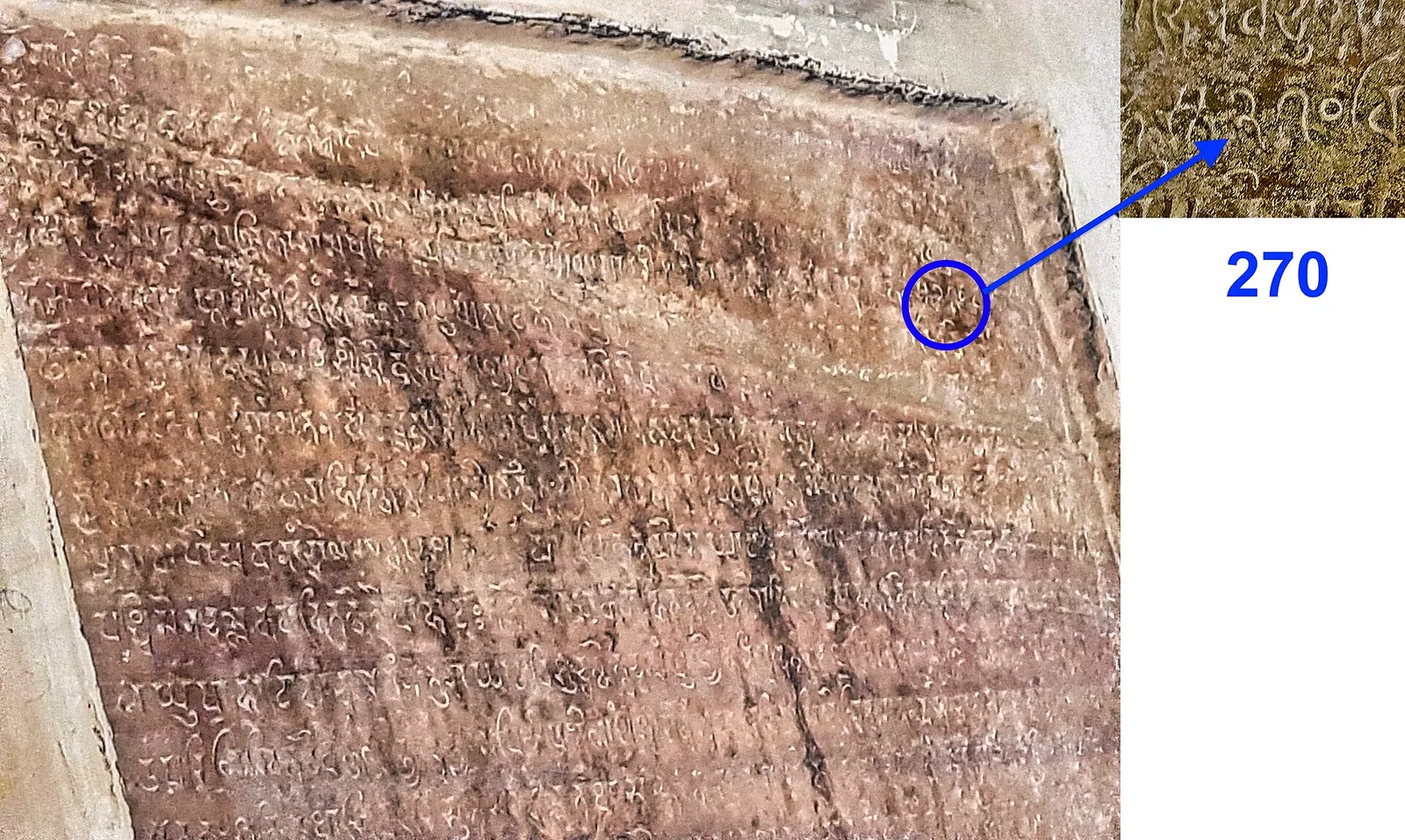
The number zero as we use it today came from India: Indian mathematicians first used a dot as a placeholder in a base-ten place-value system, and in 628 CE Brahmagupta wrote the first rules for calculating with zero as a number in its own right. Arab scholars such as al-Khwarizmi then spread these "Hindu numerals" across the Islamic world, and Fibonacci's Liber Abaci of 1202 carried them into Europe.
That is the short answer. The longer story runs from clay tablets in Mesopotamia to temple walls in Madhya Pradesh, the libraries of Baghdad and the counting houses of Pisa. It is one of the most important journeys any idea has ever made, and it is the reason the digits on your phone screen, your bank statement and every price tag look the way they do.
Counting without zero
Every early civilisation could count, but writing large numbers was clumsy. Egyptian hieroglyphs, the script whose secrets were unlocked when the Rosetta Stone was decoded, used a separate sign for 1, 10, 100, 1,000 and so on, repeated as many times as needed. Writing 999 took 27 symbols. Roman numerals worked on a similar additive principle: MMXXVI is simply 1,000 + 1,000 + 10 + 10 + 5 + 1.
Systems like these have no need for zero, because nothing depends on position. The symbol for ten means ten wherever it sits. The trouble is that they are terrible for arithmetic. Try multiplying CCCXLVII by XXIX on paper and you will understand why Roman merchants did their sums on a counting board or abacus and wrote down only the answers.
Babylon's placeholder
The first great step came from Mesopotamia. From about 2000 BCE, Babylonian scribes used a place-value system in base 60, the system that still gives us 60 minutes in an hour and 360 degrees in a circle. A wedge-shaped symbol could mean 1, 60 or 3,600 depending on its position.
Place value creates a new problem, though: how do you show an empty position? For centuries, Babylonian scribes simply left a gap, which made numbers such as 61 and 3,601 easy to confuse. By around the 4th century BCE, in the Seleucid period, they began writing a special sign of two slanted wedges to mark the empty place.
It was a genuine placeholder, but it was not yet a number. Scribes did not use it at the end of a number, so context still had to tell you whether a figure meant 2 or 120, and nobody added, subtracted or multiplied with it. Greek astronomers, including Ptolemy in the 2nd century CE, later used a small circle in their tables of angles, but Greek mathematics never treated "nothing" as a quantity. Far away, the Maya of Central America independently invented a zero glyph, often drawn as a shell, for their calendar and base-20 counting. Their brilliant system stayed in the Americas, however, and played no part in the digits the world uses now.
India puts zero to work
The decisive leap happened in India, where three ingredients came together: a base-ten system, place value, and a mark for the empty place that could be calculated with.
Indian scholars had used words for large powers of ten since the Vedic period, and a placeholder idea was built into the language. The Sanskrit word for zero is shunya, meaning empty or void, a term with deep roots in Indian philosophy. A Jain cosmological text, the Lokavibhaga, dated to 458 CE, already expresses numbers in place-value order using number words, including shunya for the empty places.
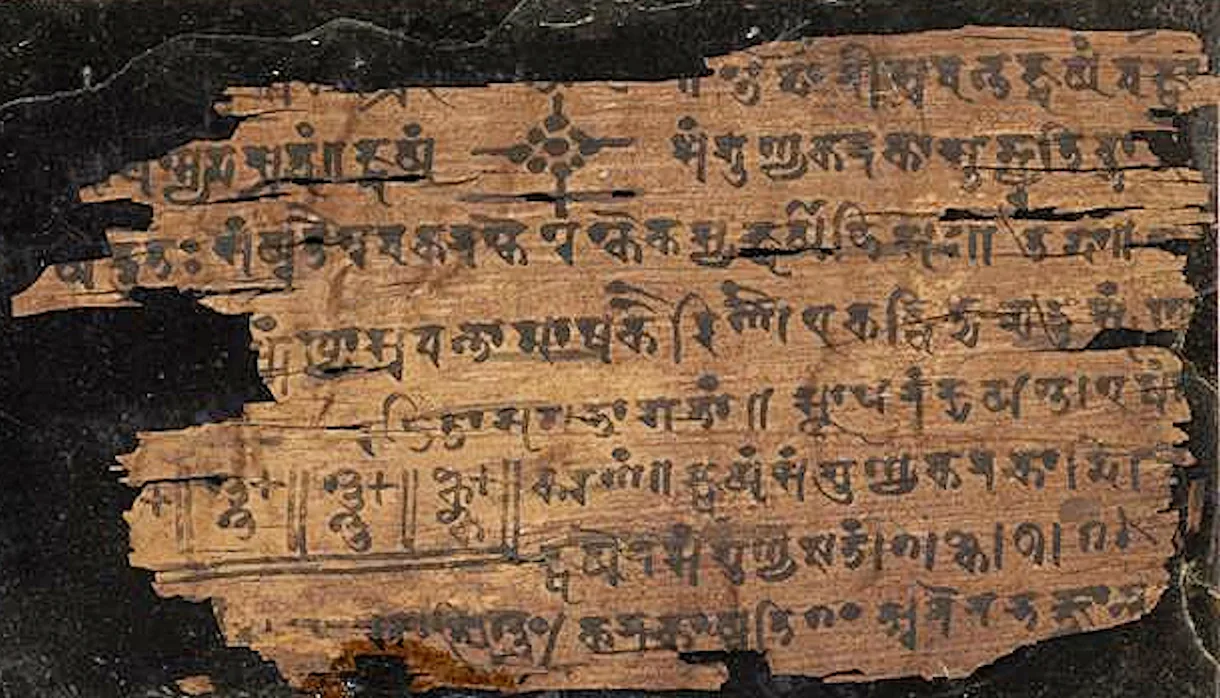
The most famous physical evidence is the Bakhshali manuscript, a mathematical text written on 70 leaves of birch bark and dug up by a farmer in 1881 in the village of Bakhshali, near Peshawar in present-day Pakistan. It is full of numbers that use a solid dot for the empty place. In 2017, radiocarbon dating commissioned by Oxford's Bodleian Library found that its leaves come from several different periods, with the oldest dated to between 224 and 383 CE. The dating is still debated, because the leaves span centuries, but the manuscript shows the dot placeholder in everyday mathematical use in the region of the northwest subcontinent.
Around 499 CE, the astronomer Aryabhata, working near Kusumapura (modern Patna), wrote the Aryabhatiya. He used his own alphabetic code for numbers rather than digits, but he stated the place-value principle plainly: each place is ten times the one before it. That principle, combined with a mark for the empty place, is the engine of all modern arithmetic.
Brahmagupta's rules
The man who turned zero into a true number was Brahmagupta, an astronomer from Bhillamala (today's Bhinmal in Rajasthan). In 628 CE, aged about 30, he completed the Brahmasphutasiddhanta, a treatise on astronomy and mathematics written in Sanskrit verse.
In it he did something nobody had done before: he set out rules for calculating with zero, alongside rules for positive "fortunes" and negative "debts". Among them:
- A number plus zero is that number, and a number minus zero is that number.
- Zero minus a positive number gives a negative number.
- Zero minus zero is zero.
- Any number multiplied by zero is zero.
Brahmagupta also tackled division and got it partly wrong. He declared that zero divided by zero equals zero, and left a number divided by zero as a fraction with zero below the line. Mathematicians are still careful with division by zero today, and later Indian scholars kept refining the idea. In the 12th century, Bhaskara II argued in his Lilavati and Bijaganita that a number divided by zero becomes an infinite quantity.
The important point is that zero was no longer a gap. It was a number with properties, something you could put into an equation. That shift made algebra, negative numbers and, much later, calculus possible.
Written zeros soon appeared in stone as well. An inscription at the Chaturbhuj Temple in Gwalior Fort, dated 876 CE, records the size of a temple garden as 270 hastas and an offering of 50 garlands, with both zeros carved as small circles. It is among the oldest surviving zeros of this shape anywhere, and it still sits on the temple wall in Madhya Pradesh. Even older dot zeros survive in 7th century inscriptions from Cambodia and Sumatra, showing that the Indian system had already travelled across Southeast Asia with traders and priests.
Through Baghdad and the Islamic world
Indian numerals reached the Islamic world in the 8th century. Around the 770s, an Indian astronomer visited the Abbasid court of Caliph al-Mansur in Baghdad, and a version of Brahmagupta's work was translated into Arabic as the Sindhind. These ideas moved along the same overland and maritime networks described in our story on why the Silk Road was never really a road, where paper, spices and knowledge travelled together.
The key figure was Muhammad ibn Musa al-Khwarizmi, a scholar at Baghdad's House of Wisdom. Around 825 CE he wrote a book on calculating with Indian numerals. The Arabic original is lost, but a Latin translation survives, beginning Dixit Algorizmi ("Thus spoke al-Khwarizmi"). His Latinised name gave us the word algorithm, and the title of another of his books, on al-jabr, gave us algebra.
Arab writers openly called the system al-arqam al-hindiyya, the Hindu numerals, and scholars such as al-Uqlidisi in the 10th century showed how to do the sums with pen and paper instead of a dust board. The Arabic word for zero was sifr, meaning empty, a direct translation of shunya.
Fibonacci brings the digits to Europe
Europe met the new numerals slowly. A Spanish manuscript, the Codex Vigilanus of 976 CE, contains the first nine digits, and the scholar Gerbert of Aurillac, who became Pope Sylvester II in 999, used them on counting boards. Neither included zero, and neither changed daily practice.
The breakthrough came from trade. Leonardo of Pisa, later nicknamed Fibonacci, grew up partly in Bugia (modern Béjaïa in Algeria), where his father managed a trading post for Pisan merchants. There he learned the "Indian method" of calculation from local teachers, and he later studied it across the Mediterranean.
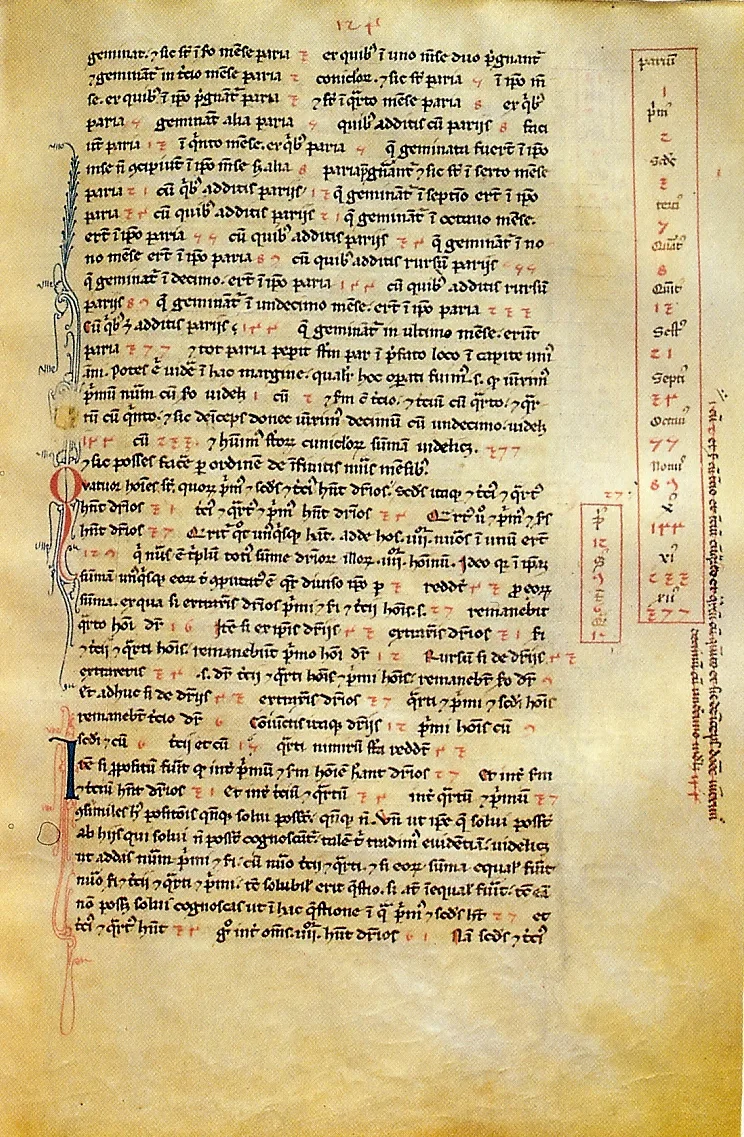
In 1202 he published the Liber Abaci (Book of Calculation). Its opening chapter states that the nine Indian figures, together with the sign 0, "which in Arabic is called zephirum", can write any number at all. The rest of the book shows merchants how to use them for profit and loss, currency exchange, interest and weights and measures. It is also where Europe first met the sequence that now bears Fibonacci's name.
Adoption still took centuries. In 1299, Florence's bankers' guild barred its members from using the new numerals in account books, partly because a 0 could easily be altered into a 6 or a 9. Counting boards and Roman numerals lingered until printing in the 15th and 16th centuries made the Hindu-Arabic digits standard. Zephirum became the Italian zefiro, then zero, while sifr also gave English the word cipher.
Why are they called "Arabic" numerals?
Europeans called the digits "Arabic" simply because they learned them from Arabic books and Arabic-speaking teachers in Spain, Sicily and North Africa. The scholars who passed them on never claimed to have invented them, and in much of the Arab world today the related Eastern digits are still called Hindi numerals. Historians now use the fairer name Hindu-Arabic numerals, which credits both the Indian origin and the Islamic world's role in refining and spreading them.
What zero means now
It is hard to overstate how much rests on that small circle. Place value with zero lets ten symbols express any number, from the price on a menu (and the curious habit of ending prices in 99) to the distance to a galaxy. Zero is the origin point of every graph, the reference mark on every thermometer scale and the boundary between positive and negative.
It also sits at the heart of computing. Every digital device runs on binary, strings of 0s and 1s, so every photo, message and payment depends on the idea Brahmagupta wrote down in Rajasthan almost 1,400 years ago.
India takes justified pride in that legacy. Aryabhata's name went into orbit on the country's first satellite in 1975, and the story of shunya is now taught in schools across the country as a reminder that one of humanity's most powerful ideas began as a dot on birch bark and a few lines of Sanskrit verse, then travelled the trade routes until the whole world counted the same way.