Where Did Samosas Come From?
India's favourite snack started life as a Persian and Central Asian pastry, reached Delhi's royal kitchens about 700 years ago and picked up its potato filling much later.
 By Kirti Kaliraman· 8 min read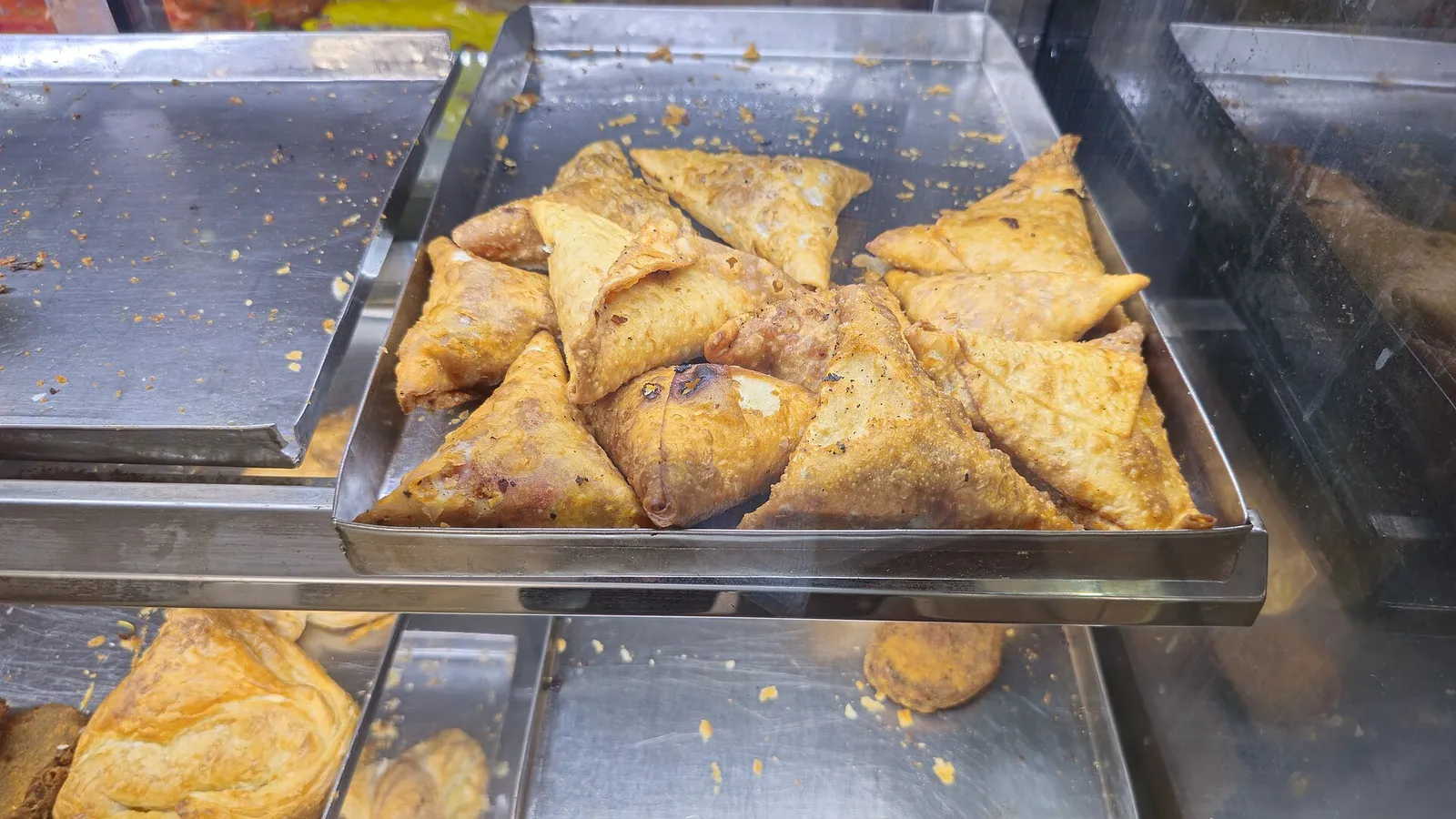
Samosas came from the Middle East and Central Asia: the name goes back to the Middle Persian sanbosag, meaning a triangular pastry, and cooks from Persia and Central Asia brought the dish to India in the 13th and 14th centuries, when they worked in the royal kitchens of the Delhi Sultanate. The potato filling most of us picture came much later, after the potato itself arrived from the Americas.
So the samosa is both foreign and deeply Indian. It began as a meat-filled snack for sultans and nobles, crossed into everyday street food, and was reinvented so thoroughly here that much of the world now thinks of it as India's signature snack. Here is how a Persian pastry became the thing you eat with chai at 5 pm.
A Persian name for a triangle
The word tells the first part of the story. English samosa comes from Hindustani samosa, which traces back to Middle Persian sanbosag. Medieval Arabic cookbooks borrowed the Persian word as sanbusak, sanbusaq and sanbusaj, and the same root lives on in Central Asian samsa, East African sambusa and Portuguese chamuça.
The earliest written traces come from the Abbasid world. The poet Ishaq al-Mawsili, who lived at the Baghdad court in the late 8th and early 9th centuries, wrote verses praising sanbusaj. A 10th century Arabic cookbook, the Kitab al-Tabikh, includes recipes for it, and the Persian historian Abu'l-Fadl Bayhaqi (995 to 1077) mentions it in his chronicle of the Ghaznavid court. Food historians such as Maxime Rodinson and Charles Perry, who edited the standard collection Medieval Arab Cookery, found the pastry under these names across 10th to 13th century Arab recipe books.
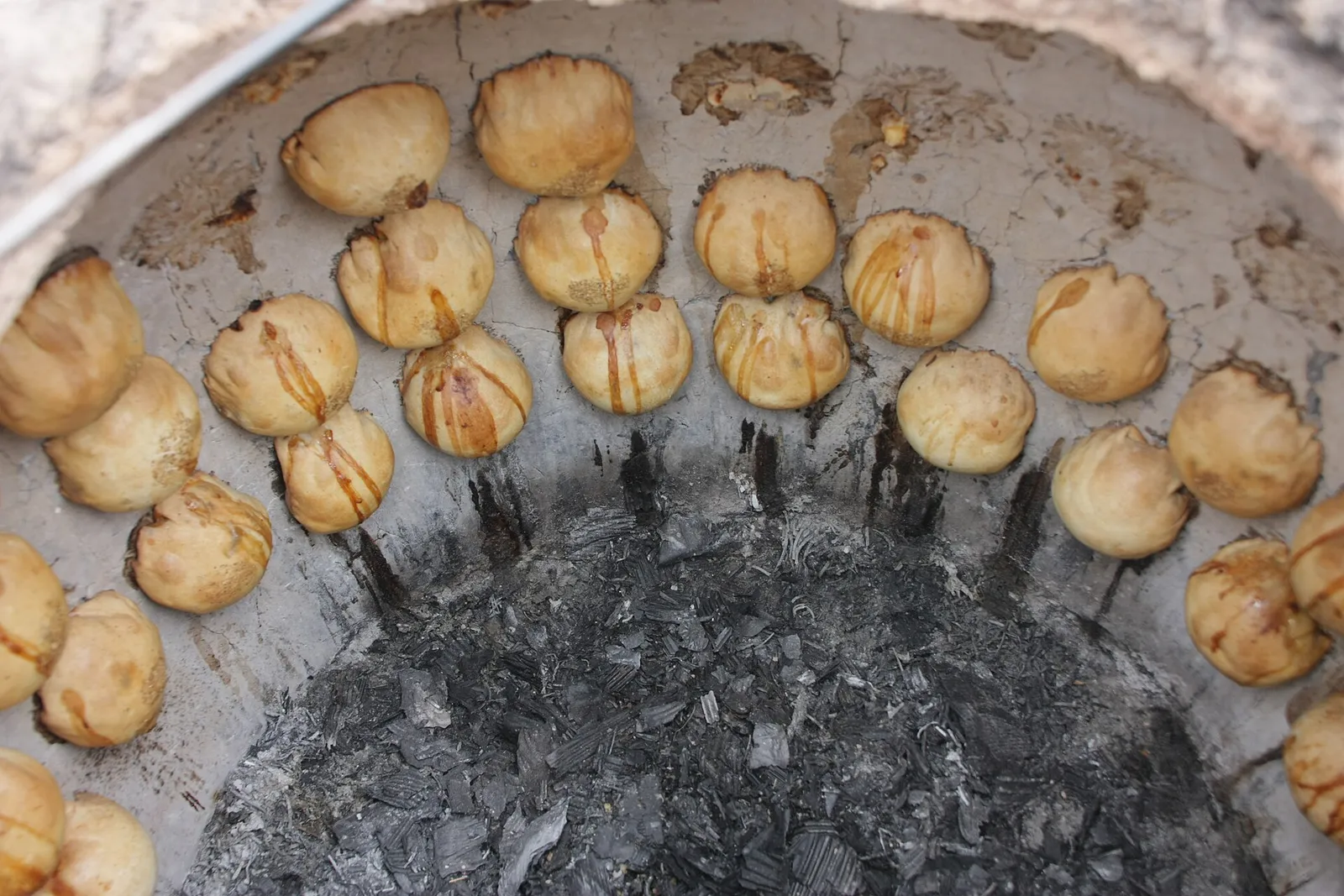
Those early versions were often baked rather than deep fried, and they were filled with minced meat, nuts and spices. In Iran the dish stayed popular until roughly the 16th century, then faded to a regional speciality. In Central Asia it survived as the samsa, still baked today against the hot clay walls of a tandoor.
How the samosa reached India
The samosa did not arrive alone. It came with people: soldiers, merchants, scholars and, above all, cooks moving along the overland routes we describe in why the Silk Road was never really a road. When the Delhi Sultanate took shape in the 13th century, its rulers and nobles had roots in Central Asia and the Persian-speaking world, and they hired chefs who knew those cuisines.
The first clear Indian mention comes from Amir Khusrau (1253 to 1325), the poet and scholar of the Delhi court. Writing around 1300, he described the princes and nobles enjoying a samosa "prepared from meat, ghee, onion, and so on." Here the dish is already fried in ghee, which suited the Indian kitchen.
A generation later, the Moroccan traveller Ibn Battuta served as a judge at the court of Sultan Muhammad bin Tughluq in Delhi and wrote down the menu of a royal meal. After dishes of meat cooked in ghee with onion and green ginger, he recorded, came the samushak: minced meat cooked with almonds, walnuts, pistachios, onion and spices, wrapped in a thin bread and fried in ghee, with four or five placed in front of every guest. They were served before the pulao course. This was luxury food, rich with nuts and imported spice.
Eight samosas for the Sultan of Mandu
The best evidence that the samosa had settled into Indian cooking comes from central India. The Ni'matnama-i Nasirshahi, or "Book of Delights," is a Persian cookbook written for Ghiyath al-Din Khilji, Sultan of Malwa from 1469 to 1500, at his capital Mandu, and completed under his son Nasir Shah. The only known copy is now in the British Library in London, which holds it because the East India Company acquired it after the fall of Tipu Sultan's capital, Seringapatam, in 1799.
The manuscript has about 50 paintings, and one of them shows samosas being prepared, with the word sanbusa written beside them. The recipes are just as revealing. Historians who have studied the text count eight different samosa recipes, with fillings such as minced meat, venison, dried milk scented with rose water, wheat cooked in ghee and sweet versions with spiced cream and coconut. Ginger, cardamom and cloves from Indian markets sit alongside Persian cumin and qeema.
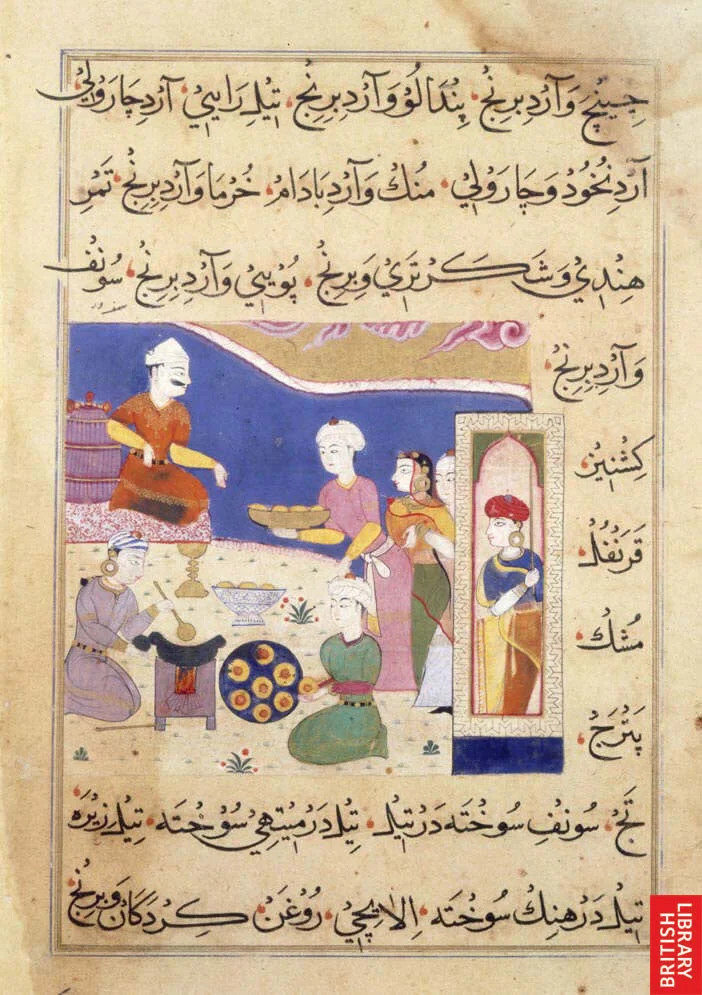
Not one of those eight recipes uses potato. That is not an oversight. The potato had not yet reached India.
The Mughal court kept the dish. The Ain-i-Akbari, the record of Emperor Akbar's administration compiled by Abu'l-Fazl in the 1590s, gives a recipe for qutab, "which the people of Hindustan call sanbusah." It lists meat, flour, ghee, onions, fresh ginger, pepper, coriander seed, cardamom, cumin, cloves and sumac, and notes that it "can be cooked in 20 different ways."
When the potato took over
The potato is an Andean crop, carried to Europe by the Spanish in the 16th century and then around the world by European ships. Its arrival in India is hard to date precisely. The earliest written mention usually cited is by Edward Terry, chaplain to the English ambassador Sir Thomas Roe, who reported "potatoes excellently well dressed" at a banquet given by the Mughal noble Asaf Khan at Ajmer in 1615. Historians such as Irfan Habib have argued that this may have been the sweet potato. By 1675 the traveller John Fryer found potatoes growing in gardens at Surat and in Karnataka, and in Goa the tuber was known as batata Surrata, the potato of Surat.
For a long time it stayed a minor garden vegetable. Large-scale cultivation spread under British rule in the 19th century, in Bengal and the northern hills first. Once potatoes became cheap and common, they transformed the samosa. A spiced potato filling, usually with peas, cumin, coriander and green chilli, was meat-free, filling and inexpensive, which made the samosa a snack for everyone rather than a delicacy for the court. The green chilli in that mix is a New World arrival too, as we explain in how chillies reached Indian cooking.
Today India grows potatoes on a vast scale. The Ministry of Agriculture's second advance estimates for 2024 to 25 put production at a record 60.18 million tonnes, up about 3.1 million tonnes on the year before. A good share of that ends up folded into pastry and fried in kadhais across the country.
One snack, many shapes
As it spread, the samosa took on regional forms. A few of the best known:
- Punjabi samosa: large, cone-shaped and stuffed with spiced potato and peas, the version sold in most of north India and abroad.
- Singara or shingara: the smaller eastern version eaten in West Bengal, Odisha, Bihar, Assam and Bangladesh, often with potato, peanuts and sometimes raisins. Its name comes from singhara, the water chestnut, whose sharply pointed fruit it resembles.
- Lukhmi: Hyderabad's smaller, thicker-crusted version filled with minced meat.
- Chamuça: the Goan and Portuguese version, often filled with chicken, beef or pork.
- Kaghazi samosa: a paper-thin, crisp variety associated with Karachi.
The same family keeps going outside South Asia. Somali sambuus, Burmese samuza (sometimes chopped into a salad called samuza thoke), Middle Eastern sambousek and the South African samoosa all share the name. Indian traders and workers who settled in East Africa, Southeast Asia and later Britain and North America spread the fried, potato-filled style worldwide. Wrapping a filling in dough is such a universal kitchen idea that the samosa belongs to a much bigger global family, the one we trace in why every cuisine has a dumpling.
The samosa and the "oil board" debate
The samosa is so central to Indian eating that it makes news. In June 2025 the Union Health Ministry asked government departments to display "Oil and Sugar Boards" in canteens, lobbies and meeting rooms, as part of its programme against obesity, diabetes and other non-communicable diseases. A sample oil board attached to the advisory listed one samosa (100 g) at about 17 g of fat, alongside items such as vada pav, kachori, pizza and French fries.
Headlines soon claimed that samosas and jalebis would carry cigarette-style warning labels. On 15 July 2025 the ministry issued a clarification through the Press Information Bureau calling those reports "misleading, incorrect, and baseless." The advisory, it said, was a general behavioural nudge about hidden fats and sugar in all foods, did not direct warning labels on food sold by vendors and "does not target India's rich street food culture."
The episode showed how personal the samosa is. It is a snack, but it is also a shared ritual: the office tea break, the railway platform, the monsoon evening, the party plate.
What the samosa tells us
Follow one samosa back in time and you cross most of Asian history. A Persian name, Abbasid cookbooks, Central Asian bakers, Delhi sultans, a painted manuscript from Mandu, a Mughal recipe list, an American tuber carried on European ships and a British-era farming boom all sit inside that triangle of pastry.
That is the pattern of Indian food more broadly. Ingredients and ideas arrived from elsewhere, and Indian cooks absorbed them so completely that they now feel native. The samosa did not begin in India. It became Indian, and then it went back out into the world as one of India's best-known foods.