Why Is the Keyboard in QWERTY Order?
The QWERTY keyboard was not built to slow typists down. Its odd letter order grew out of an 1870s typewriter, telegraph operators' feedback and a patent workaround, and it survived because everyone had already learned it. Here is the real story, from Milwaukee to Godrej's typewriter factory.
 By Sushant Kataria· 7 min read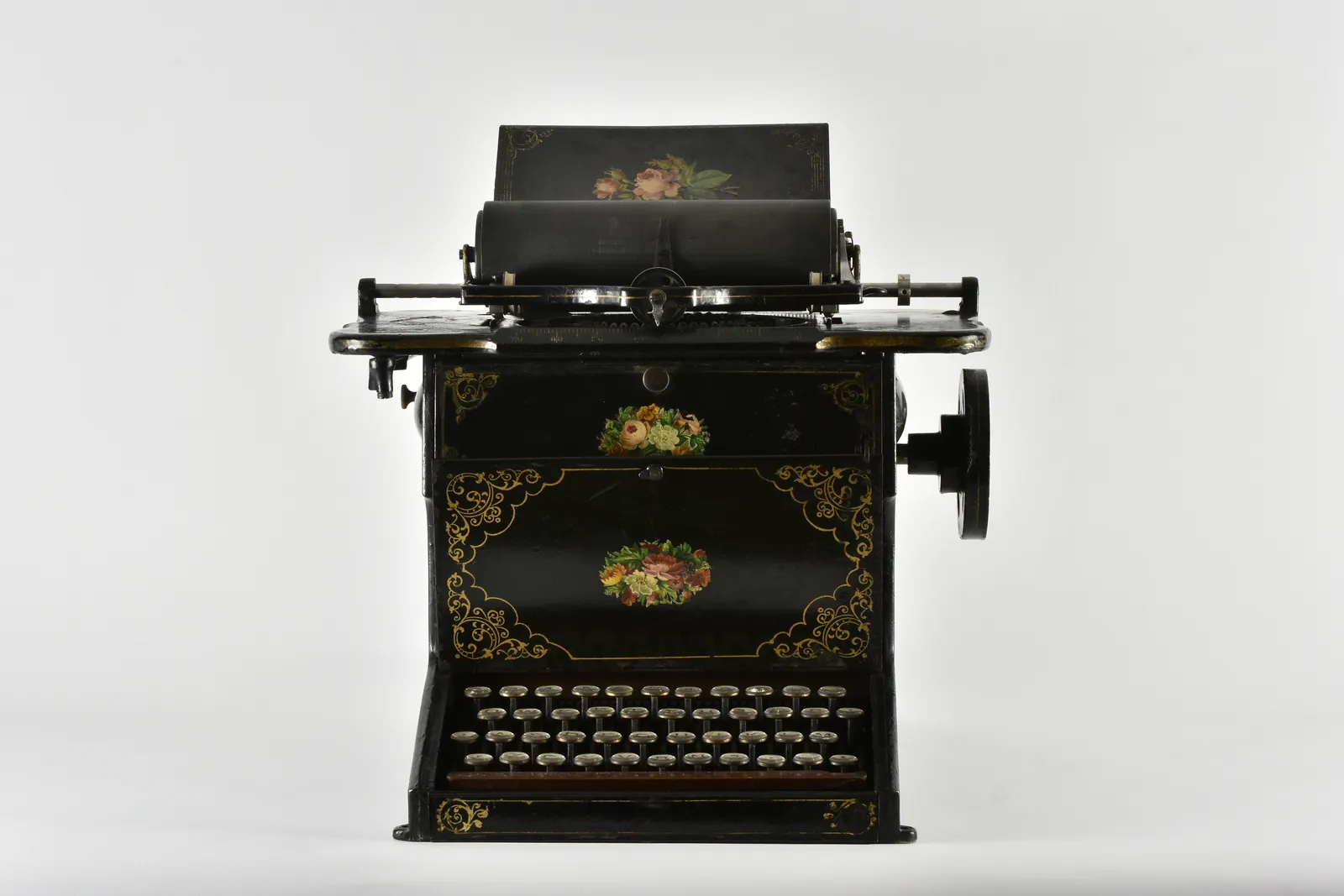
Keyboards are in QWERTY order because that is the layout of the Sholes and Glidden typewriter, which E. Remington and Sons put on sale in 1874, and every keyboard since has copied it so that typists would not have to relearn. The arrangement was shaped by the needs of telegraph operators, the mechanics of the machine and a later patent dodge, not by any plan to make people type slowly.
The name simply comes from the first six letters on the top row: Q, W, E, R, T and Y. Once offices, typing schools and manufacturers had all standardised on it, switching became more expensive than living with its quirks, and that is still true on the laptop or phone in front of you.
A printer's machine in Milwaukee
The story starts with Christopher Latham Sholes, a printer and newspaper editor in Milwaukee, Wisconsin. With his friends Carlos Glidden and Samuel W. Soulé he patented a writing machine in 1868, backed financially by James Densmore. The first version looked nothing like a modern keyboard. It had a piano-style row of keys with the letters in alphabetical order, A to N running one way and O to Z running back the other.
According to the detailed reconstruction by Kyoto University researchers Koichi and Motoko Yasuoka, published as On the Prehistory of QWERTY in 2011, the first Type-Writer left Milwaukee in November 1868. Its first customer was Edward Payson Porter, who ran Porter's Telegraph College in Chicago. That detail turns out to matter more than any other.
The telegraph connection
In the 1860s the people who most needed to type fast were telegraph operators. They listened to incoming Morse code and had to transcribe it as it arrived, at the speed of the sender, with no chance to ask for a repeat. Porter and other operators tested Sholes's machines and asked for changes, including numerals and punctuation. By April 1870 Sholes had a four-row machine with 38 keys.
The Yasuokas argue that operators' needs explain several of QWERTY's odd pairings. In American Morse, the code for Z could easily be mistaken for S followed by E, so a receiving clerk who was not yet sure which he had heard benefited from having Z, S and E close together. Not every typewriter historian accepts the Morse argument, but the broad point is now widely agreed: the layout was tuned for the working habits of telegraph clerks, the trade that laid the first telegraph lines across the seabed, long before today's undersea internet cables.
The jamming myth
The most popular explanation, repeated in countless classrooms, is that Sholes scattered common letters to slow typists down so the metal typebars would not jam. The Yasuokas call the "slow down the operator" idea flatly "nonsense", and the evidence backs them.
Typebar clashes were a real problem on early machines, and separating some frequent letter pairs did help. But that is the opposite of slowing anyone down. Spreading common pairs across both hands lets one hand reach for the next key while the other is still striking, which speeds typing up. Rival machines of the era also avoided clashing entirely with print wheels and type sleeves, so nothing about the technology forced QWERTY into existence. Like many tidy origin stories, including the one about why prices end in 99, the jamming legend is easier to repeat than to prove.
Another favourite claim is that Remington's salesmen wanted to type the words TYPE WRITER using only the top row, which is why R ended up there. It is a charming idea, and the letters do all sit on that row, but no document from the period confirms it.
Remington, the shift key and a patent workaround
In 1873 Densmore sold the manufacturing rights to E. Remington and Sons, a gun maker in Ilion, New York. Remington's mechanics adjusted the layout again, and the Sholes and Glidden Type-Writer went on sale in 1874. It typed only capital letters.
The real breakthrough was the Remington No. 2 of January 1878, which added a shift key so the same typebar could print a capital or a small letter. On 27 August 1878 Sholes received US Patent 207,559, whose drawing shows a layout almost identical to ours, apart from a few details: M sat at the end of the middle row, and C and X were swapped.
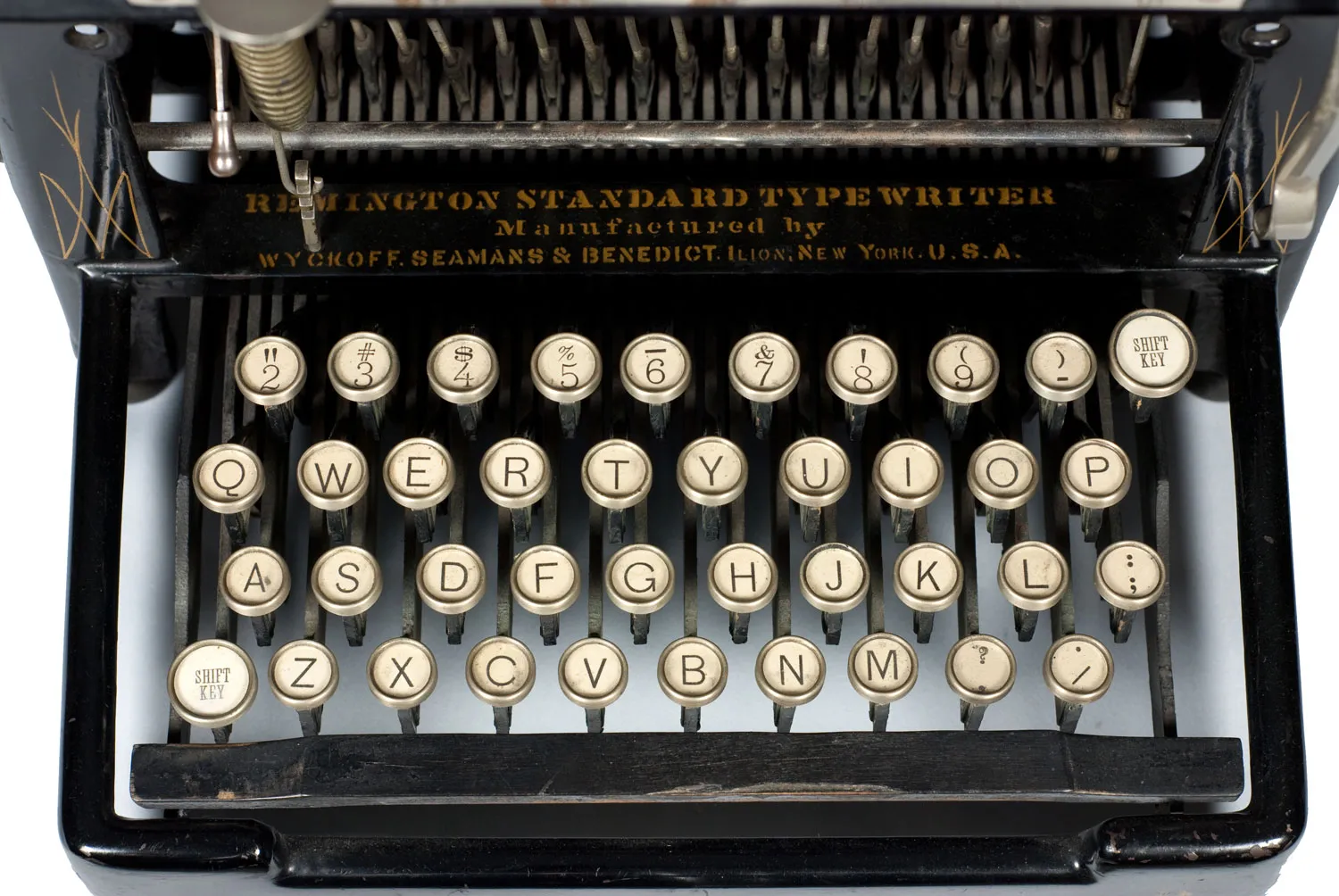
Those last two differences were fixed by the company that took over selling the machine, Wyckoff, Seamans and Benedict. The Yasuokas date the change to around 1882 and say it was made partly to steer clear of older patents. M moved down next to N and C changed places with X, and the result was the exact QWERTY layout on your keyboard today. In their words, there was "no consistent policy" behind it. The arrangement was changed "first to receive telegraphs, then to thrash out a compromise between inventors and producers, and at last to evade old patents."
Why nobody switched
Better layouts have been tried for a century. The best known is the Dvorak Simplified Keyboard, patented by August Dvorak and William L. Dealey on 12 May 1936. It puts all five vowels under the left hand's home row and the most common consonants, D, H, T, N and S, under the right, with the stated aim of fewer errors, more speed and less fatigue.
It never caught on. Economists still argue about why. Paul David's 1985 paper "Clio and the Economics of QWERTY" made the keyboard the textbook example of lock-in, where an early choice sticks because everyone has already invested in it. Stan Liebowitz and Stephen Margolis replied in 1990 with "The Fable of the Keys", arguing that the evidence for Dvorak's superiority was weak, and that the studies showing big gains were poorly controlled. Either way, the cost of retraining millions of typists was always higher than any proven benefit.
QWERTY also locked itself into computing. Teletype machines adopted it in the 1910s, those machines became the first computer terminals, and personal computers inherited their keyboards. Even the diagonal stagger of the keys is a fossil: it once kept each key's lever from hitting its neighbour, and it survives on keyboards that have no levers at all.
Local versions did appear. Germany uses QWERTZ, which swaps Z and Y because Z is far more common in German and pairs such as "tz" and "zu" are frequent. France and Belgium use AZERTY. But both are close cousins of the American original.
QWERTY in India
India's typing history ran on the same machines. In 1955 Godrej and Boyce produced the Godrej Prima, India's first indigenously made typewriter, and its launch was presented to Prime Minister Jawaharlal Nehru, who saw it as a symbol of independent India. During the 1990s the company made about 50,000 machines a year out of an Indian total of roughly 150,000, according to a 2011 Business Standard report.
Godrej was the last company in the world still making office typewriters when it stopped production in 2009, and its plant at Shirwal near Pune was converted to make refrigerators. When the news spread in 2011, the company had about 500 machines left, priced at ₹12,000, with courts, government offices and defence agencies as its main remaining buyers.
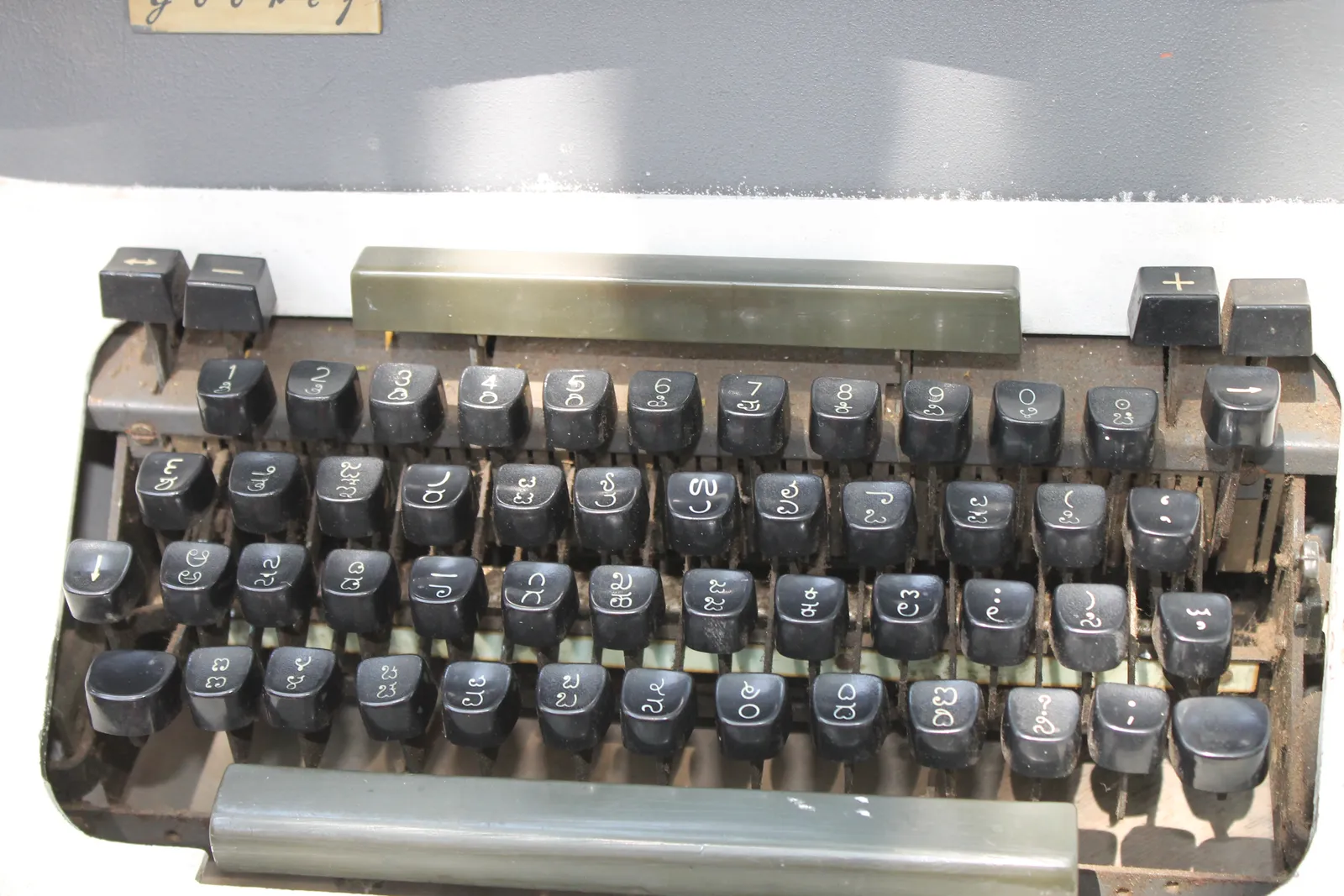
Indian scripts posed a problem that QWERTY was never designed for. Typewriters in Hindi, Kannada and other languages used their own layouts, the best known being the Remington Hindi arrangement. For computers, a committee of the Department of Electronics standardised the InScript keyboard in 1986, revised it in 1988 and folded it into the Bureau of Indian Standards' IS 13194 of 1991. InScript sits on top of the ordinary QWERTY keys, with vowels on the left and consonants on the right, and it follows the same logic that India's ISCII code later gave to Unicode.
That old typewriter legacy still decides careers. Since 1 December 2011 the Staff Selection Commission has used InScript (Modified) with the Mangal font for Hindi typing tests, and for its CHSL 2020 skill test it let candidates choose between InScript, Kruti Dev and two Remington layouts. English candidates simply pick "English (U.S)", the QWERTY layout, and type a passage of about 1,750 key depressions.
And the QWERTY habit is only growing. IDC reported that India shipped a record 15.9 million desktops, notebooks and workstations in 2025, up 10.2% and the first year above 15 million. Each of those keyboards, and the touchscreen keyboard on most Indian phones, starts with the same six letters a Milwaukee printer and a room of telegraph clerks settled on more than 150 years ago.