What Is Chikankari?
Chikankari is the hand embroidery of Lucknow: delicate, traditionally white-on-white needlework in more than 30 stitches, from shadowy bakhia to net-like jaali. Here is how it is made, who makes it, and how to tell the real thing from a machine copy.
 By Kirti Kaliraman· 10 min read
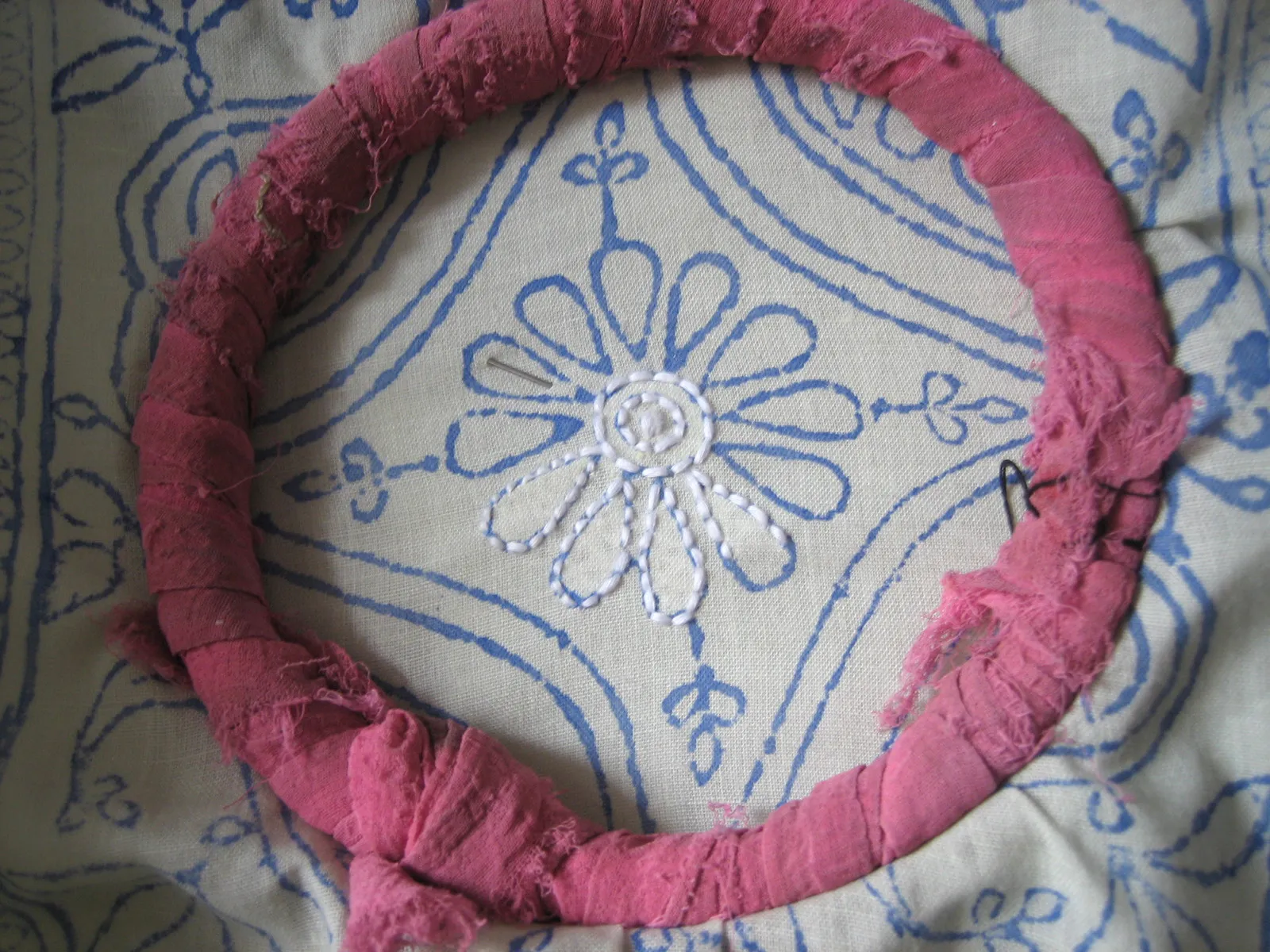
Chikankari is the traditional hand embroidery of Lucknow, in Uttar Pradesh: fine, delicate needlework, classically done in white thread on white muslin or cotton, using more than 30 named stitches. It is famous for its textures rather than its colours, from shadowy stitches worked on the back of sheer cloth to tiny raised knots and open, net-like jaali, and since 2008 "Lucknow Chikan Craft" has been a registered Geographical Indication of India.
That legal name matters because chikankari is everywhere now, on kurtas, saris, dupattas and even wedding wear sold far beyond Lucknow, and much of it is machine-made. Here is what the craft really is, where it came from, how a piece is made, and how to tell the hand-stitched original from a copy.
What makes chikankari different
Most Indian embroidery announces itself with colour, mirrors or metal thread. Chikankari does the opposite. The Impart encyclopedia of South Asian art describes it as intricate needlework in a variety of stitches, "traditionally using white thread applied on white cloth", and compares it to European whitework. The pattern appears as play of light: some areas look shaded, some raised, and some almost transparent.
Impart groups its 30-plus stitches into three families:
- Flat stitches, which lie on the surface or show through it, such as bakhia and the chain stitch zanjeera.
- Raised or embossed stitches, such as the grain-like murri and the small knotted phanda.
- Jaali work, in which the threads of the cloth itself are teased apart and held open with tiny stitches to make a mesh.
The base fabric was traditionally muslin, the fine hand-woven cotton for which Bengal and north India were famous, the same kind of cloth that dressed women in the sari for centuries. Today chikankari is also worked on voile, mulmul, georgette, chiffon, silk and even linen, and coloured or pastel threads have joined the classic white. The finished cloth is usually cut into kurtas, saris, dupattas, shirts and caps, and older pieces include bolster and cushion covers.
Where did chikankari come from?
The honest answer is that nobody knows exactly. Impart notes that even the origin of the word chikan is contested: scholars have traced it to the Persian chakeen, a coin with which artisans were paid, and to chiq, the latticed screen behind which women in purdah sat. The early history of the craft is just as cloudy.
The most popular story credits Nur Jahan, the 17th-century Mughal empress and wife of Jahangir, with bringing Persian white embroidery to the court. Another credits a Begum of Murshidabad. Both are attractive, but neither is backed by firm evidence. According to Impart, most scholars instead trace chikan to the rafoogars (cloth menders) who worked on fine jamdani muslins, and the earliest surviving chikan work dates from the 19th century, when it was being made in Calcutta, Dacca, Peshawar and Madras as well as Lucknow.
What is clear is that Lucknow made it its own. Under the patronage of the Nawabs of Awadh, and in particular Nasir-ud-din Haidar, who ruled from 1827 to 1837, the city's artisans developed the craft into the refined style now linked with its name. By the late 19th century Lucknow chikan was good enough to collect. The Victoria and Albert Museum in London holds a chikan-embroidered muslin sari made in Lucknow around 1881-82, 4.84 metres long, with a scrolling leaf border, rows of large buta and diagonal bands of flowers. Its 1883 register entry records that the museum bought it for five shillings.
That patronage did not last. Once the court culture of Awadh faded, chikan lost its elite buyers, and in the 20th century it slid into cheap, hurried commercial work, paid by the piece through middlemen.
How a chikan piece is made
A traditional chikankari garment passes through several pairs of hands, and each stage is a specialism of its own. Impart describes three main phases.
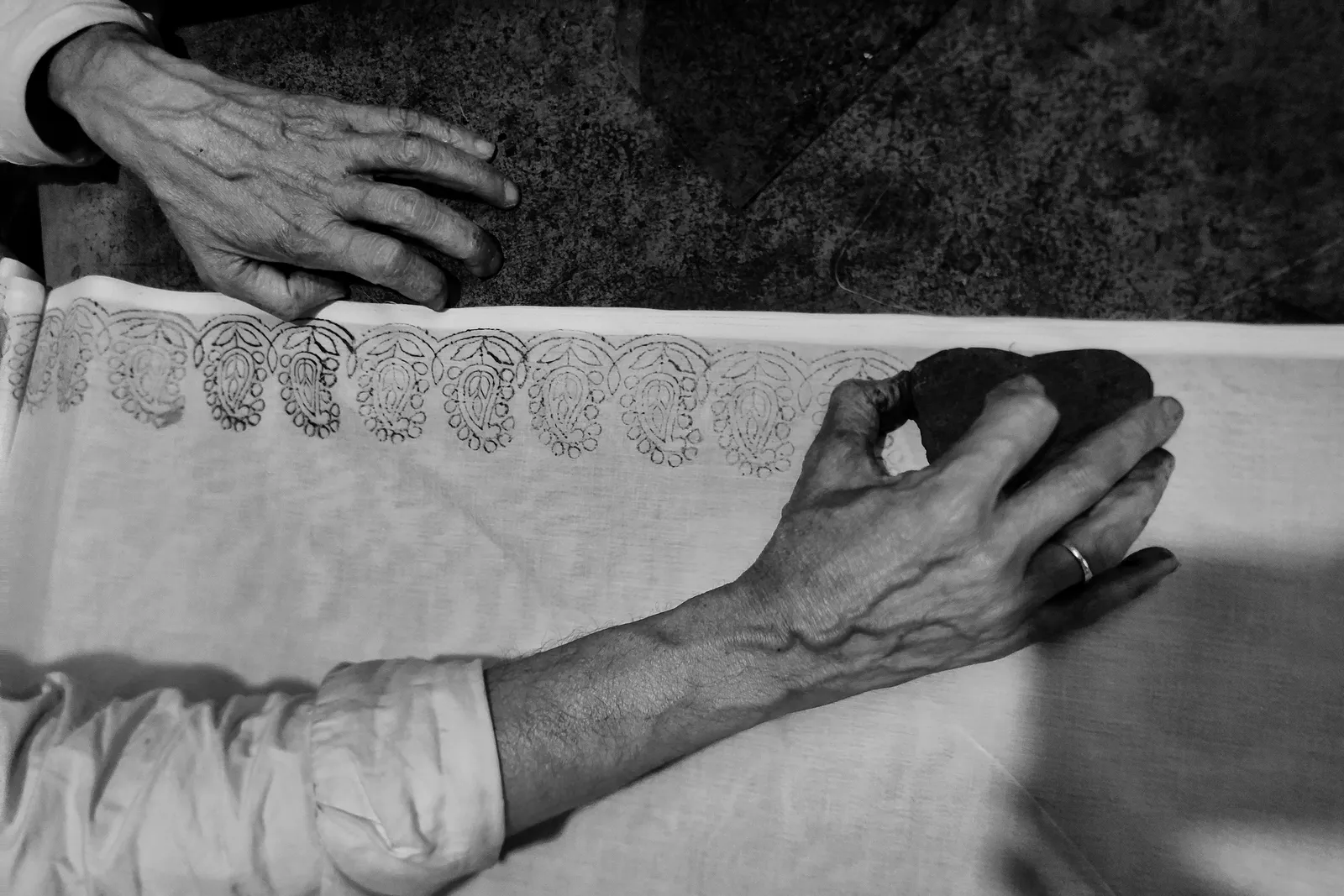
- Chhapai (printing). The cut cloth is stamped with carved wooden blocks dipped in a temporary dye, traditionally made with safeda and neel (indigo), so that the pattern shows as faint blue lines.
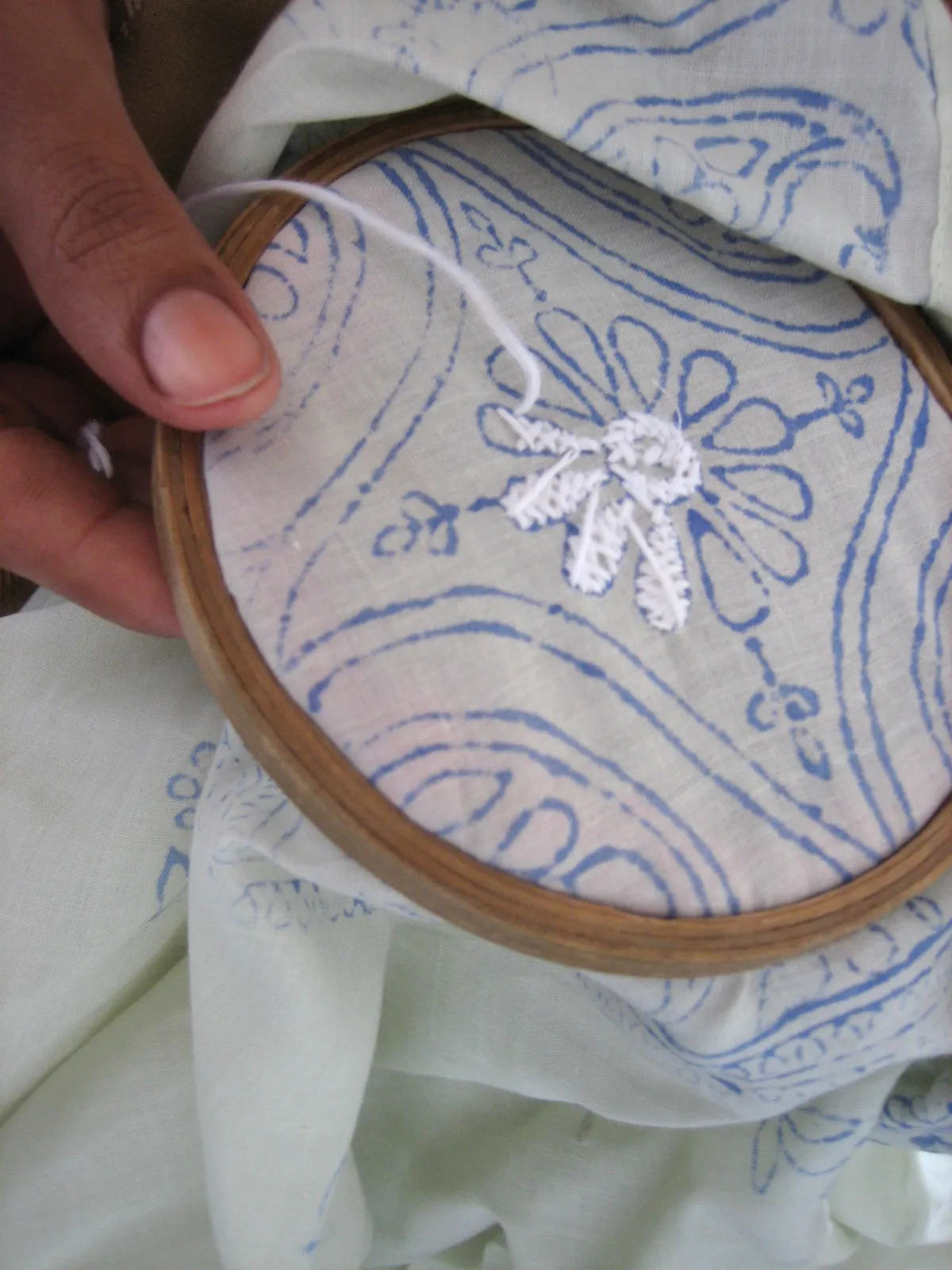
- Tankai (embroidery). The embroiderers stretch the cloth on a small hoop and stitch over the printed lines. Different artisans often specialise in different stitches, so one garment can travel between several homes before it is finished.
- Dhulai (washing). The finished piece is washed to remove every trace of the blue print, then starched and pressed, a job traditionally done by Lucknow's dhobis (washermen).
It is slow work. Impart puts a single chikan garment at 10 to 15 days of work, and says an artisan typically masters four or five of the 30 stitches and needs at least 15 years of practice to become truly proficient. Densely worked saris and wedding outfits can take months.
The stitches worth knowing
You do not need all 30-plus names to appreciate chikankari, but a handful explain most of what you see.
- Bakhia (shadow work). The signature stitch. Worked as ulta bakhia on the back of sheer fabric, a close criss-cross of thread shows through as a soft, opaque shadow on the front, which is why motifs look filled in without any visible stitching on top. Worked on the front (seedhi bakhia), it becomes a surface fill.
- Murri. A tiny, elongated knot that looks like a grain of rice, often clustered in flower centres. Very fine murri work is among the most prized and the most time-consuming.
- Phanda. A shorter, rounder knot, described by Impart as "millet-shaped".
- Jaali. The craft's most technical feature. Instead of cutting holes, the embroiderer pushes the warp and weft threads apart with a needle and locks them in place, producing a lace-like screen. Impart notes that the jaali are thought to echo the carved stone lattices of Indo-Islamic architecture, and there are many named types, such as bulbul chashm and phool jaali.
- Zanjeera, keel kangan, tepchi. A fine chain stitch for outlines, a looped stitch for small petals, and a simple running stitch used for stems and light fills.
The motifs themselves are mostly floral: creepers (bel), scattered sprigs (buti), paisleys, vines and leaves. That is one reason chikan looks equally at home on a cotton office kurta and a georgette wedding lehenga.
Who makes chikankari today?
Almost entirely women, working from home. Impart notes that the craft was once male-dominated in workshops (karkhanas), but the needlework is now done mostly by women in Lucknow's old city and the villages around it, fitted in between household and farm work.
For decades that work was badly paid. The Self Employed Women's Association (SEWA) Lucknow says it grew out of a 1979 study by UNICEF and Literacy House, Lucknow, which found that women and children in the chikan industry were "more cruelly exploited than in any other craft of the unorganized sector in U.P." Thirty-one women registered SEWA Lucknow in February 1984 to sell directly and cut out middlemen, and the organisation now says it provides self-employment to more than 10,000 women artisans. A Hindustan Times profile of its founder, Runa Banerjee, reports that the 1979 study found the industry employed over 40,000 chikan artisans in and around Lucknow.
Pay remains modest. During a press tour organised by the Press Information Bureau in March 2026, artisans in Badi Garhi village in Lucknow's Malihabad block told visiting journalists that they earn ₹1,200 to ₹1,500 per finished product, working about four hours a day alongside domestic and farm work. Home-based artisans interviewed by India Today in April 2026 put their earnings at ₹300 to ₹500 for an embroidered piece.
The GI tag and Uttar Pradesh's push
"Lucknow Chikan Craft" is protected under India's Geographical Indications of Goods (Registration and Protection) Act, 1999. The Geographical Indications Registry record shows it as Application No. 119, filed on 7 December 2007 by the Uttar Pradesh government's small-scale industry department with three other applicants, covering classes 24, 25 and 26. It was registered with Certificate No. 102 on 2 December 2008, was renewed in 2017, and is currently valid until 6 December 2027. A GI does not stop anyone from embroidering in a chikan style, but it does reserve the name "Lucknow Chikan Craft" for work from the registered area made by its producers.
Uttar Pradesh has also made chikankari, together with zari-zardozi metal embroidery, Lucknow district's product under its One District One Product (ODOP) programme, which offers artisans training, toolkits, loans and marketing support and lists a common facility centre for the two crafts as under implementation. In July 2026 the Lucknow district industries centre invited chikankari and zari-zardozi artisans to apply for free training and modern toolkits under the scheme, with applications open until 31 July. When India's Prime Minister listed the country's signature garments at Bharat Tex 2025, "Lucknowi chikankari" came first, ahead of bandhani, patola, Banarasi silk, Kanjivaram and pashmina.
How big is the chikankari trade?
There is no official census of the industry, but trade bodies give a sense of its size, and 2026 has tested it. According to industry figures reported by the Hindustan Times in April 2026, Lucknow's chikankari business is worth about ₹550 crore a year, including roughly ₹100 crore of exports to the Gulf and about ₹70 crore to Europe and other markets. Nearly five lakh people in and around the city depend on chikan embroidery and the garment trade built on it, directly or indirectly.
The Gulf matters because it is home to a large South Asian diaspora that buys chikan kurtas, saris and wedding outfits. When the West Asia conflict escalated in early 2026, exporters told the paper that shipments to the region stopped entirely for more than a month, that overall exports had fallen by at least 60%, and that raw-material prices had risen by about 20%. Coming after US tariffs had already hurt orders, it was a reminder of how a craft practised in Lucknow homes is tied to markets thousands of kilometres away, much as Varanasi's weavers depend on demand for the Banarasi saree.
How to tell real hand chikankari from a copy
Machine embroidery can imitate the look of chikan at a fraction of the price, so the label alone tells you little. A few checks help.
- Turn it over. Hand chikankari shows small knots, joins and thread ends on the back. In shadow work you should see the criss-cross of ulta bakhia behind each filled motif. Machine embroidery tends to have an identical, continuous thread pattern on the reverse, often with a stiff backing.
- Look for small irregularities. Hand-made murri knots and petals vary slightly from one to the next. Perfectly uniform motifs repeated across a whole garment usually mean a machine.
- Check the jaali. True jaali is made by pulling the threads apart, not by cutting holes and binding the edges. Cut-and-bound holes are a common shortcut.
- Feel the density and weigh the price. A kurta with dense hand murri or jaali takes days or weeks of skilled work. If a "pure hand chikankari" piece costs about the same as a printed cotton kurta, it is almost certainly not what it claims.
- Buy close to the source. Artisan collectives, GI-registered producers and established Lucknow sellers are more likely to sell genuine work, and are usually able to tell you who stitched it.
Why chikankari still matters
Chikankari has survived the end of the courts that patronised it, decades of exploitation, cheap machine copies and, in 2026, a collapse in Gulf orders. It keeps coming back because it does something few embroideries can: it makes light, breathable cloth look rich without making it heavy, which is exactly what a north Indian summer demands. Like hand-spun khadi, it is also a craft whose value lies in the hands behind it. Each shadowed petal and grain-sized knot is the work of a woman in Lucknow or a nearby village, and when you buy the real thing, that is who you are paying.