What Do U, UA and A Mean on Indian Films?
U means a film is fit for everyone, UA with a 7+, 13+ or 16+ marker means anyone may watch but parents should decide for younger children, and A means adults only. Here is how the Central Board of Film Certification hands out those letters, the 1970 case that upheld them and the 2024 overhaul that split UA in three.
 By Kirti Kaliraman· 9 min read

On an Indian film, U means the film is fit for unrestricted public exhibition and suitable for every age, UA (now shown as UA 7+, UA 13+ or UA 16+) means anyone may watch but parents should decide whether a child below that age should, and A means the film is restricted to adults aged 18 and over. The letters are issued by the Central Board of Film Certification (CBFC), and under Indian law no film can be shown publicly in a cinema until it has one.
There is also a rarely seen fourth letter, S, for films meant only for a specialised audience such as doctors or scientists. Everything else about the system, from the age markers added in 2024 to the reason a court once had to defend the letters at all, follows from a simple idea: India decided in 1952 that cinema is too powerful to be released without a certificate.
What each certificate means today
Since 24 October 2024, the CBFC has certified films in five public categories, as it explained in a Press Information Bureau release that November:
| Certificate | Who can watch | What it signals |
|---|---|---|
| U | Everyone | Suitable for unrestricted public exhibition and all age groups |
| UA 7+ | Everyone, with parental caution below 7 | Mild content that may disturb very young children |
| UA 13+ | Everyone, with parental caution below 13 | Stronger violence, fear or mature themes |
| UA 16+ | Everyone, with parental caution below 16 | Content close to adult level |
| A | Adults only (18+) | Restricted to people who have completed their eighteenth year |
| S | Specialised audiences | Restricted to members of a profession or class of people |
The key word for UA is caution. The age markers are recommendatory: a theatre does not turn away a 12-year-old from a UA 13+ film if a parent brings them. The CBFC says UA films may contain elements such as horror or violence, sex or intimacy, body exposure, addictive habits or deviant behaviour, and that the marker reflects how strongly those elements are shown. An A certificate is different. It is a legal restriction, and exhibitors are expected to keep minors out.
Where the letters came from
The CBFC began life on 15 January 1951 as the Central Board of Film Censors, headquartered in Bombay, the city that would later give the Hindi industry the nickname Bollywood. A year later Parliament passed the Cinematograph Act, 1952, which still governs the board.
At first, the CBFC explains on its certification page, there were only two certificates: U for unrestricted exhibition and A for adult audiences. They were the same two letters Britain had used since its own censors began work on 1 January 1913. In Britain's original scheme, as the BBC's history of film classification notes, U marked a film "especially suitable for children" and A one "generally suitable for public exhibition". India made its A stricter: adults only.
In June 1983, the Cinematograph (Certification) Rules, 1983 came into force, the board was renamed the Central Board of Film Certification, and two new letters arrived: UA, for unrestricted viewing with parental guidance for children below 12, and S for specialised audiences.
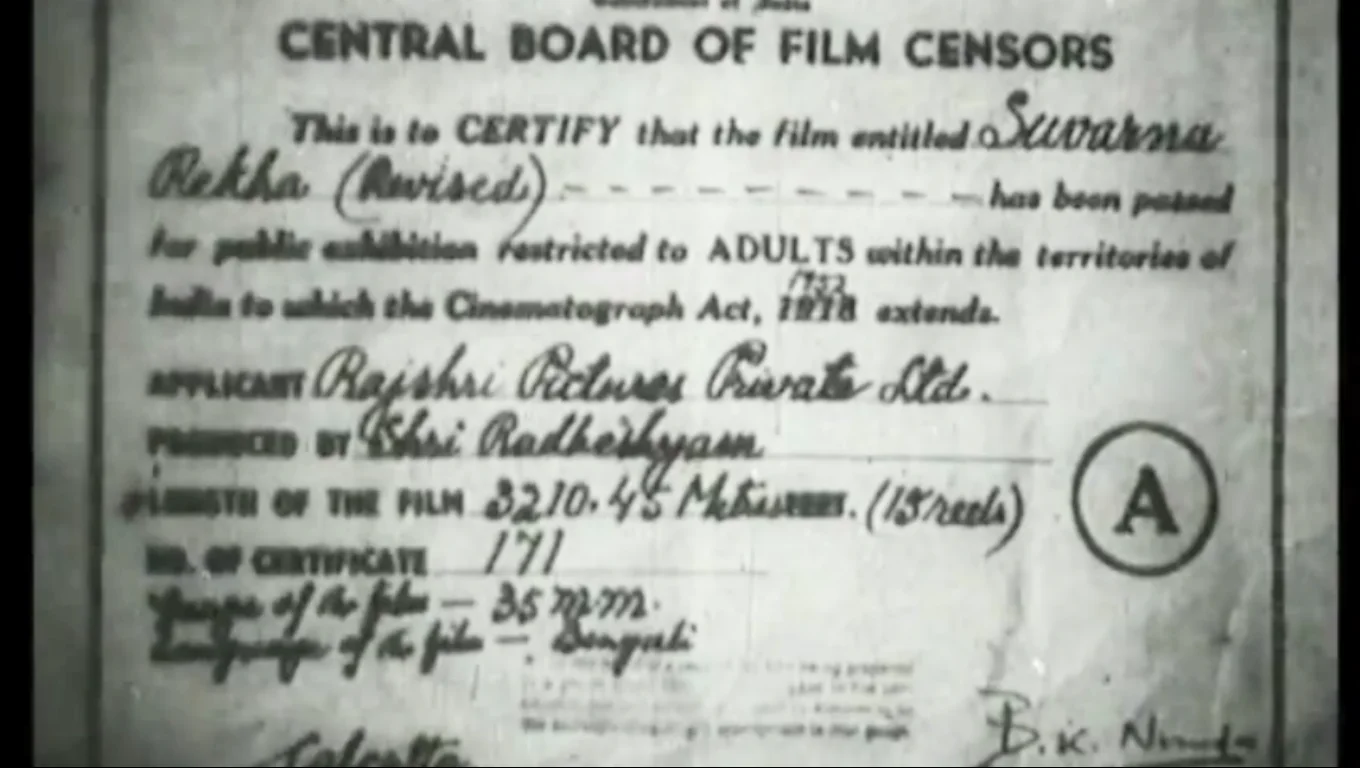
That certificate card is still the first thing on screen before an Indian film. Old ones like the one above also record the film's length in metres and reels, a reminder that 35mm film ran at a fixed 24 frames per second: at that speed, 3,210 metres works out to just under two hours.
How a film gets its certificate
A producer applies online, and the film is watched by an Examining Committee drawn from the CBFC's advisory panels, people from different walks of life nominated by the central government. The board has nine regional offices, in Mumbai, Kolkata, Chennai, Bengaluru, Thiruvananthapuram, Hyderabad, New Delhi, Cuttack and Guwahati. If the producer disagrees with the result, the chairperson can send the film to a Revising Committee.
The committee judges the film against Section 5B of the Act, which says a film cannot be certified if it, or any part of it, is against the sovereignty and integrity of India, the security of the State, friendly relations with foreign States, public order, decency or morality, or involves defamation, contempt of court or incitement to an offence. The committee can pass a film as it is, pass it with cuts or modifications, give it a stricter category, or refuse it.
The volumes are enormous. In a March 2026 reply in the Rajya Sabha, the Ministry of Information and Broadcasting said the CBFC certified 71,963 films (feature and short, digital and video) in the five years from 2020-21 to 2024-25. Of those, 41,817 were rated U, 28,268 UA and 1,878 A. In 2024-25 alone the board certified 15,444 films, and 3,033 of them were passed only after cuts or modifications.
The same reply said the legal deadline under Rule 37 is 48 working days, but the online system now averages 22 working days for a feature film and three for a short. For feature films alone, the ministry's statistics handbook counts 741 Indian features certified in 1983 and 3,455 in 2024-25.
The 1970 case that defended the letters
Not everyone accepted that films should need permission at all. In 1968 the writer and director Khwaja Ahmad Abbas made a 16-minute documentary, A Tale of Four Cities, contrasting the lives of the rich and the poor in Calcutta, Bombay, Madras and Delhi. It included shots of Bombay's red-light district. Abbas asked for a U certificate and got an A. When the government offered a U only if he made cuts, he went to the Supreme Court, arguing that pre-censorship violated the freedom of speech in Article 19(1)(a).

He lost. In K.A. Abbas v. Union of India, decided on 24 September 1970, a Constitution Bench led by Chief Justice M. Hidayatullah held that censorship of films, including prior restraint, is justified under the Constitution. "The motion picture is able to stir up emotions more deeply than any other product of art," the judgment says, and because children "more willingly suspend their disbelief", the court found that "classification of films into two categories of 'U' films and 'A' films is a reasonable classification."
That reasoning still underpins the system. It is also why a book can be published without a government certificate in India while a film cannot be screened without one.
When courts push back
The same Constitution that allows certification also limits it. In 2000, in K.M. Shankarappa v. Union of India, the Supreme Court struck down the central government's power to overrule the CBFC after it had certified a film, and the 2023 amendment finally removed that power from the Act.
The most famous recent clash came in June 2016, when the CBFC wanted 89 cuts to Udta Punjab, a drama about drug abuse in Punjab, including every mention of the state's name. The Bombay High Court cleared it with a single cut and a revised disclaimer, observing that the board's job was to certify, not to censor, as the BBC reported. Appeals against CBFC orders now go straight to the High Courts, because the Tribunals Reforms Act, 2021 abolished the Film Certification Appellate Tribunal that used to hear them.
What changed in 2023 and 2024
The old UA certificate drew one line, at 12. Parliament replaced it with three age markers when it passed the Cinematograph (Amendment) Act, 2023 on 31 July 2023, the first major change to the law in 40 years. According to the government's summary of the Bill, the amendment also:
- made CBFC certificates valid forever, instead of lapsing after 10 years;
- required a separate, edited certificate before a film is shown on television, where only unrestricted-category content can be broadcast;
- made camcording and online piracy punishable with three months to three years in jail and a fine of up to 5% of the audited gross production cost.
The detailed rules followed in the Cinematograph (Certification) Rules, 2024, notified on 15 March 2024. Besides the UA 7+, UA 13+ and UA 16+ markers, The Hindu reported that they moved certification fully online, cut processing timelines and require one-third of the board's members to be women.
How streaming fits in
The new cinema markers were not invented from scratch. Streaming services have used almost identical labels since February 2021, when the IT (Intermediary Guidelines and Digital Media Ethics Code) Rules told platforms to self-classify their shows and films as U, U/A 7+, U/A 13+, U/A 16+ or A. Platforms must offer parental locks for anything rated U/A 13+ or higher and a reliable age check for A titles.
The difference is who decides. A film headed for a cinema hall is rated by the CBFC before release. A series made for a streaming platform is rated by the platform itself, with complaints handled through a three-level grievance system. Since a pause button removes the need for a mid-film interval, the streaming rating is often the only part of the theatrical ritual that survives at home.
How India compares
India's system is statutory: a government board issues the certificate, and showing an uncertified film is an offence. In the United States, ratings are handed out by the Classification and Rating Administration, a division of the Motion Picture Association, using G, PG, PG-13, R and NC-17. In Britain, the British Board of Film Classification, the board that began with U and A in 1913, now uses U, PG, 12A, 15 and 18.
The letters differ, but the logic has converged. Each system now gives parents graded advice for children and teenagers and keeps a firm line at adulthood. India arrived there later, splitting UA into three only in 2024, but it now uses the same age steps in cinemas and on streaming apps.
The short version
U means everyone. UA 7+, UA 13+ and UA 16+ mean everyone may watch, but parents should judge for children under that age. A means adults only, and S means a specialised audience. The letters come from the Central Board of Film Certification, founded in 1951 as a censors' board, defended by the Supreme Court in 1970 and rebuilt for the streaming age in 2024. Look for them on the certificate card that opens every film: it tells you who the board thinks the film is for.