What Is the DLS Method in Cricket?
The Duckworth-Lewis-Stern method sets a fair new target when rain cuts a limited-overs match, by counting the overs and wickets each side has left. Here is how the table works, the 1992 fiasco that created it, the 2023 IPL final it decided and India's home-grown rival, the VJD method.
 By Sushant Kataria· 8 min read
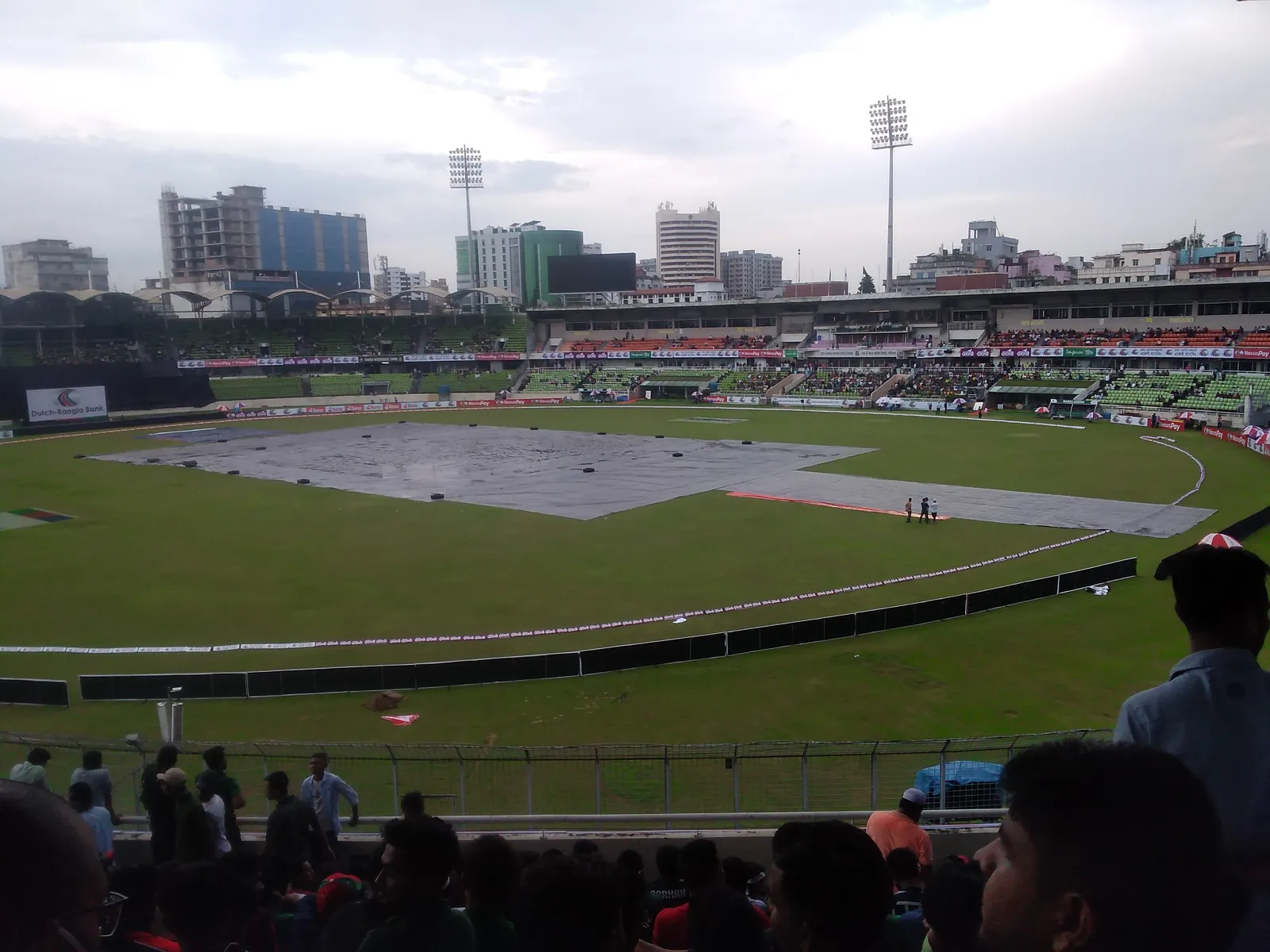
The DLS method (Duckworth-Lewis-Stern) is the formula cricket uses to set a fair new target when rain or any other stoppage cuts overs from a one-day or T20 match. Instead of scaling the target by overs alone, it treats overs left and wickets in hand together as "resources", and resets the chasing side's target in proportion to the resources each team actually had, as the International Cricket Council explains in its official DLS documents.
That one idea, that a wicket is worth runs just as an over is, is why a side chasing 250 with nine wickets down cannot simply be told to score at the same rate in fewer overs. It is also why the method has decided World Cup games, an IPL final played past midnight in Ahmedabad and hundreds of Indian domestic matches, though in that last case India often uses a rival formula of its own.
The problem DLS was built to solve
Before DLS, rain rules were crude. The oldest simply took the first side's run rate and multiplied it by the overs the chasing side would get, which ignored wickets entirely and heavily favoured the team batting second. Australia then tried a Most Productive Overs rule: if the chase lost overs, the target fell only by the runs from the first side's least productive overs.
The rule collapsed in public at the 1992 World Cup semi-final in Sydney. As ESPNcricinfo's account of the match recalls, South Africa needed 22 runs from 13 balls against England when rain stopped play for 12 minutes. Because South Africa had bowled two maiden overs earlier, deducting two overs barely reduced the target. The scoreboard ended up showing 22 from one ball (the real requirement was 21 because a leg-bye had been overlooked), Brian McMillan pushed a single, and England went to the final. The scorers had worked to the rules; the rules themselves had failed.
Listening in England was a statistician called Frank Duckworth. He later told the ICC that hearing the commentator Christopher Martin-Jenkins say "surely someone, somewhere could come up with something better" convinced him that "it was a mathematical problem that required a mathematical solution."
From a conference paper to the ICC
Duckworth, a metallurgist turned statistician at a nuclear research laboratory, presented a short paper called "A fair result in foul weather" at the Royal Statistical Society's 1992 conference in Sheffield, according to the RSS tribute published after his death. That brought him into contact with Tony Lewis, a mathematics lecturer at the University of the West of England, and the two refined the idea against years of real one-day score sheets.
Their method was first used in an international on 1 January 1997, when Zimbabwe beat England by six runs on a revised target in Harare. The ICC's ten-year review notes that it was also applied in India, New Zealand, South Africa, Pakistan and the West Indies in 1998, used at the 1999 World Cup in England and then formally adopted by the ICC. The pair set out the full model in the Journal of the Operational Research Society in 1998, under the title "A fair method for resetting the target in interrupted one-day cricket matches."
Lewis died in 2020 aged 78, as ABC News reported. Duckworth, who remained a consultant statistician to the ICC until 2014, died on 21 June 2024 aged 84; the ICC's statement said the method he co-created "has stood the test of time."
How the resource table works
The heart of the method is a table. The ICC's published Duckworth-Lewis playing conditions give every combination of overs left and wickets lost as a percentage of the resources of a full 50-over innings. A few entries from that Standard Edition table show the logic:
| Overs left | Wickets lost | Resources remaining |
|---|---|---|
| 50 | 0 | 100.0% |
| 35 | 0 | 82.7% |
| 20 | 0 | 56.6% |
| 20 | 5 | 38.6% |
| 10 | 0 | 32.1% |
| 50 | 9 | 4.7% |
Two things stand out. Twenty overs are worth far more than 40% of an innings, because a side with all ten wickets can bat freely. And wickets matter enormously: with nine down, even 50 overs are worth less than 5%, because the last pair cannot use them.
The calculation then follows two simple rules. If the chasing side (Team 2) ends up with fewer resources than the side batting first (Team 1), its target is scaled down by the ratio of the two. If Team 2 has more resources, typically because Team 1's innings was cut short mid-flow, the target is raised by the extra resources multiplied by an average 50-over score called G50. In the Standard Edition, G50 is 245 for matches between full member nations and 200 for under-19, women's and associate internationals.
The ICC's own worked example makes this concrete. In a 45-over match, Team 1 scores 212. Rain then cuts Team 2's innings to 35 overs. Team 1 had 95.0% of the resources; Team 2 now has 82.7%. The new target is 212 × 82.7 ÷ 95.0, plus one, rounded down: 185 from 35 overs. A pure run-rate rule would have asked for about 165, ignoring the fact that a side with ten wickets in hand can attack harder over a shorter chase.
In live matches the umpires and scorers do not use the paper table. The playing conditions require the "ICC Duckworth-Lewis-Stern Calculator" software, with the printed Standard Edition kept only as a back-up if the computer fails. Broadcasters also show a running par score: the total the chasing side needs at that moment to be level if no more play is possible.
Where Stern comes in
The original tables were built in an era of 230-run totals. T20 cricket and ever bigger ODI scores pushed them to their limits, and the method went through a "Professional Edition" in the early 2000s before Duckworth and Lewis retired. Their successor as custodian was Steven Stern, an American-born statistician who discovered cricket while doing his doctorate at Stanford and later made his home in Australia, as he told Mint in 2015.
Stern's change, described in the Journal of the Operational Research Society as "extending the Duckworth-Lewis methodology to deal with modern scoring rates," gave more weight to the start and the end of very high-scoring innings. He told Mint that for ODIs under about 325 or T20s under about 165, DL and DLS give essentially identical results. The difference shows at the top end: in a 2010 T20 World Cup game, West Indies were set 59 from six overs chasing England's 191; DLS, he said, would have asked for 65. The name became Duckworth-Lewis-Stern from 2014, as ABC News noted.
The IPL final that DLS decided
India's most famous DLS night came at the 2023 IPL final at the Narendra Modi Stadium in Ahmedabad. Rain had already pushed the match to its reserve day. Gujarat Titans made 214 for 4 in 20 overs, then rain returned, and Chennai Super Kings' chase was cut to 15 overs with a target of 171, as the BBC reported.
Notice what the method did there. A simple run-rate rule would have asked for about 161 from 15 overs. DLS asked for 171, because Chennai would face 15 overs with all ten wickets in hand and could bat far more aggressively than a side pacing a 20-over chase. Chennai needed 10 from the last two balls; Ravindra Jadeja hit Mohit Sharma for a six and a four to win the title by five wickets in the early hours of 30 May, according to The Hindu.

India's own rain rule: the VJD method
The IPL plays under DLS, but much of Indian domestic cricket does not. Since 2007 the BCCI has used the VJD method, devised by V. Jayadevan, a civil engineer from Thrissur in Kerala, for rain-hit List A and T20 matches. The Times of India reported that the board adopted it on the recommendation of a technical committee headed by Sunil Gavaskar, that it had settled more than 500 domestic matches, and that state leagues such as the Karnataka and Tamil Nadu Premier Leagues used it too.
The key difference is philosophical. DLS uses a single resource curve. VJD uses two: a "normal" curve for how a side bats when it expects its full quota of overs, and a "target" curve for how it should speed up once overs are lost, as the Indian Express explainer sets out. Its biggest stage so far was the 2019 Vijay Hazare Trophy final, which Karnataka won against Tamil Nadu by 60 runs under VJD. The ICC reviewed the method and in 2012 said it found "no evidence of any significant flaws" in Duckworth-Lewis, so the international game stayed with DLS.
Why the method still draws grumbles
DLS is opaque by design. The full Professional and Stern tables are run by software, so fans cannot check a target on the back of a ticket, and a team that has just lost two wickets can suddenly fall well behind par without a ball being bowled. Yet the ICC's 2010 review found that sides batting first won about 52% of both interrupted and uninterrupted matches, which is the best evidence that the method is not quietly tilting results. It has also handled stranger stoppages than rain: the same review counted floodlight failures, crowd disturbances, a sandstorm in Rawalpindi, snow in Durham and low sun in Derby.
Like the 22-yard pitch or tennis's 15, 30, 40, DLS is one of those sporting numbers people use without quite understanding. The difference is that this one was designed on purpose, by statisticians, after a single ball in Sydney showed what happens without it. Cricket rarely settles anything by decree, which is why even India's "national game" was never formally named; a rain rule is the rare case where the sport decided it needed a formula, and kept it.