Why Do We Have Leap Years?
We have leap years because Earth takes about 365.2422 days, not 365, to go round the Sun, so an extra day every four years keeps the calendar in step with the seasons. Here is how Julius Caesar, Pope Gregory XIII, Meghnad Saha and today's atomic clocks fixed the drift.
 By Sushant Kataria· 8 min read

We have leap years because Earth takes about 365.2422 days, not a neat 365, to travel once around the Sun and bring back the same season. Adding an extra day, 29 February, roughly every four years soaks up those leftover hours and stops the calendar from sliding out of step with the solstices, the monsoon and the harvest.
Without that fix, the error would be about a quarter of a day a year. That sounds harmless, but in a single lifetime it would add up to more than two weeks, and within a few centuries the hottest days of an Indian summer would land in what the calendar called winter.
The problem: the year is not a whole number of days
A calendar has to count in whole days, because people live by sunrise and sunset. The Sun does not cooperate. The time from one March equinox to the next, called the tropical year, is about 365 days, 5 hours, 48 minutes and 45 seconds, or 365.24219 days.
A 365-day calendar runs ahead of the Sun by almost six hours every year. After four years, it is nearly a full day early. After 120 years it is about a month off. Every calendar that tracks the seasons has to deal with that awkward fraction, and the history of the leap year is the history of people getting closer and closer to it.
Julius Caesar's quarter day
The Romans learned the hard way. Their old republican calendar had 355 days and relied on priests to slip in an extra month when needed. The priests did this unevenly, sometimes for political reasons, and by the time Julius Caesar took power the calendar was about three months out of line with the seasons.
On the advice of the Alexandrian astronomer Sosigenes, Caesar reset everything. The year 46 BCE was stretched to 445 days to catch up, a stretch Romans called the "year of confusion". From 45 BCE the new Julian calendar gave every year 365 days and added one extra day every fourth year, making the average year exactly 365.25 days.
That extra day went into February because February was originally the last month of the Roman year, the traditional place for adjustments. The Romans did not add a 29th; they counted the sixth day before the start of March twice. That is why leap years are still called bissextile years, from the Latin for "twice sixth".
The 11 minutes that piled up
Caesar's calendar was brilliant but slightly too generous. A year of 365.25 days is about 11 minutes longer than the real tropical year. That gap adds up to roughly one full day every 128 years.
By the 1500s the drift had grown to about ten days. The March equinox, which the Church used to fix the date of Easter, was arriving around 11 March instead of 21 March. The calendar was quietly moving away from the sky.
Pope Gregory's rule: skip three leap days every 400 years
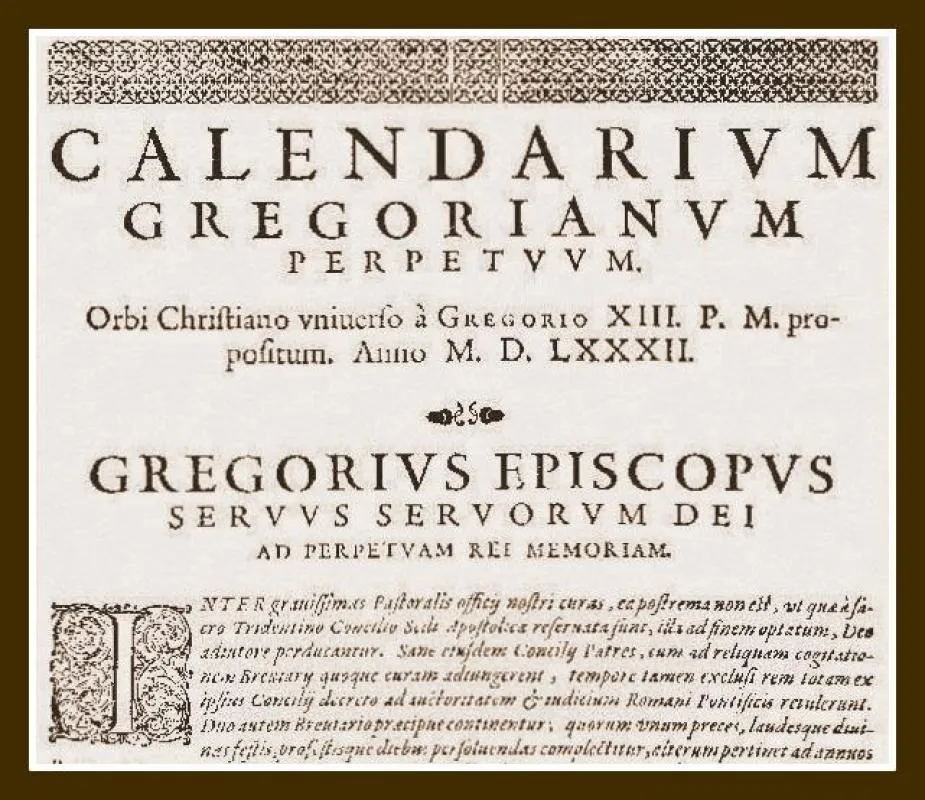
The fix came from a Calabrian physician, Aloysius Lilius, whose plan was refined and defended by the Jesuit mathematician Christopher Clavius. Pope Gregory XIII made it law with the bull Inter gravissimas, dated 24 February 1582. To remove the accumulated error at a stroke, ten days were deleted: in the countries that complied, Thursday 4 October 1582 was followed directly by Friday 15 October.
The bigger change was a new rule for the future, the one we still use:
- A year divisible by 4 is a leap year (2024, 2028).
- But a year divisible by 100 is not a leap year (1700, 1800, 1900, 2100).
- Unless it is also divisible by 400, in which case it is a leap year (1600, 2000, 2400).
That drops three leap days every four centuries, giving 97 leap years in every 400 and an average year of 365.2425 days. The remaining error is about 26 seconds a year. The Vatican Observatory notes that the calendar will drift by a full day only after about 3,000 years, so nobody alive needs to worry about it.
Catholic Europe switched almost at once. Others took centuries. Britain and its colonies, including the East India Company's settlements in India, changed in 1752, when Wednesday 2 September was followed by Thursday 14 September. Russia waited until 1918, which is why the October Revolution of 1917 is remembered in November under the new calendar.
India's own answer to the same problem
Indian astronomers had wrestled with the year for centuries before Rome's reform reached the subcontinent. The Surya Siddhanta, a key astronomical text from around 500 CE, put the year at 365.258756 days. That is the sidereal year, measured against the fixed stars, and it is about 20 minutes longer than the tropical year that governs the seasons. The difference comes from the slow wobble of Earth's axis, called precession.
The effect is visible in the festival calendar. Makar Sankranti marks the Sun's entry into the constellation of Capricorn and once roughly coincided with the winter solstice. Because traditional almanacs follow the sidereal year, the festival has drifted to 14 or 15 January, more than three weeks after the solstice on about 21 December. The Calendar Reform Committee calculated that the Indian solar year beginning had advanced by about 23 days in nearly 1,400 years.
Lunar calendars face an even bigger gap. Twelve lunar months add up to about 354 days, roughly 11 days short of the solar year. Hindu lunisolar calendars fix this by inserting an extra month, the adhik maas, about once every 32 or 33 months. In 2026 that extra month was Adhik Jyeshtha, which ran from 17 May to 15 June, giving the year two Jyeshtha months. The Islamic Hijri calendar takes the opposite approach: it adds no extra month, so Ramadan moves about 11 days earlier each year and travels through every season over about 33 years.
Meghnad Saha and the national calendar
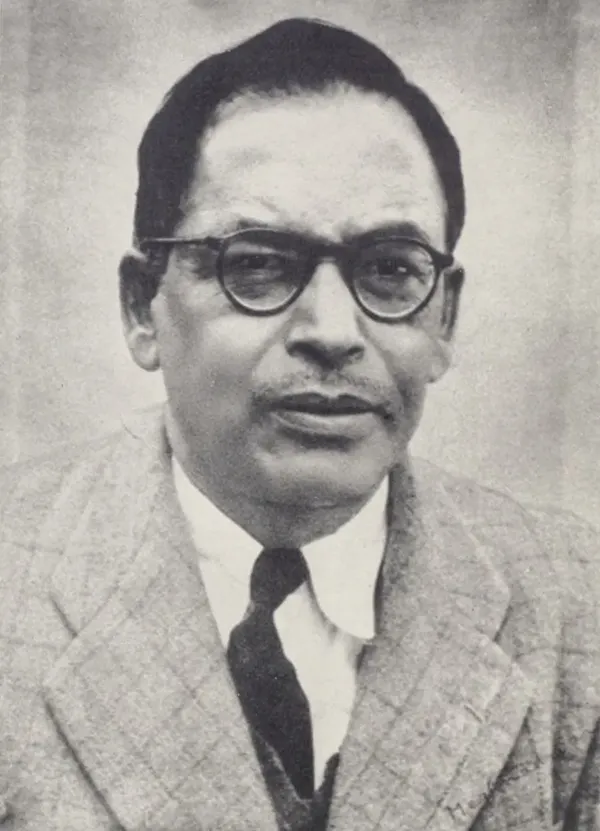
After Independence, India had about 30 different calendars in regular use. In November 1952 the Council of Scientific and Industrial Research appointed a Calendar Reform Committee under the astrophysicist Meghnad Saha, best known for the Saha ionisation equation that helps astronomers read the temperatures of stars. Its report, published in 1955 with a preface by Jawaharlal Nehru, recommended a single solar civil calendar based on the Saka era.
The government adopted the national calendar from 22 March 1957, which was 1 Chaitra 1879 Saka, alongside the Gregorian calendar. It runs on the same leap-year rule as the Gregorian one: add 78 to the Saka year, and if the result is a Gregorian leap year, so is the Saka year. In a normal year Chaitra has 30 days and begins on 22 March; in a leap year it has 31 days and begins on 21 March. The next time that happens is 21 March 2028, the start of Saka 1950.
You can see it at work in any Gazette of India. The notification of India's new timekeeping rules, issued on 27 August 2026, is dated in print as "August 27, 2026/Bhadra 5, 1948".
Leap seconds, and the end of them
Leap years correct for Earth's orbit. A second kind of correction dealt with Earth's spin. Since 1967 the second has been defined by atomic clocks, which are steadier than the planet, whose rotation wobbles and, over long periods, slows as tides drag on it. That slowing is the same braking that explains why the Moon is drifting away.
To keep clock time within 0.9 seconds of Earth's rotation, timekeepers added leap seconds. According to the US National Institute of Standards and Technology, 27 have been inserted since the first on 30 June 1972, the most recent on 31 December 2016. Each one is a minute that ends at 23:59:60, and computers handle that badly. The systems that rely on split-second time, from GPS satellites to stock exchanges and power grids, have suffered glitches when one was added.
So the world is retiring them. In 2026 the General Conference on Weights and Measures, meeting under the International Bureau of Weights and Measures, passed Resolution 5: continuous UTC becomes effective on 20 May 2027, and clock time will be allowed to drift up to an hour from Earth's rotation before any adjustment. The resolution also noted that Earth's spin has recently sped up enough that experts put the chance of a first ever negative leap second at 30% by 2035, a risk nobody wanted to take.
India is tightening its own clocks at the same moment. The Legal Metrology (Indian Standard Time) Rules, 2026, notified on 27 August 2026 and published in the Gazette on 29 August, make IST the legal time reference for official, commercial and critical systems. According to the Press Information Bureau, IST is generated by CSIR-National Physical Laboratory in New Delhi from an ensemble of atomic clocks and kept within a few nanoseconds of UTC, with backup time scales at five regional laboratories in Ahmedabad, Bengaluru, Bhubaneswar, Faridabad and Guwahati, and satellite delivery through NavIC. The rules take effect 180 days after publication.
What a leap year means in practice
The everyday effects are small but real. A leap year has 366 days, so monthly salaries cover one extra working day, and anyone paid a fixed annual amount earns a little less per day. People born on 29 February, about one in every 1,461 births, usually celebrate on 28 February or 1 March in other years. And because 2000 was divisible by 400, most people alive today have never seen the century rule in action: the first skipped leap year of our lifetimes will be 2100.
The next leap day is Tuesday, 29 February 2028. When it arrives, it will be the result of more than 2,000 years of corrections, from a Roman dictator and a Calabrian doctor to a Bengali astrophysicist, all chasing the same stubborn fraction of a day. Like the Jantar Mantar sundials that still cast their shadows in Jaipur, the leap year is a reminder that our clocks and calendars are only ever as good as our measurements of the sky.