How Do Undersea Cables Carry the Internet?
Satellites get the headlines, but roughly 99% of intercontinental data travels through cables no thicker than a garden hose, lying on the ocean floor.
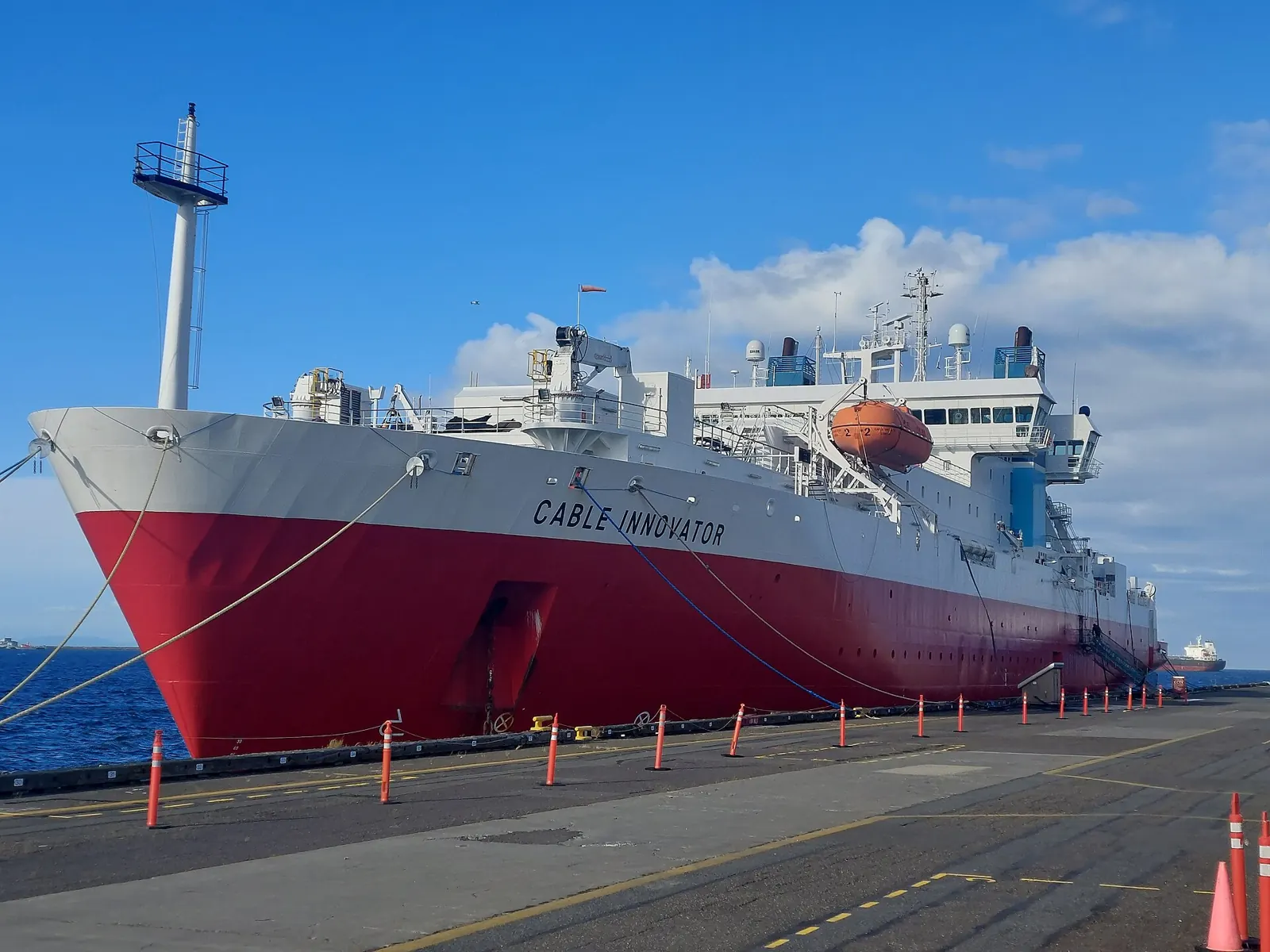
Undersea cables carry the internet as pulses of laser light through hair-thin glass fibres laid on the seabed, boosted by powered repeaters every 50 to 100 kilometres, and they handle the vast majority of data travelling between continents. Satellites carry only a small fraction of international traffic; when you stream a video from another continent, it almost certainly crossed the ocean through a cable.
When you open a video hosted on another continent, the data almost certainly does not bounce off a satellite. It races along a strand of glass lying on the seabed. Around 99% of international data traffic moves through submarine fibre-optic cables. The research firm TeleGeography's 2025 Submarine Cable Map shows 597 cable systems and 1,712 landings that are active or under construction, stretching well over a million kilometres in total (TeleGeography).
Thin, tough and astonishingly fast
In deep water a modern cable is roughly the width of a garden hose. At its heart sit a handful of hair-thin optical fibres, wrapped in copper, polyethylene and, closer to shore where anchors and trawlers are a threat, layers of steel armour wire.
Light pulses carry the data. Every 50 to 100 kilometres, powered repeaters boost the signal, which is why the copper sheath carries thousands of volts from stations on land. A single new transatlantic system can move hundreds of terabits per second, enough to stream millions of HD films at once.
The cloud is not in the sky. It is mostly on the bottom of the sea.
Who builds them
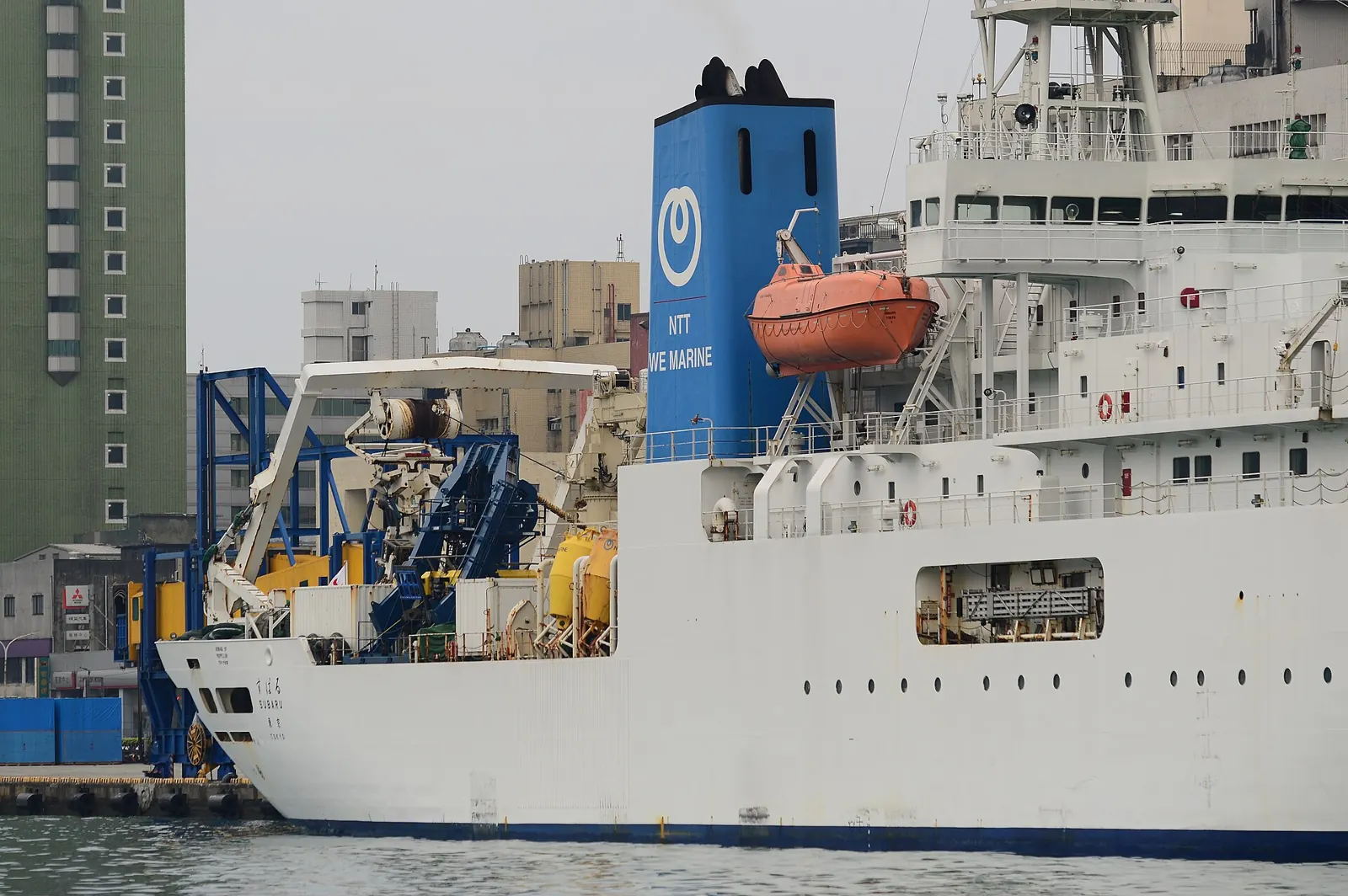
For most of the 20th century, cables were funded by consortia of national telecom companies. That has shifted dramatically. Today the biggest investors are content and cloud giants such as Google, Meta, Microsoft and Amazon, who need private, high-capacity links between their data centres. Specialised ships lay the cable at a few kilometres per hour, ploughing it into the seabed near shore and letting it rest on the ocean floor in the deep.
Breaks happen, more often than you think
Roughly 150 to 200 cable faults are recorded every year. Most are accidents: fishing gear and dragged anchors cause the majority, with earthquakes and underwater landslides behind many of the rest. The 2006 Hengchun earthquake off Taiwan severed several cables at once and slowed internet access across East Asia for weeks.
Repair ships are dispatched with grapnels to hook the damaged section, haul it to the surface and splice in a new length. A typical fix takes days to weeks, depending on depth, weather and permits.
Where India plugs into the world
India is one of the busiest junctions on the global cable map. According to the telecom regulator TRAI, the country had 17 international subsea cables landing at 14 distinct cable landing stations in five cities: Mumbai, Chennai, Kochi, Thoothukudi (Tuticorin) and Thiruvananthapuram, as of the end of 2022 (Submarine Networks, citing TRAI). The two big hubs are on opposite coasts:
- Mumbai faces west, towards the Arabian Sea, the Gulf, Africa and Europe. Systems landing there include AAE-1, BBG, EIG, Falcon, FLAG, IAX, MIST and SEA-ME-WE 4 (DCD).
- Chennai faces east, across the Bay of Bengal towards Singapore and the rest of Asia, and also hosts the cable that links the mainland to the Andaman and Nicobar Islands.
A landing station is a surprisingly modest building near the beach: the cable comes ashore through a buried duct, and inside, equipment powers the repeaters, converts the signals and hands the traffic on to terrestrial networks and data centres. Indian operators such as Tata Communications, Bharti Airtel, Reliance Jio, Sify and BSNL own most of the country's stations.
New cables landing in 2025
India's cable count is rising quickly. Bharti Airtel landed SEA-ME-WE 6, a roughly 21,700-kilometre system linking Singapore to Marseille in France, in Mumbai on 30 December 2024 and in Chennai in February 2025; Airtel says the system adds about 220 Tbps of capacity for India (Submarine Networks). In March 2025 Airtel also landed 2Africa Pearls in Mumbai, a branch of 2Africa, which at about 45,000 kilometres is described as the world's longest subsea cable system (DCD). Reliance Jio's IAX and IEX systems, linking India eastwards to Asia and westwards to Europe, add further routes.
The motive is not just speed. Most cables between India and Europe squeeze through the Red Sea and the narrow Bab-el-Mandeb strait, a single corridor that a few accidents can disrupt.
What happened in the Red Sea in September 2025
On 6 September 2025, faults on the SEA-ME-WE 4 and IMEWE systems near Jeddah, Saudi Arabia degraded internet connectivity in several countries, including India, Pakistan and the UAE, according to the monitoring group NetBlocks (Indian Express). Microsoft warned that Azure traffic passing through the Middle East would see higher latency (Network World).
India did not go offline. Operators rerouted traffic over other cables, but data published by the network-monitoring firm Kentik showed latency between Mumbai and Europe rising from roughly 110 to 150 milliseconds to 190 to 300 milliseconds, depending on the provider (The Hindu). For most people that meant slower video calls rather than blank screens, which is exactly what a resilient network is supposed to deliver. It also strengthened the case, made repeatedly at industry events, for more cables and more landing points around the Indian coast.
Why governments now care so much
Because so much of the global economy rides on so few strands, cables have become a strategic concern. Where they land, who owns them and who repairs them are now questions of national security. That explains the recent wave of new routes designed for redundancy, including links across the Arctic, the South Atlantic and the Pacific that avoid crowded chokepoints like the Red Sea and the Strait of Malacca.
Light in glass is also how scientists measure the heavens: the same principle lets researchers time laser pulses bounced off mirrors on the Moon, which is how we know the Moon is drifting away from Earth. Closer to home, those cables also carry the QR-code payments that now settle millions of small purchases every day.
The takeaway
The next time a page loads in a blink, remember the journey: down to a landing station, across an abyss several kilometres deep, and up onto another shore, all in a fraction of a second.