Why Doesn't the Iron Pillar of Delhi Rust?
The Gupta-era iron pillar at the Qutub Minar has stood in the open for some 1,600 years with barely a speck of rust. The secret is phosphorus in the metal, which builds a self-sealing skin, plus Delhi's dry air and the sheer mass of the pillar.
 By Sushant Kataria· 10 min read
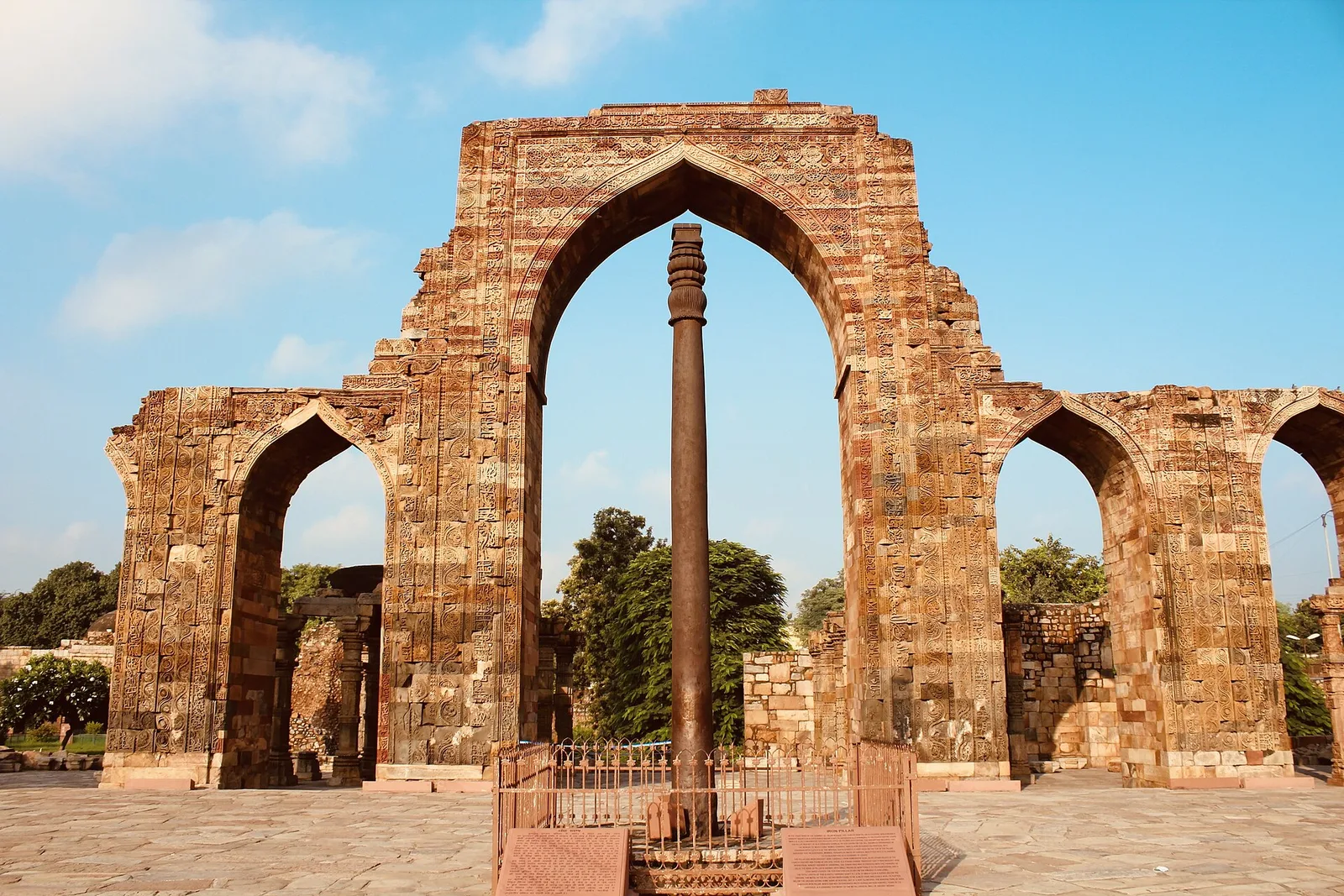
The iron pillar of Delhi does not rust away because its iron is unusually rich in phosphorus, and that phosphorus helps it grow a thin, tight, self-sealing film of iron phosphate and iron oxyhydroxide that keeps air and water off the metal underneath. Delhi's mostly dry air, the way the pillar was hand-forged from small lumps of iron, and its six-tonne bulk all help that film form and stay put.
So the pillar is not magic and it is not stainless steel. It did rust, briefly, when it was new. Then the rust it made turned out to be the kind that protects rather than destroys. That is why a column of iron cast in the time of the Gupta emperors, around 1,600 years ago, still stands in the open air at the Qutub Minar while modern railings a few metres away need regular coats of paint.
What the pillar is
The pillar stands in the courtyard of the Quwwat-ul-Islam mosque, inside the Qutub complex at Mehrauli in south Delhi. According to a detailed account by the metallurgist R. Balasubramaniam of IIT Kanpur, published by the National Metallurgical Laboratory, it weighs nearly 6,000 kilograms and rises about 23 feet (roughly 7 metres) above its stone platform, with more of it buried below, and it is crowned by a decorative bell-shaped capital. A 2002 report in MRS Bulletin gives its diameter as about 16.5 inches at the bottom, narrowing to 12.5 inches at the top.
The Archaeological Survey of India (ASI), which looks after the site, describes it as a pillar bearing a fourth-century Sanskrit inscription in Brahmi script. It is part of the Qutb Minar and its Monuments World Heritage Site, inscribed by UNESCO in 1993. UNESCO's citation singles out the pillar for giving the mosque a "unique Indian aesthetic".
Few objects of its age get more visitors. The Ministry of Tourism's India Tourism Data Compendium 2025, built on ASI ticket counts, records 3,204,760 domestic and 220,044 foreign visitors at the Qutub Minar in 2024-25, about 3.42 million in all. That made it the third most visited ticketed monument in India for both groups, behind only the Taj Mahal and, for Indian visitors, the Sun Temple at Konark. Almost every one of those visitors walks past the pillar.
Who made it, and when
The oldest and largest of the pillar's inscriptions is a three-stanza Sanskrit poem in six lines, set about 7 feet above the platform. It says the pillar was raised as a lofty standard of the god Vishnu on a hill called Vishnupadagiri, by a king named Chandra. The ASI notes that a deep socket on top of the capital probably once held an image of Garuda, Vishnu's eagle mount.
The poem never gives Chandra's full name, so historians argued over him for more than a century. Balasubramaniam compared the pillar with the gold "archer" coins of the imperial Guptas and concluded that Chandra was Chandragupta II Vikramaditya, who ruled from around 376 to 414 CE, and that the pillar dates to late in his reign. That places it in the same Gupta world that produced the astronomer Aryabhata and the place-value numbers that led to zero, a period often described as a classical age of Indian science and art.
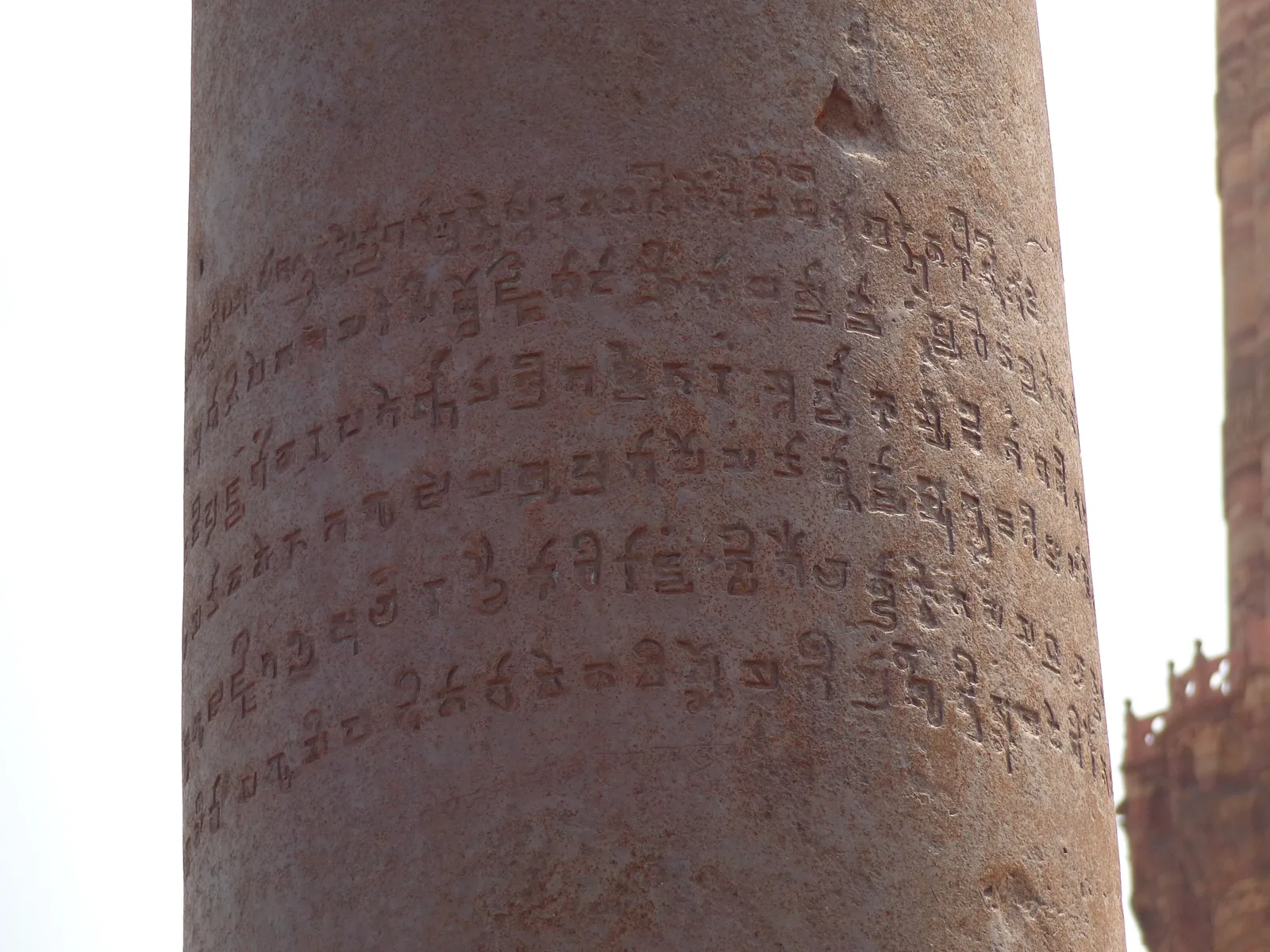
The sharpness of those letters is itself evidence. If the surface had been rusting steadily for sixteen centuries, a few millimetres of loss would have erased the carving long ago.
How it got to Delhi
The pillar was almost certainly not made for Delhi. In his NML paper, Balasubramaniam argues that Vishnupadagiri was Udayagiri, near Vidisha in Madhya Pradesh, where the Guptas created their first rock-cut temples. He suggests the pillar originally stood in front of the great Varaha panel in Cave 5, which shows Vishnu as a boar lifting the Earth goddess from the ocean, an image widely read as a tribute to Chandragupta II's victories.
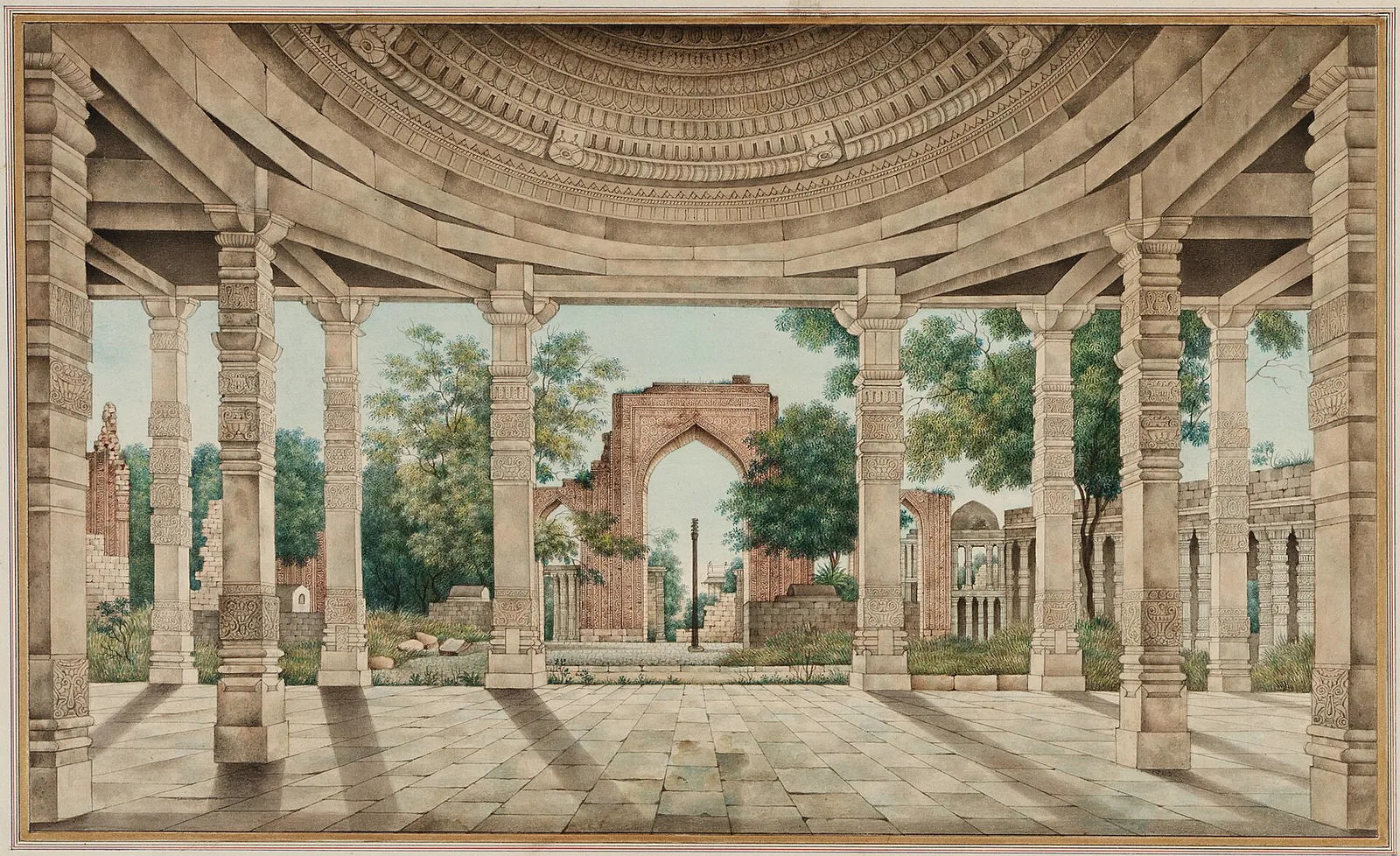
When it moved is not recorded. What is known is that it was set up in the main temple of Lal Kot, the fortress city built around 1050 CE by the Tomar king Anangapala. After Prithviraj Chauhan's defeat in the early 1190s, Qutb-ud-din Aibak took the city and, between 1192 and 1199, built the Quwwat-ul-Islam mosque on the temple site, reusing material from what the ASI says were 27 Hindu and Jain temples. The pillar was kept and stood at the heart of the new courtyard. The mosque was later enlarged by Iltutmish and Alauddin Khalji, and the minar rose beside it.
The myths that do not hold up
Because the pillar looks so clean, it has collected plenty of theories. Balasubramaniam's 2000 review in Corrosion Science lists many of them: that the iron is extraordinarily pure, that it was treated with steam or coated in slag, that worshippers rubbed it with ghee, that sulphur-free air spared it, that layers of cinder inside the metal stop rust going deeper, or that Delhi's climate alone is too dry to cause damage.
None of these explains the whole story. The iron is not pure in the modern sense. Average analyses quoted in the paper give about 0.15% carbon and 0.25% phosphorus, with tiny amounts of sulphur, silicon and manganese, and the metal is full of slag particles left over from smelting. Slag ought to make iron rust faster, because each particle sets up a tiny electrochemical cell with the metal around it. And the pillar is not rust-free. Its surface carries a thin brownish to black layer, and the part buried underground, which was dug out in 1961 for the ASI's centenary, was found covered in rust up to 15 millimetres thick and pitted with cavities.
So the pillar does corrode. The question is why the part in the open air corrodes so slowly that the inscription survives.
The real reason: phosphorus and a self-sealing skin
Ordinary rust is a poor shield. When plain iron or mild steel is exposed to damp air, the first products are flaky iron oxyhydroxides, lepidocrocite and goethite, the same family of iron oxides that paints the dust of Mars red. They crack and let fresh oxygen and moisture reach the metal, so the iron keeps rusting until there is nothing left.
The pillar's rust is different. Balasubramaniam's team scraped samples from just below the bell capital, the oldest rust on the pillar and out of reach of visitors, and analysed them by X-ray diffraction, infrared spectroscopy and Mössbauer spectroscopy. The Corrosion Science paper reports that the scale is made mostly of crystalline iron hydrogen phosphate hydrate, together with amorphous iron oxyhydroxides and magnetite.
The process runs roughly like this:
- Fast start. In the first years, the slag particles make the new iron corrode quickly. That early rusting concentrates phosphorus at the surface, between the metal and the rust.
- First shield. The phosphorus helps form a compact, amorphous layer of an oxyhydroxide called δ-FeOOH, or misawite, right against the metal. This slows corrosion sharply.
- Phosphate seal. Phosphorus also reacts with moisture to make phosphoric acid, which deposits a thin, continuous layer of iron phosphate next to the metal.
- Hardening with time. Repeated wetting and drying gradually turns that phosphate from amorphous to crystalline, with very little porosity, so it blocks oxygen and water even better.
The same MRS Bulletin summary of this work puts it simply: an initial fast corrosion rate lasts about three years until the misawite layer forms, after which the corrosion rate is negligible. Balasubramaniam's follow-up paper on the growth kinetics of the protective film, in Current Science, worked through how slowly that film keeps thickening over centuries.
Why so much phosphorus? The NML paper traces it to the furnaces. Ancient Indian smiths reduced iron ore in the solid state without adding lime, unlike today's blast furnaces, and without lime in the slag far less phosphorus is pulled out of the metal. It adds that some smiths may have added it deliberately: an 18th-century account of steelmaking in Karnataka describes sealing wrought iron in clay crucibles with the bark of Cassia auriculata, a plant rich in phosphorus.
Why Delhi's weather and the pillar's size help
The environment is the other half of the answer. The Corrosion Science paper notes that atmospheric rusting of iron becomes significant only when relative humidity stays above about 70%, and Delhi's humidity does not stay that high for long stretches of the year. Most of the year is either hot and dry or cool and dry, with the monsoon supplying a few humid months.
Those swings are not a weakness. The paper argues that the crystalline phosphate forms precisely because the surface goes through alternate wetting and drying cycles. The pillar's six-tonne mass amplifies this: a large lump of metal lags behind the air temperature, so dew condenses on it at dawn and then dries off as the day warms, again and again.
The underground section shows what happens when those conditions are removed. When the pillar was re-erected in the 19th century, its buried part was wrapped in a layer of lead about 3 millimetres thick. Trapped in salty, wet soil and in electrical contact with the lead, that part corroded far more than the part in the open air.
Forged by hand, and tough enough to survive a cannonball
The pillar was not cast. Balasubramaniam's study of its surface marks and joints suggests it was built by forge welding: lumps of hot, spongy iron from small furnaces were laid against the side of the growing column, which lay horizontally, and hammered on by hand until they fused, building the column up piece by piece. Handling clamps on its surface would have let workers roll and lift a mass of several tonnes as it grew.
That construction made the metal strong. Tests quoted in the Corrosion Science paper give a yield strength close to its ultimate tensile strength, a sign of a well-bonded composite of iron and slag. In the 18th century a cannonball was fired at the pillar, either by Nadir Shah's forces in 1739 or by Ghulam Qadir in 1787. It did not break.
Not the only ancient Indian iron that refuses to rust
The Delhi pillar is the most famous example, but not a one-off. The same paper points to the massive iron beams at the Sun Temple at Konark in coastal Odisha and the iron pillar at the Mookambika temple at Kollur on the rainy western coast of Karnataka. Both have survived far more humid climates than Delhi's. That supports the idea that the material, phosphorus-rich iron made by the smiths of the Gupta period and later, matters at least as much as the weather.
Why you can no longer hug it
For generations, visitors tried to stand with their backs to the pillar and wrap their arms around it behind them, a feat said to bring good luck. All that rubbing polished a bright band at about five feet above the ground. In 1997 the ASI built an iron railing around the pillar to stop the wear. Balasubramaniam's team photographed the polished band over the following years and found that within about a year it had darkened under a thin, adherent layer of rust, which turned black by early 2000. The pillar was quietly rebuilding its protective skin, just as the theory predicts.
What the pillar teaches modern engineers
Modern weathering steels, used in some bridges and building facades, work on a similar principle: small alloying additions make the rust form a dense, adherent patina that slows further corrosion. The Delhi pillar is a 1,600-year field test of the same idea, and the Corrosion Science study sets its phosphate-rich film side by side with the rust that forms on mild and weathering steels to show why it holds up so well. Phosphorus is normally treated as an impurity in steel because it makes the metal brittle when cold, so nobody is about to build bridges out of Gupta-style iron. But the pillar shows how much a small change in chemistry can change how a metal ages.
So the next time you visit the Qutub Minar, look past the tower for a moment. The dark column in the courtyard is not rust-proof. It simply rusted in exactly the right way, a long time ago, and has been sealed ever since.