Why Is a Cricket Pitch 22 Yards Long?
The 22 yards between the stumps are the most famous strip of grass in sport, and the number comes from English land surveying, not from any calculation about bowling. Here is how a farmer's measuring chain became the heart of cricket, and why the game has never changed it.
 By Sushant Kataria· 7 min read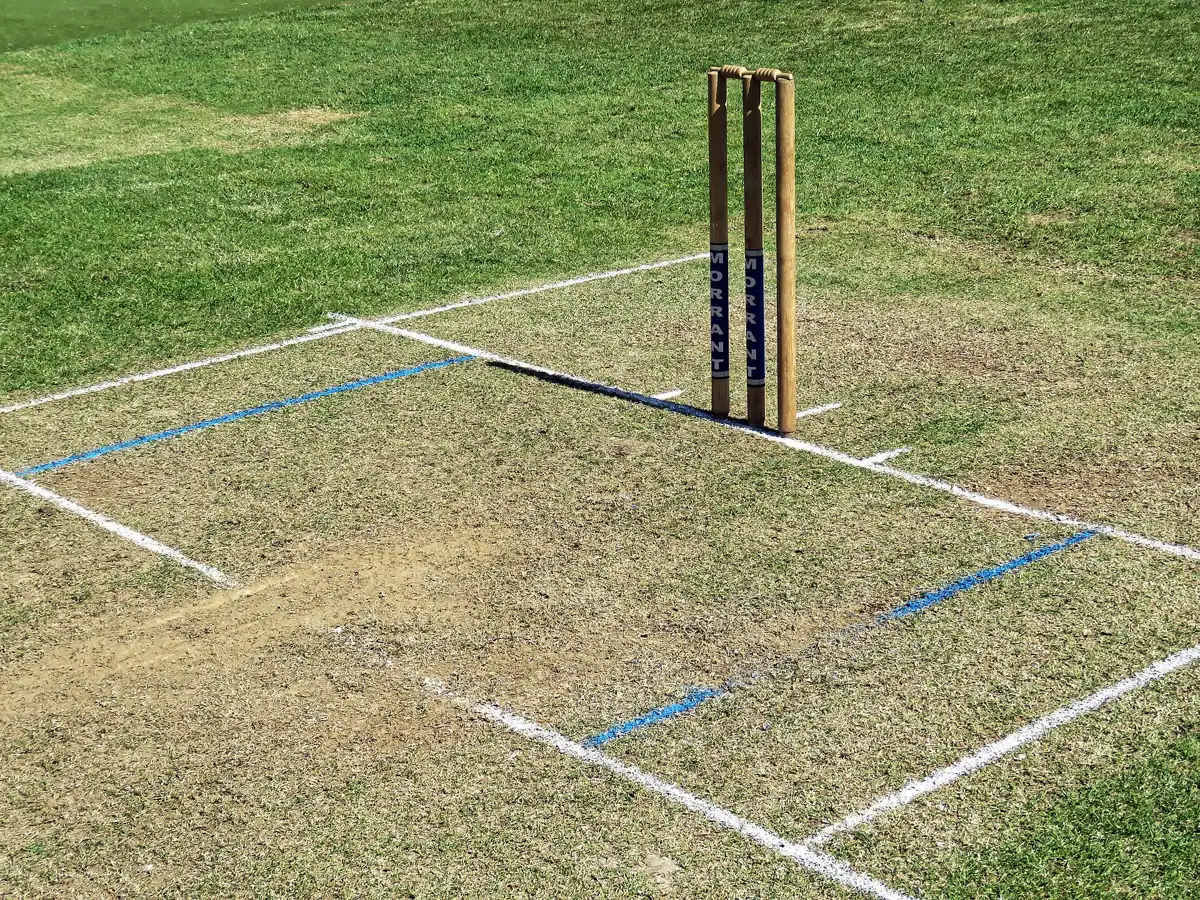
A cricket pitch is 22 yards long because 22 yards was exactly one chain, the standard unit English surveyors used to measure farmland, and it was the obvious length to mark out on a village field. The distance was written into the first known Laws of Cricket in 1744, and it has never been changed since.
Ask a cricket fan in Kolkata, Karachi, Cape Town or Adelaide how long the pitch is and you will get the same answer instantly. The 22 yards (20.12 metres) between the two sets of stumps are so central to the game that commentators use "the 22 yards" as shorthand for cricket itself. In Hindi commentary the strip is often called baees gaz, 22 gaz, the gaz being the traditional South Asian measure close to a yard.
Yet nobody sat down and worked out that 22 yards was the perfect distance for bowling. The number was inherited from the countryside, and the story behind it says a lot about how sport and everyday life grew up together.
The chain that measured England
For centuries, English land was measured in rods (also called poles or perches), each 5½ yards long. Four rods made 22 yards, a convenient length for laying out strips of ploughed land.
In 1620, the mathematician Edmund Gunter turned that length into a practical tool. Gunter's chain was a measuring chain 66 feet (22 yards) long, made of 100 metal links, with brass tags at intervals so a surveyor could read off distances quickly. Its genius was that it fitted neatly into the units people already used:
- 1 chain = 4 rods = 22 yards
- 10 chains = 1 furlong (220 yards), the length of a furrow in a ploughed field
- 80 chains = 1 mile
- 10 square chains = 1 acre
Gunter's chain became the standard instrument of land surveying across England and later the British Empire. Surveyors in British India measured revenue land with it, and the chain and its links still turn up in older land records across South Asia. Parish fields, the open greens where village cricket was played, were laid out and measured with the same tool.
So when 18th century players needed a fixed distance between the wickets, the chain was the natural choice. It was a unit everyone understood, and a groundsman or a local surveyor could stretch one across the grass in seconds.
Written into the 1744 Laws
Cricket was being played in southeast England by the 16th century, and by the early 1700s it was attracting aristocratic patrons and heavy betting. Big wagers needed agreed rules, and agreed rules needed numbers.
The oldest surviving full code, the Laws of Cricket of 1744, was drawn up by a group of noblemen and gentlemen associated with the London Cricket Club. Among its first instructions is that the wickets be pitched opposite each other 22 yards apart. The same code set the stumps at 22 inches high with a bail 6 inches long, and it fixed the position of the popping crease in front of each wicket.
Nobody recorded a debate about the distance, which strongly suggests 22 yards was already the customary length on English fields by then. The 1744 code simply wrote down what most players were doing.
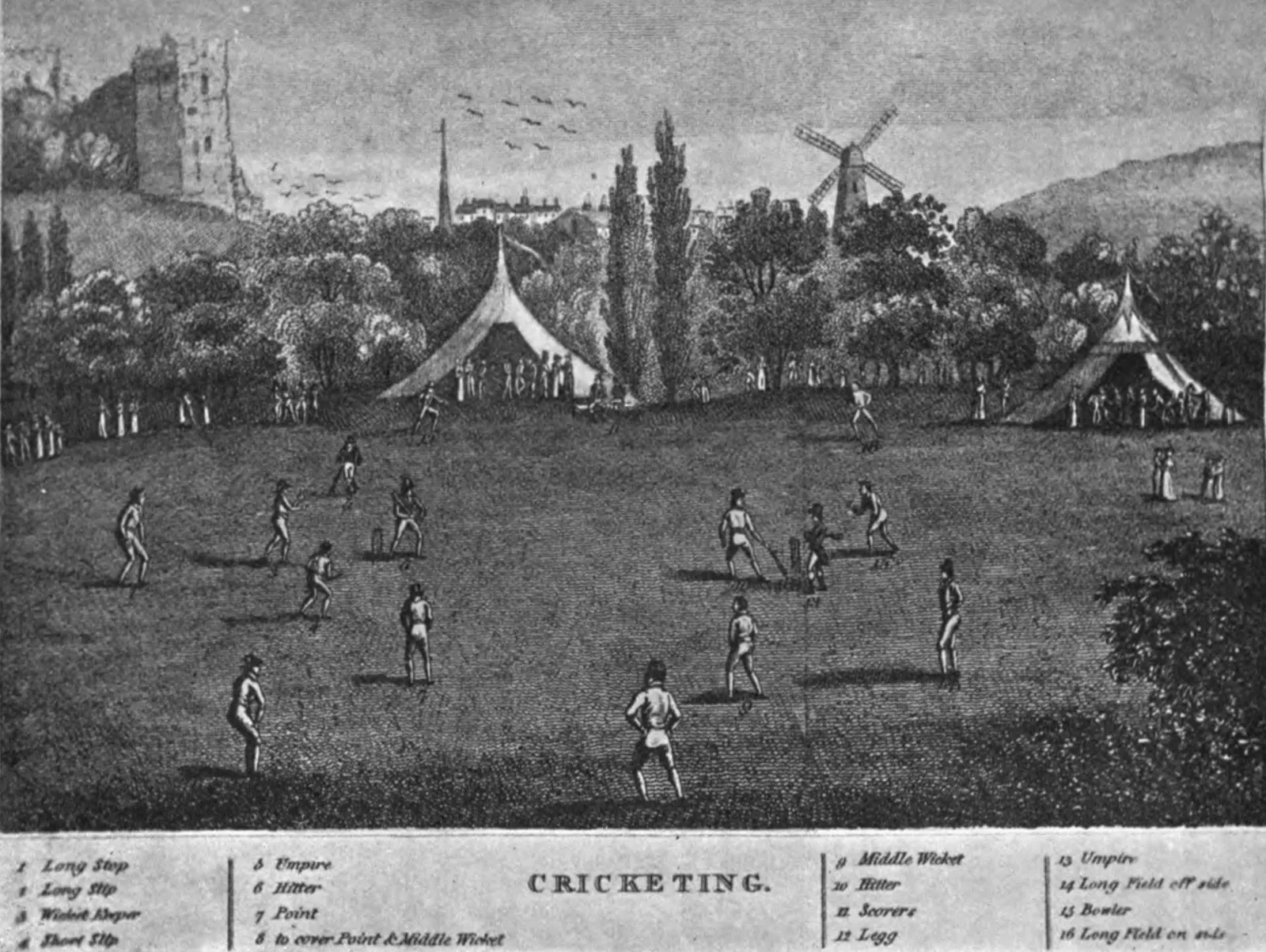
The Marylebone Cricket Club (MCC), founded in 1787, took over responsibility for the Laws the following year and remains their custodian today. Every code it has issued since, up to the current one, keeps the length at 22 yards. Modern editions add the metric equivalent, 20.12 metres, and specify that the pitch is 10 feet (3.05 metres) wide.
Everything else changed, except the length
What makes the 22 yards remarkable is how much of cricket has been rebuilt around it.
In 1744, bowlers rolled or skimmed the ball underarm along the ground. Over the next century they began raising the arm. Roundarm bowling, with the hand level with the shoulder, was legalised in 1835 after years of controversy, and overarm bowling was finally permitted in 1864. That shift transformed the game: the ball now arrived from a height, bounced, and travelled far faster.
The bat changed shape from a curved club to the straight blade used today. Stumps went from two to three, and grew taller. Pads, gloves and helmets arrived. Matches went from timeless contests to five-day Tests, then to one-day internationals and the 20-over game. Through all of it, the distance between the stumps stayed exactly where a 17th century surveyor's chain had put it.
That is unusual in sport. Plenty of games have tinkered with their dimensions. Baseball moved its pitcher's mound back to 60 feet 6 inches in 1893 because pitchers had become too dominant. Tennis kept its odd medieval scoring, as we explored in why tennis counts 15, 30, 40, but its court dimensions were only standardised in the 1870s. And the marathon only settled on its odd distance at the 1908 London Olympics, a story told in why a marathon is 26.2 miles. Cricket's central measurement is older than all of them.
Why 22 yards still works
The length survived partly through tradition, but also because it happens to produce a superb contest.
The bowler's front foot lands at the popping crease, and the batter stands at the other popping crease, so the ball actually travels about 17 to 18 metres to the bat. A fast bowler operating at 145 km/h covers that in a little under half a second, and the ball slows after it bounces. Shoaib Akhtar's delivery measured at 161.3 km/h against England at the 2003 World Cup remains the fastest officially recorded, and even that gave the batter time to react.
Half a second is right on the edge of human reaction. Batters have to read the bowler's hand, pick the length and commit to a shot before the ball has travelled most of the way. Shorten the pitch and fast bowling would become dangerous and close to unplayable. Lengthen it and batters would have time to settle into every shot, while spin bowlers would lose much of their control and bite. Twenty-two yards sits in the middle, which is why so little pressure has ever built up to change it.
Junior cricket is the main exception. Many boards use shorter pitches for young players so that children can bowl the full distance without strain, and then move them up to 22 yards as they grow.
The same 22 yards, very different pitches
Because the length is fixed, all the variety in cricket comes from what is underneath it. Curators decide how much grass to leave, how hard to roll the surface and how much moisture to keep in the soil, and those choices shape entire series.

India offers some of the clearest examples. Indian curators work with different soils: red soil, which tends to dry out and offer more bounce and turn, and black soil, which tends to bind tightly and keep the ball lower. Pitches at grounds such as Eden Gardens in Kolkata, the Wankhede Stadium in Mumbai and the M. A. Chidambaram Stadium in Chennai have become famous for very different characters, and visiting teams plan their spin and pace attacks around them. A green-tinged surface in Wellington, a hard, bouncy one in Perth and a dry, turning one in Chennai are all exactly 22 yards long, yet they can feel like three different sports.
That is also why the International Cricket Council monitors pitches and outfields at international grounds. Match referees rate each surface after a game, and venues whose pitches are judged poor can receive demerit points. The length is never in question; the behaviour of the soil is.
A unit that outlived its world
Britain moved its official measurements towards the metric system in the 20th century, and India adopted metric units in the late 1950s and early 1960s. Land is now measured with laser rangefinders and satellite positioning rather than iron chains. The surveyor's chain itself has largely disappeared from working life.
Cricket kept it anyway. Every time a groundsman marks out a pitch in a school field in Lucknow or a county ground in England, they are reproducing a unit Edmund Gunter designed in 1620, built on rods that were already old when he was born. Number systems carry history in the same quiet way, as the story of where the number zero came from shows.
So the next time a commentator talks about the battle fought out over 22 yards, it is worth remembering what that number really is. It is a piece of the English countryside, measured link by link with a farmer's chain, that the rest of the cricket world adopted and never let go.