Why Does Tennis Score 15, 30, 40?
Love, 15, 30, 40, deuce. Tennis has the oddest scoring in world sport, and it is older than the modern game itself. Here is where the numbers came from, which popular theories fall apart, and how the tiebreak finally tamed the endless set.
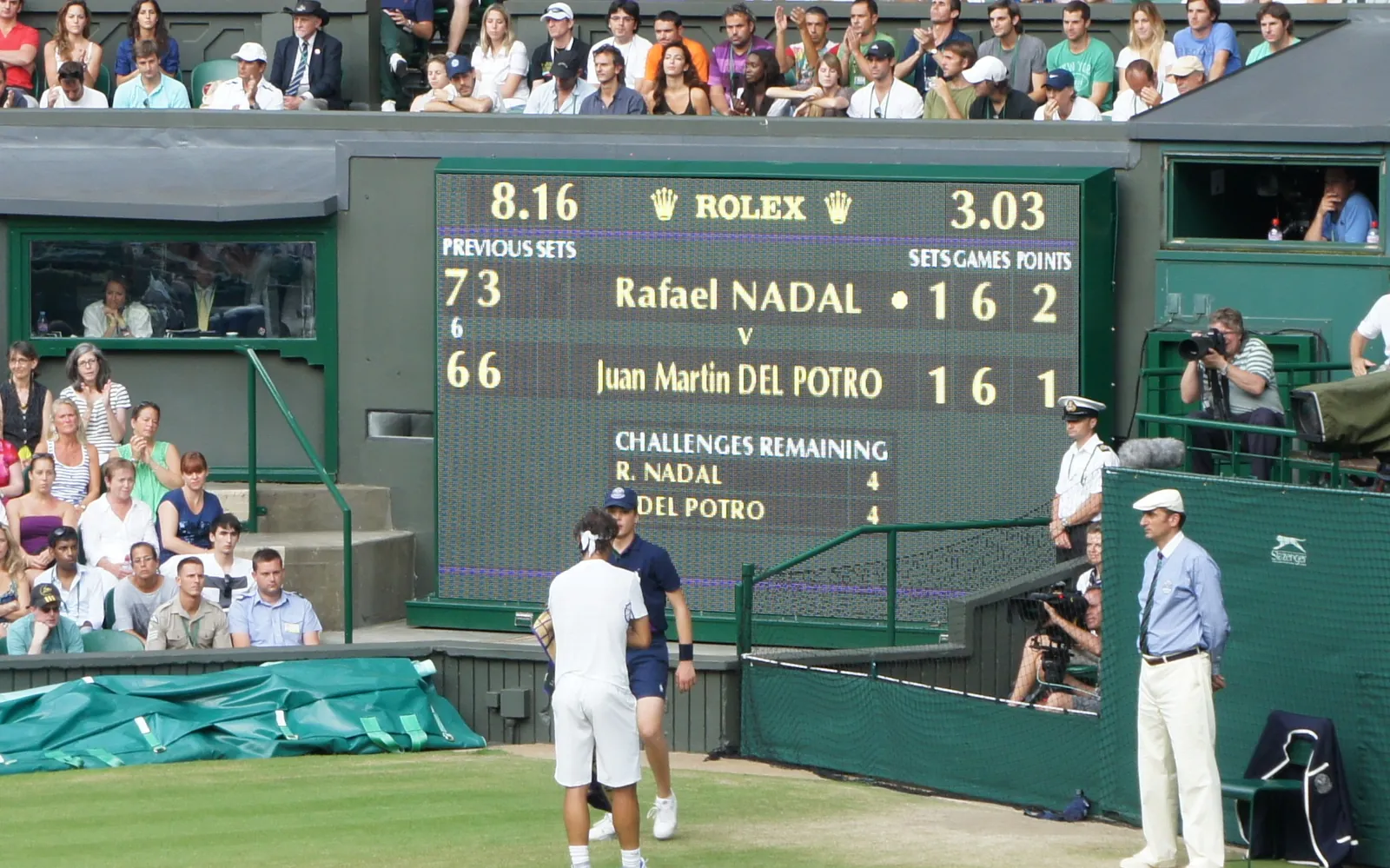
Nobody knows for certain why tennis is scored 15, 30, 40, but the most popular theory is that medieval French players used a clock face, moving the hand a quarter at a time, with 45 later shortened to 40. Another theory links the count to jeu de paume, the indoor game from which tennis descends, where points may have been tied to distances on the court.
Most sports count the way a child does: one, two, three. Tennis does not. Win your first point and you have 15, then 30, then 40. Win the fourth, by a clear margin, and the game is yours. Zero is "love," a tie at 40 is "deuce," and umpires from Melbourne to New York call it that way every day of the season.
The system looks arbitrary, but it is a fossil: a direct inheritance from the medieval courts of France, older than lawn tennis by several centuries.
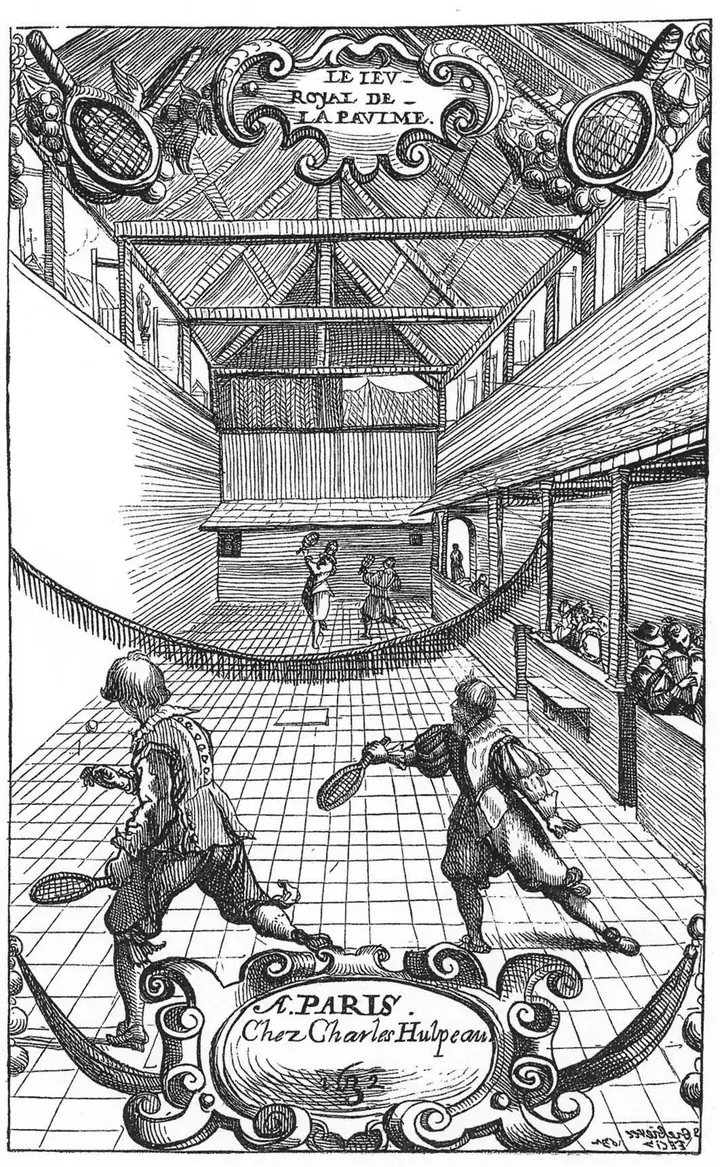
Born on the courts of jeu de paume
Modern tennis descends from jeu de paume, "the game of the palm," which emerged in France around the 12th century. Players originally struck the ball with the hand; rackets arrived in the 16th century. Played in walled indoor courts with sloping roofs and galleries, it became a passion of kings and commoners alike. Its surviving form is known in English as real tennis.
Royal enthusiasm in England was intense. Henry VIII built a court at Hampton Court Palace around 1530, and that building is still in use. By the late 16th century, a papal envoy reported some 250 courts in Paris alone.
The written record shows the familiar numbers long before anyone hit a ball on grass:
- A Middle English poem written in the years after the Battle of Agincourt (1415) uses a tennis match between Henry V and the French Dauphin as a metaphor for the war, and counts the points as 15, 30, 45.
- In the 1430s, the poet Charles d'Orléans, held captive in England after Agincourt, wrote a ballad comparing his life to a game of tennis and playing on quarante-cinq, "forty-five," as both his age and the score.
- In the 1520s, the scholar Erasmus wrote a Latin dialogue in which two players call out "we have 30" and "we have 45."
So the original count was 15, 30, 45, and then game, which was treated as 60. Four steps of fifteen.
Why fifteen? The theories that fail, and the one that fits
The most popular explanation is the clock face. Scorers, the story goes, moved a hand around a dial a quarter at a time: 15, 30, 45, and back to the top for the game. The trouble is timing. The scores are attested in the early 15th century, while clocks with minute hands only became common much later, generally after the invention of the pendulum clock in the second half of the 17th century. A few advanced medieval clocks did chime on the quarter hours, but there is no evidence anyone kept tennis scores on a dial.
A second theory points to the court itself: the server supposedly advanced 15 feet after each point won, then 15 more, then 10. This also collapses: real tennis courts had no standard length in the medieval period.
The explanation many tennis historians find most convincing is money. Medieval Europe counted heavily in base 60, inherited from ancient sexagesimal arithmetic and embedded in coinage and accounting. Tennis was a betting game, with players and spectators routinely wagering on the outcome. A game worth 60, divided into four equal steps of 15, fits naturally into how people of the time counted stakes. Historian Heiner Gillmeister, one of the leading authorities on the sport's origins, links the base-60 scoring to the money matters of the period.
How 45 became 40
The drop from 45 to 40 is easier to explain. The most likely reason is convenience: "forty" is quicker to call than "forty-five," and the shortened form appears in French as early as the 1530s and in English by the end of the 16th century.
Love and deuce
Love for zero is often traced to the French l'œuf, "the egg," because an egg looks like a zero, much as cricket's "duck" comes from "duck's egg." The more widely accepted explanation is the English phrase "playing for love," meaning playing for nothing, with no stakes on the result.
Deuce, the tie at 40, comes from the French word for two, deux, because a player now needs two consecutive points to win: one to gain the advantage and one more to close it out.
From the palace to the lawn
When lawn tennis took off in Victorian England, the old scoring was not guaranteed to survive. In 1874 Major Walter Clopton Wingfield patented and marketed his outdoor game, which he called Sphairistikè, and he used the rackets method of scoring, where a game ran to 15 points. The Marylebone Cricket Club, which published the first unified Laws of Lawn Tennis in 1875, adopted that rackets scoring too.
The decisive moment came in 1877, when the All England Croquet and Lawn Tennis Club staged the first Wimbledon Championship. Its rules committee rewrote the laws for the event and declared that "the real tennis method of scoring by fifteens (15, 30, 40) will be adopted." Those Wimbledon rules spread through the sport, and the medieval count became the global standard for the modern game.
The tiebreak: tennis finally sets a limit
Advantage scoring has one weakness: a game, and especially a set, can in principle go on forever. The American James Van Alen set out to fix this. After experimenting with table-tennis-style scoring in the 1950s, he unveiled the tiebreak at a professional event in Newport, Rhode Island, in 1965.
The US Open adopted a tiebreak at 6–6 in 1970. Wimbledon followed in 1971, though initially only at 8–8, and moved to 6–6 in 1979. Final sets at most majors, however, still had to be won by two clear games.
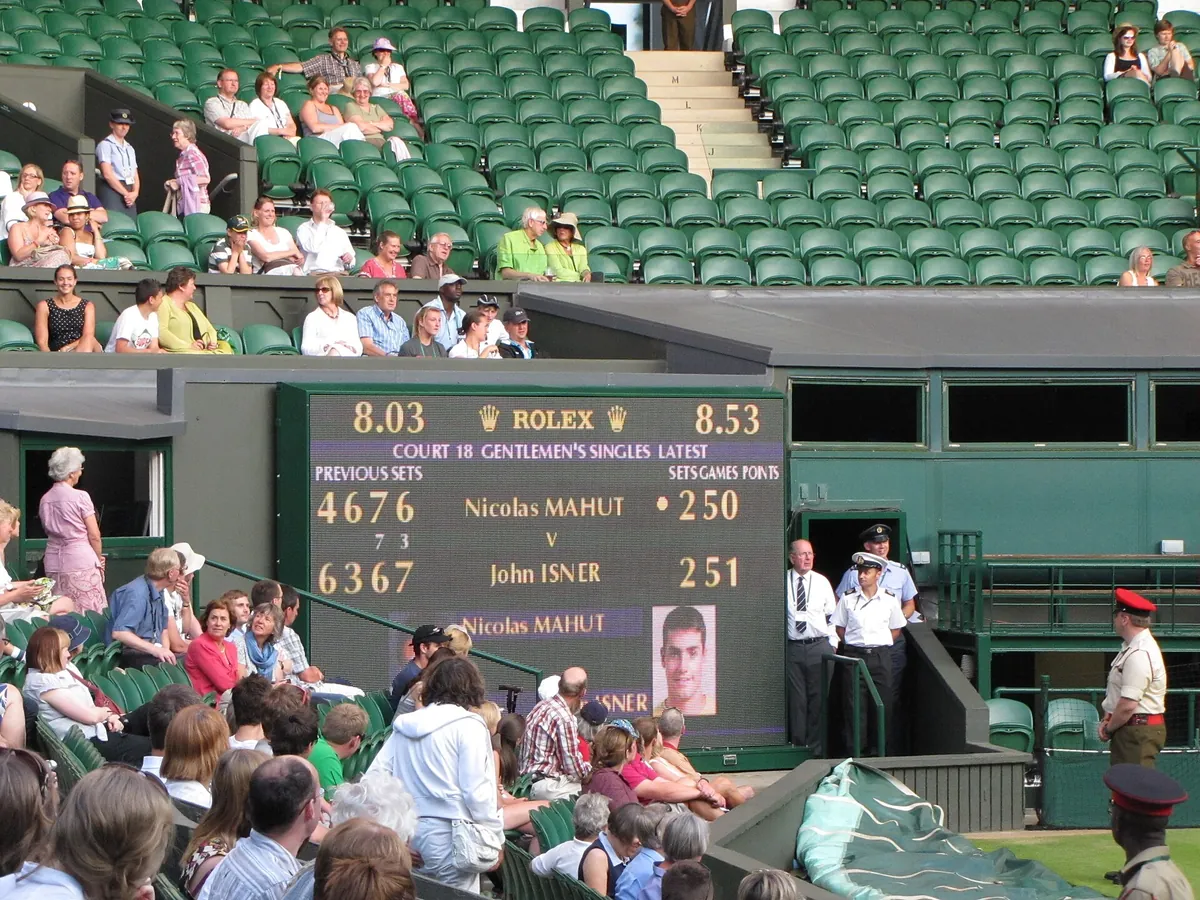
That gap produced the most famous match in the sport's history. At Wimbledon in 2010, John Isner beat Nicolas Mahut 6–4, 3–6, 6–7, 7–6, 70–68 in a first-round match lasting 11 hours and 5 minutes over three days. The fifth set alone took 8 hours and 11 minutes.
Reform followed slowly. Wimbledon introduced a final-set tiebreak at 12–12 in 2019, and the Australian Open opted for a first-to-10 "super tiebreak" at 6–6. In 2022, the four Grand Slam tournaments finally agreed on a single rule: a 10-point tiebreak at 6–6 in the deciding set.
A living relic
Tennis has modernised almost everything else, from rackets and surfaces to electronic line calling. Yet the scoring has barely changed in six centuries. The USTA rulebook even notes that players may say "one, two, three" instead. Almost nobody does.
"Fifteen-love" and "advantage, deuce" connect a night session at Flushing Meadows to a covered court in 15th-century Paris. Every time an umpire calls "forty-thirty," the game quietly reminds its audience of where it came from.
Sport's strange numbers often trace back to a single moment in history, as with the 26.2-mile marathon. Not every athletic habit needs a scoreboard, though: daily walking might be the most beneficial exercise of all.