What Is a Lagrange Point?
A Lagrange point is one of five positions in a two-body system, such as the Sun and Earth, where a small spacecraft can hold its place relative to both. India's Aditya-L1 now watches the Sun from a halo orbit around Sun-Earth L1.
 By Sushant Kataria· 6 min read
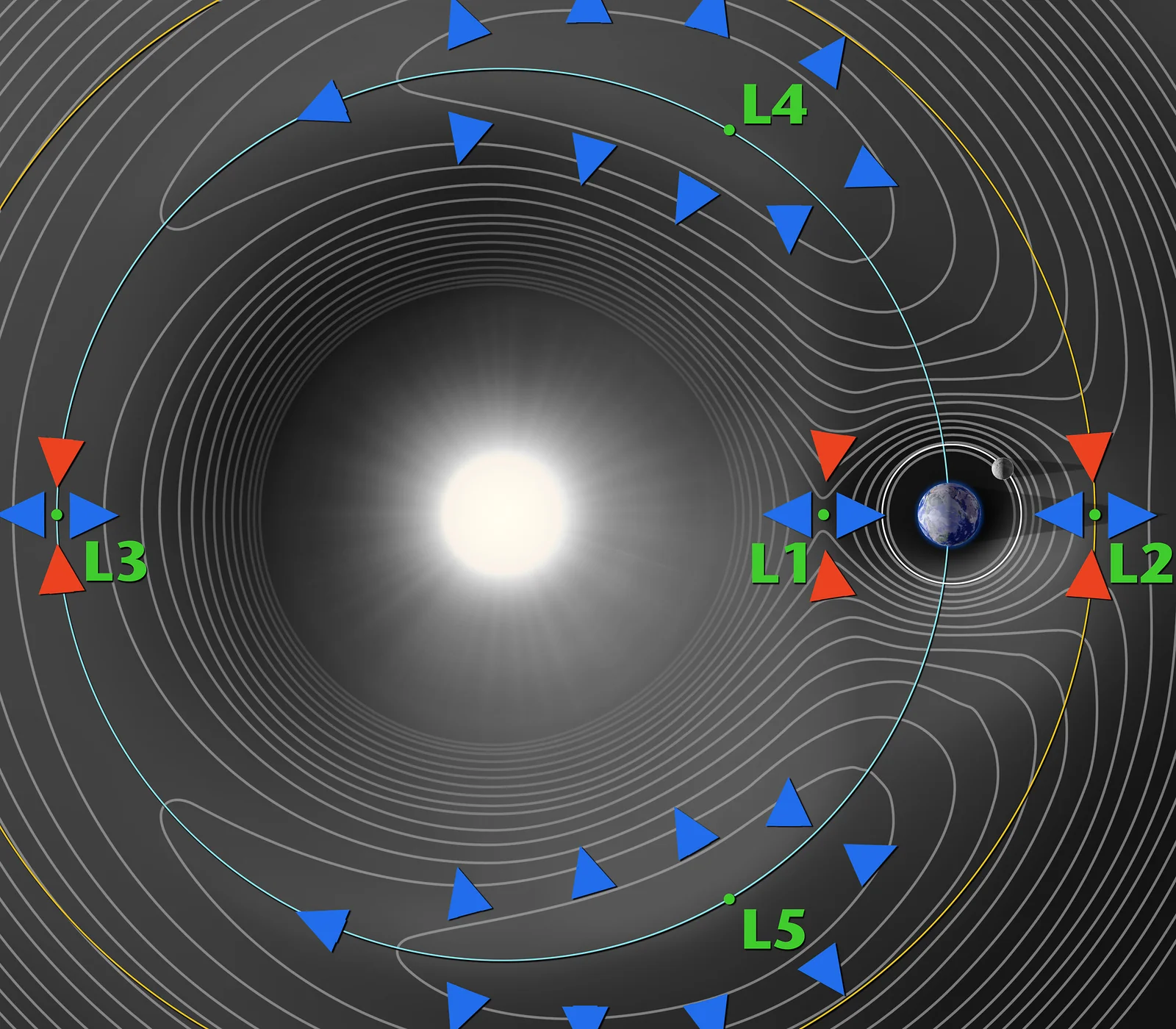
A Lagrange point is one of five positions in a two-body system, such as the Sun and Earth, where a small spacecraft can hold its position relative to both, because the combined gravity of the two larger bodies supplies exactly the centripetal force needed to orbit in step with them. NASA calls these spots the places where the gravitational pull of two large masses "precisely equals the centripetal force required for a small object to move with them."
That balance is why agencies park solar monitors sunward of Earth and deep-space telescopes on the night side: the craft stays roughly fixed in the Sun-Earth frame instead of racing ahead or falling behind like a free asteroid would.
From Euler's line to Lagrange's triangles
The mathematics is eighteenth-century celestial mechanics. Leonhard Euler, in work published in 1767 on three bodies that stay aligned under mutual attraction, developed the collinear configuration that today corresponds to L1, L2 and L3. Joseph-Louis Lagrange, in his 1772 prize essay Essai sur le Problème des Trois Corps, showed that constant-pattern solutions exist in two geometries: bodies on a straight line, and bodies at the vertices of an equilateral triangle. Annotated translations of Euler's papers, including that 1767 collinear study, are available via DOI 10.4236/ahs.2019.85018. The five points later took Lagrange's name even though Euler already had the three on the line joining the masses.
In the Sun-Earth system the map is simple. L1 sits between the Sun and Earth, about 1.5 million km from Earth toward the Sun. L2 sits the same distance beyond Earth, opposite the Sun. L3 lies on the far side of the Sun, roughly opposite Earth. L4 leads Earth in its orbit by 60°, and L5 trails by 60°, each forming an equilateral triangle with the Sun and Earth. NASA's primer is blunt about stability: L1, L2 and L3 are unstable; L4 and L5 are stable when the mass ratio of the two large bodies is large enough, a condition both the Sun-Earth and Earth-Moon pairs meet.
Sun-Earth L1: India's Aditya and the solar fleet
L1 is the solar weather balcony. A craft there can watch the Sun continuously, without Earth eclipsing the view, and still talk to ground stations. The joint ESA-NASA Solar and Heliospheric Observatory (SOHO) has worked near L1 since the mid-1990s. NASA's Advanced Composition Explorer (ACE) samples solar wind and energetic particles from the same neighbourhood. The Deep Space Climate Observatory (DSCOVR), a NASA, NOAA and US Air Force partnership, monitors the solar wind for geomagnetic-storm alerts while its EPIC camera photographs the sunlit Earth. All need regular station-keeping: NASA notes that L1 and L2 are unstable on a timescale of roughly 23 days, so thrusters nudge the orbit before the craft drifts away.
India joined that club with Aditya-L1, the country's first dedicated solar observatory. The Indian Space Research Organisation launched it on 2 September 2023 at 11:50 IST aboard PSLV-C57 from Sriharikota. After Earth-bound burns and a cruise of about 110 days, halo-orbit insertion succeeded on 6 January 2024 at about 16:00 IST. The Press Information Bureau recorded the same milestone that evening. The targeted halo has an orbital period of about 177.86 Earth days and was chosen for a five-year life with modest fuel use and an unobstructed solar view.
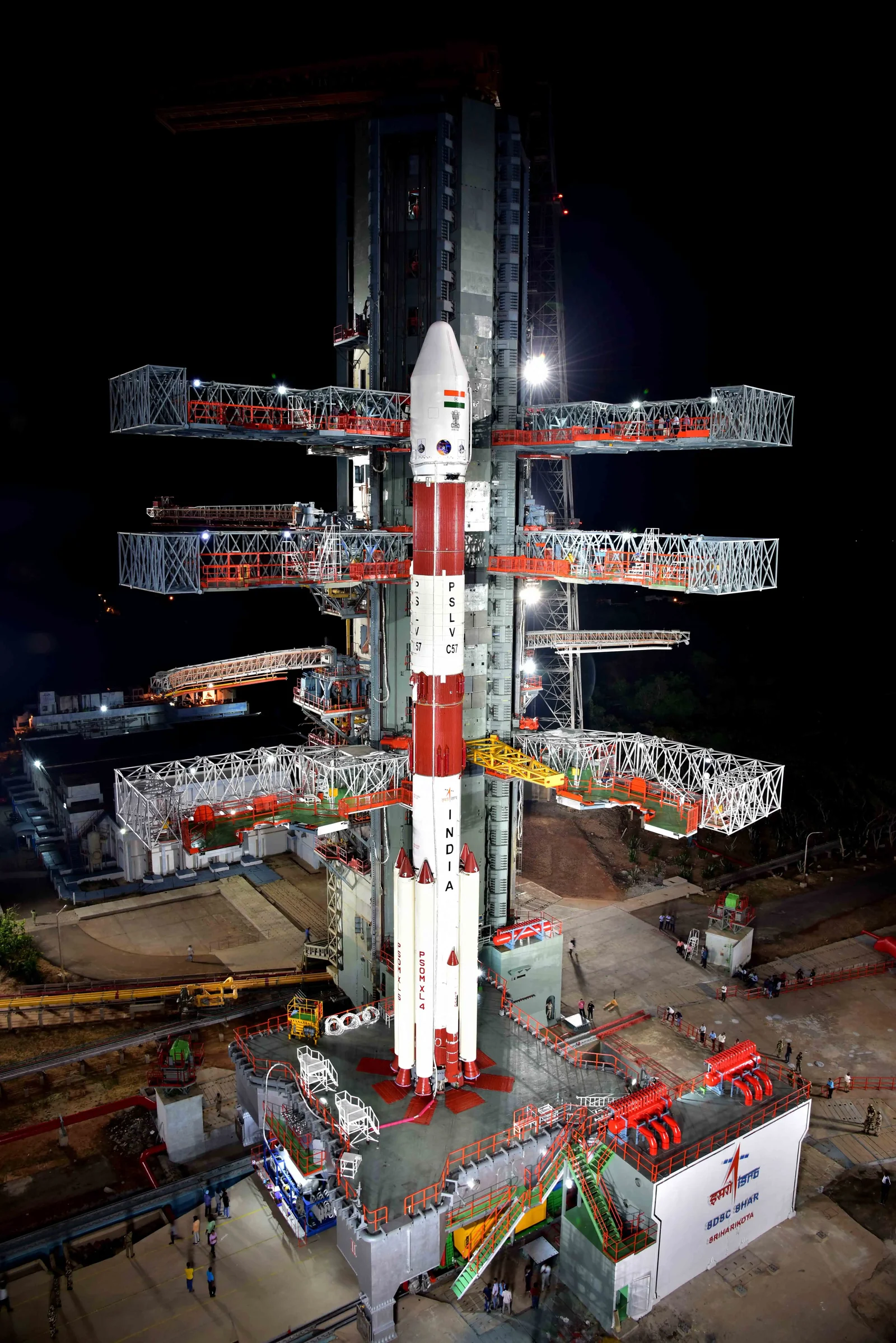
Aditya-L1 carries seven indigenous payloads. Four look at the Sun: the Visible Emission Line Coronagraph (VELC), the primary coronagraph led by the Indian Institute of Astrophysics; the Solar Ultraviolet Imaging Telescope (SUIT); the Solar Low Energy X-ray Spectrometer (SoLEXS); and the High Energy L1 Orbiting X-ray Spectrometer (HEL1OS). Three sample the local plasma and field: the Aditya Solar wind Particle Experiment (ASPEX), the Plasma Analyser Package For Aditya (PAPA), and Advanced Tri-axial High Resolution Digital Magnetometers. That suite targets coronal heating, flares, coronal mass ejections and the space-weather chain that links the Sun to Earth, the same physics that makes L1 valuable for SOHO and its neighbours.
Soft-landing Chandrayaan-3 near the Moon's south pole proved India could put hardware on a hard lunar target. Parking a solar observatory at L1 proved a different skill: navigating to a moving balance point 1.5 million km away, then living there for years on thruster sips.
Sun-Earth L2: cold, dark and perfect for telescopes
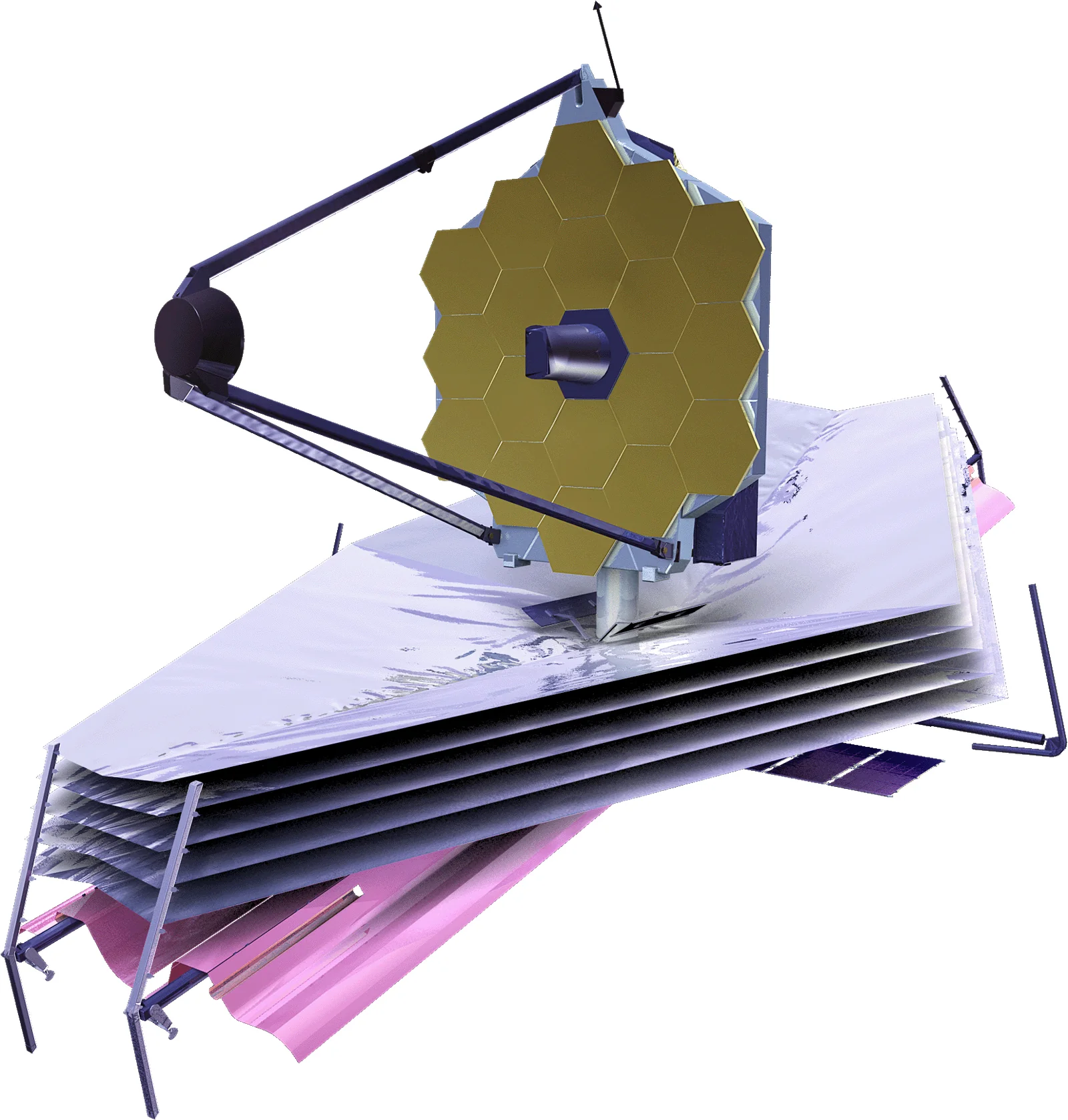
L2 is the astronomer's twin of L1. A craft there keeps the Sun, Earth and Moon roughly in one direction, so a single sunshield can block heat and stray light while antennas still face Earth. NASA's James Webb Space Telescope arrived at L2 in January 2022 and surveys the infrared universe from about 1.5 million km away. ESA's Gaia likewise works from an L2 orbit, mapping more than a billion stars. Neither sits exactly on the mathematical point; both fly halo or Lissajous orbits around it, so they avoid long Earth shadow and keep station-keeping cheap.
L3, opposite Earth on the far side of the Sun, is almost useless for operations: communications would have to punch past or around the Sun, and the point is as unstable as L1 and L2. Science fiction likes hidden planets there; flight dynamics does not.
L4, L5 and the Trojan swarms
The triangular points behave differently. Because they are stable for Sun-planet pairs with a large mass ratio, nature fills them with leftovers. The most famous tenants are the Jupiter Trojans, asteroids that share Jupiter's orbit while oscillating around the Sun-Jupiter L4 and L5 points. NASA's Lucy mission, launched in October 2021, is the first spacecraft dedicated to that population: after main-belt flybys it will visit multiple Trojans at L4 in the late 2020s and the Patroclus-Menoetius binary at L5 in 2033. Earth has a thinner haul; NASA notes that WISE confirmed the first Earth Trojan, 2010 TK7, at Sun-Earth L4 in 2010.
Earth-Moon Lagrange points exist too. The same tidal engine that is pushing the Moon slowly away from Earth also defines five balance locations in that smaller two-body system. The geometry is universal; only the distances change.
Halo orbits and the cost of staying put
A "Lagrange point mission" almost never means hovering on a pin. Designers prefer halo orbits and Lissajous orbits: three-dimensional paths that loop around L1 or L2 while the whole pattern travels with Earth around the Sun. Aditya-L1's published halo semi-axes (roughly 209,200 km by 663,200 km by 120,000 km in the rotating Sun-Earth frame) show how large those loops are. Station-keeping burns correct errors that would otherwise grow on the roughly 23-day instability timescale NASA quotes for L1 and L2. Fuel is life; thruster efficiency and accurate navigation decide whether a solar observatory lasts five years or fifteen.
Euler and Lagrange solved a special case of the three-body problem on paper. Modern guidance computers turn those solutions into parking orbits for weather sentinels, star mappers and India's first solar observatory. Compared with explaining why the sky is blue from Rayleigh scattering in air, a Lagrange point is quieter physics: nowhere special in empty space, until two big masses make five spots where a small mass can keep time with both.
So what is a Lagrange point? It is one of five gravitational parking spots in a two-body system where centripetal need and combined pull match. Three demand constant babysitting; two can hold natural swarms for aeons. From SOHO and ACE to Webb, Gaia and Aditya-L1, the solar system's most useful empty addresses are those five points Euler and Lagrange found before anyone had a rocket to visit them.